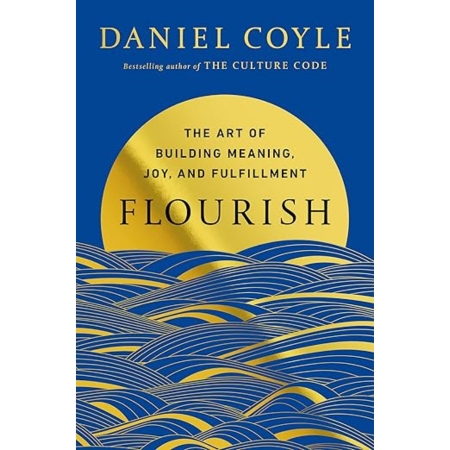

In this episode of Inside Personal Growth, Greg Voisen sits down with New York Times bestselling author Daniel Coyle to discuss his transformative new book, Flourish: The Art of Building Meaning, Joy, and Fulfillment.
For years, Coyle has been the go-to expert on high performance. His previous bestsellers, The Talent Code and The Culture Code, decoded how individuals and groups reach the absolute pinnacle of their fields. But after the passing of his parents, Coyle found himself staring at the “success mountain” and realizing that reaching the top often just reveals more mountain. This realization sparked an inward journey from the high-pressure world of performance to the soulful, messy world of flourishing.
The Trap of “Treasure Hunting”
In a culture obsessed with productivity, most of us spend our lives in “treasure hunting” mode. We believe that if we just hit the next revenue goal, get the promotion, or finish the next project, we will finally find the happiness we seek. Coyle argues that this is a fundamental misunderstanding of how a good life is built.
Coyle references the work of Barry Schwartz, noting that life is not a treasure hunt; it is treasure creation. While treasure hunting is about the destination, treasure creation is about the process of engaging with others, solving problems together, and being present in the “valleys” of life where growth actually happens.
The Biology of Connection: Relational Attention
One of the most striking parts of Coyle’s research involves the neurobiology of how we connect. He discusses the work of psychologist Lisa Miller, who identifies a specific neural pattern she calls “relational attention.”
Modern life often traps us in “task attention”—a narrow, controlling focus used to get things done. While necessary for work, staying in this mode too long makes us feel “dead inside.” Flourishing requires us to pivot to relational attention, the space where we form deep bonds and feel a sense of shared aliveness.
During the podcast, Coyle guides listeners through “The Council Exercise,” a mental tool where you visualize the people in your life who truly have your best interests at heart. This exercise isn’t just “woo-woo” sentimentality; it is a way to ground oneself in the stability and clarity that only strong relationships can provide.
Lessons from the Deep: The Chilean Miners
How do humans thrive under the most extreme pressure imaginable? Coyle points to the story of the 33 Chilean miners buried 2,000 feet underground. For 16 days, they had no hope of rescue, yet they didn’t descend into chaos. Instead, they built a “brotherhood” through simple, repetitive rituals.
They created systems for eating together, watching over each other while they slept, and even a ritual for confessing mistakes and mistreatment. These weren’t “efficient” actions in a traditional sense, but they were “awakening cues”—moments of care, curiosity, and contribution that kept their spirits alive when their environment was dark and stagnant.
Embracing the “Beautiful Mess”
A common mistake leaders and parents make is trying to treat human groups like machines. Coyle distinguishes between “complicated” systems and “complex” systems.
-
Complicated systems (like a Ferrari) are predictable and require expert instructions.
-
Complex systems (like raising a teenager or building a team culture) change as you interact with them.
In a complex system, “mess” isn’t a sign of failure; it’s a sign of life. Coyle suggests that if you know exactly what is going to happen next, you aren’t truly alive—you’re just executing a program. Flourishing groups embrace surprise and disorder because that is where the most creative and meaningful solutions are born.
The “Yellow Door” Moments
How do we start flourishing today? Coyle introduces the concept of Yellow Doors. Most of us look for Green Doors (open opportunities) or Red Doors (closed paths). A Yellow Door is a “maybe.” It’s an invitation to something you might not be interested in or might even be afraid of.
Coyle shares his personal “Yellow Door” story: a group of friends invited him to try indoor rock climbing in his 50s. Despite a fear of heights and a lack of interest in the sport, he said “maybe.” That single decision led to a five-year journey of deep friendship, shared music, and a sense of community that redefined his later years.
Conclusion: Life is a Garden, Not a Game
Daniel Coyle’s message is a refreshing departure from the “hustle culture” that dominates our feeds. He reminds us that our lives are not games to be won, but gardens to be grown. By shifting our attention from the summit to the soil—focusing on curiosity, care, and contribution—we can move past the flatness of modern life and into a state of true flourish.
Whether you are a CEO looking to revitalize your company culture or an individual seeking more meaning in your daily routine, Coyle’s insights provide a practical, science-backed roadmap to a more fulfilled existence.
You may also refer to the transcripts below for the full transcription (not edited) of the interview.
[fusebox_transcript]











Leave a Reply