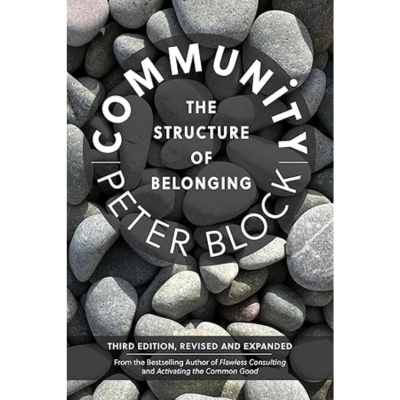

In this episode of Inside Personal Growth, Greg Voisen sits down with the legendary Peter Block—one of the most influential thinkers in organizational development and community building of the past half-century. In a world increasingly defined by digital isolation and a “colonial culture” that prioritizes speed over soul, Peter returns to the show to discuss the highly anticipated third edition of his seminal work, Community: The Structure of Belonging.
This conversation is a masterclass in shifting our collective narrative from fear and scarcity to possibility and generosity. If you have ever felt like a “wandering outsider” in your own workplace, neighborhood, or city, Peter Block offers the architectural blueprints to finally build a place where you truly belong.
The Crisis of Isolation in a Connected World
We live in a paradoxical era. We are more digitally “connected” than ever, yet the Surgeon General has declared a loneliness epidemic. Peter argues that while we have developed the vocabulary for belonging, our daily practices remain stuck in a “colonial” mindset. This mindset values consistency, control, and predictability above all else.
“The problem with community,” Peter jokes, “is that there are too many night meetings.” But the deeper issue is structural. Our systems—from city councils to corporate boardrooms—are designed to deliver services, not to produce care. To bridge this gap, we must move away from the “consumer” model of citizenship, where we wait for leaders to fix things, and toward an “associational” life where we reclaim our own agency.
The Power of Linguistic Transformation
One of the most profound takeaways from Peter’s work is the idea that all transformation is linguistic. A shift in how we speak and listen is the very essence of changing a culture. When we change the conversation, we change the room.
Peter identifies six specific “conversations” that have the power to materialize belonging:
-
Invitation: Shifting from mandates to a choice-based summons.
-
Possibility: Moving from problem-solving to dreaming of a future that has no relationship to the past.
-
Ownership: Asking, “What have I done to contribute to the very thing I complain about?”
-
Dissent: Creating space for “no” so that “yes” can be authentic.
-
Commitment: Making promises with no expectation of return.
-
Gifts: Focusing on the assets we bring rather than the deficiencies we need to fix.
By engaging in these dialogues, we stop treating bosses as the sole “cause” of outcomes and start seeing the relationship between citizens as the true engine of change.
Reclaiming Agency Through Inversions
Peter’s framework relies on “inversions”—concepts that are counterintuitive to the Western mind but essential for true growth. He posits that:
-
Citizens create leaders: A leader is only as effective as the space the citizens provide.
-
The audience creates the performance: The energy of the listeners dictates the quality of the speech.
-
Students create the teacher: Curiosity is the precursor to effective instruction.
These inversions take the pressure off the “heroic leader” and place the power back into the hands of the collective. It moves us from a state of helplessness to a state of agency.
Humanizing the Virtual and Professional Space
With the rise of remote work and Zoom fatigue, the challenge of building community has moved into the digital realm. Peter shares how we can humanize virtual spaces by breaking the “webinar” mold. Instead of passive listening, he suggests using small breakout groups and music to foster “side conversations” that mimic real-world connection.
In the professional world, Peter encourages leaders to stop looking at employees as “doing beings” and start seeing them as “being beings.” When we stop trying to “get” things out of people and start being curious about who they are, performance naturally follows. Curiosity, as Peter puts it, is the antidote to the misuse of imagination we call “worry.”
A Call to Action: The First Step
Building community doesn’t require a massive budget or a 10-year plan. It starts with a simple change in protocol. In your next meeting, try one of Peter’s “small structures”:
-
Start by asking, “Why was it important for you to be here today?”
-
Halfway through, ask, “Are you getting what you came for?”
-
End by acknowledging the gifts each person brought to the table.
These small shifts rearrange the social contract. They move us from a narrative of “What can I get?” to “What can we create?”
Connect with Peter Block:
Our Guest, Peter Block:
➥ Book: Community, Third Edition: The Structure of Belonging
➥ Buy Now: a.co/d/05kOGBYV
➡️ LinkedIn: www.linkedin.com/in/peter-block-238848a/
➡️ Facebook: www.facebook.com/AuthorPeterBlock/
You may also refer to the transcripts below for the full transcription (not edited) of the interview.
[fusebox_transcript]











Leave a Reply