

with Stacy Winsett
May 12, 2026
Inside Personal Growth
Listen on your favorite platforms
In this episode
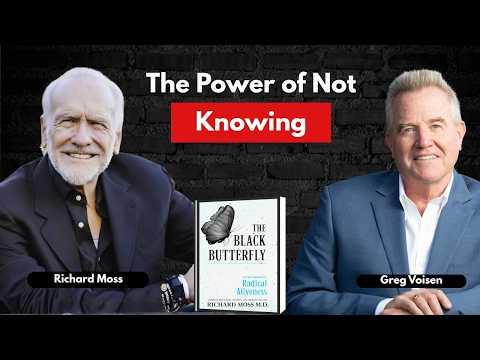
In this episode of Inside Personal Growth, Greg Voisen sits down with Dr. Richard Moss, a visionary teacher who has spent nearly five decades at the forefront of human consciousness and spiritual transformation. Nearly 50 years ago, Dr. Moss was a practicing physician when he experienced a spontaneous and irreversible state of illumination—an event that shattered his conventional reality and redirected his life’s work toward guiding others through the mystery of inner transformation.
Today, they discuss the 40th-anniversary rerelease of his seminal work, The Black Butterfly: An Invitation to Radical Aliveness. This is not just a conversation about self-improvement; it is an exploration of the “assemblage point” of human identity and what happens when we finally stop running from the vastness of our own being.
Dr. Moss uses a powerful metaphor to describe the process of spiritual awakening: the sugar cube in boiling water. For most of us, our consciousness is “assembled” around the “me”—the ego, the history, the desires, and the fears. We are like sugar cubes trying to maintain our shape.
Awakening, as described in The Black Butterfly, is the moment that sugar cube is dropped into the boiling water of universal awareness. The “me” doesn’t necessarily disappear—as Richard’s wife often says, “The ego survives enlightenment”—but the context changes. You are no longer the cube; you are the water. You still have a mind, feelings, and a body, but you are no longer a victim of them. You move from being owned by your emotions to being in a relationship with them.
One of the most gripping parts of the book and this interview is the story of Laura. Suffering from terminal liver cancer, kidney failure, and partial blindness, Laura attended one of Dr. Moss’s retreats. During a spontaneous moment of “radical aliveness”—an exercise involving singing where she felt her boundaries vanish into the earth and sky—she underwent a profound shift.
Medical records later confirmed that her ailments had vanished. However, Dr. Moss is careful to distinguish this from a “miracle” in the traditional sense. He explains that when the “sugar cube” dissolves, the energetic structures that hold illness in place can sometimes lose their reality. It isn’t about “fixing” a body; it’s about the body reorganizing itself within a state of absolute wholeness.
In a Western culture that rewards “knowing,” expertise, and certainty, Dr. Moss introduces a counter-intuitive practice: The Sacrament of Ignorance. He suggests that true intimacy with the present moment is found in the “don’t know” mind. When we confess that we do not know where we are going or who we are supposed to be, we stop telling ourselves stories. These stories—of guilt, resentment, or future anxiety—are what create our suffering. By embracing ignorance, we become vulnerable to the present moment, which Dr. Moss describes as a “great mother” constantly birthing us anew.
Voisen and Moss discuss the modern explosion of the “personal growth” industry—the podcasts, the plant medicines, and the endless retreats. Dr. Moss offers a stinging but necessary critique: much of this is merely “perturbation.”
Perturbation is like moving the furniture around in a dark room; you feel like you’ve made a change, but the room is still dark, and the walls are still there. Radical Aliveness is not about rearranging the furniture of the ego; it’s about turning on the light. It is a fundamental shift in the level of consciousness, not just an improvement of the personality.
Perhaps the most practical takeaway from Dr. Moss’s 80 years of wisdom is his shift in the definition of love. He admits that in his younger years, much of what he called love was actually narcissism—loving how someone made him feel or loving the image of himself being kind.
Now, his life and his marriage are guided by a single, revolutionary question: “What does love want?”
This question removes the “me” from the center of the universe. It isn’t about what I want or what you want; it is about what the living energy between two people requires to flourish. If you are angry, resentful, or pushing for an outcome, you aren’t asking what love wants. Love wants openness, even when it’s uncomfortable.
The conversation takes a bold turn into the nature of war. Dr. Moss suggests that humanity will not transcend war until we find something that generates more collective aliveness than conflict does. He notes that people often feel most “alive,” united, and creative during wartime because the stakes are so high.
To counter this, he proposes a radical form of “passive” energy—imagine leaders or citizens engaging in massive hunger fasts or “walks of blankets” into conflict zones. It is a level of aliveness that requires one to be willing to lose their life for the sake of the whole. It is the ultimate expression of the “Black Butterfly”—the dark, mysterious, yet beautiful transformation that occurs when we stop fighting “against” and start living “for.”
As Dr. Moss approaches his 80th birthday, his message has softened but deepened. He is no longer the “zealous” teacher seeking big, dramatic shifts in thousands of people. He is a man “loving a few people well” and inviting everyone to touch the ground of their own being.
The Black Butterfly: An Invitation to Radical Aliveness is more than a book; it is a permission slip to stop running, to embrace the “don’t know,” and to finally ask the only question that matters: In this breath, in this moment, what does love want?
Connect with Our Guest, Richard Moss:
➥ Book: The Black Butterfly: An Invitation to Radical Aliveness
➥ Buy Now: a.co/d/0hHotSiX
LinkedIn: www.linkedin.com/in/richardmossseminars/
Youtube: www.youtube.com/@RichardMossDeepWork
Continue Listening