

with Jim Bramlett
May 12, 2026
Inside Personal Growth
Listen on your favorite platforms
In this episode
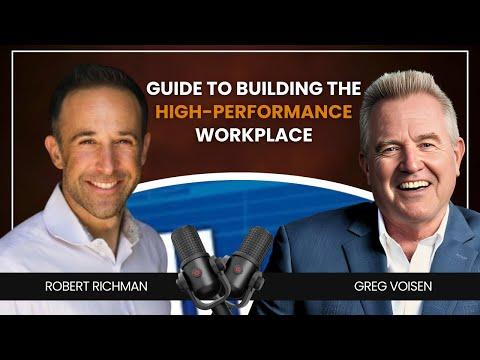
In one of the most insightful episodes of Inside Personal Growth, Greg Voisen sits down with Robert Richman — cultural strategist, keynote speaker, former co-creator of Zappos Insights, and author of The Culture Blueprint: A Guide to Building the High-Performance Workplace.
Robert has spent his career studying what makes organizations come alive. His work at Zappos, a company revered for redefining workplace culture, gave him unusual behind-the-scenes access into how high-performance environments are actually built — not through posters or slogans, but through human behavior, emotional intelligence, and systems that allow people to thrive.
👉 Explore more of Robert’s work at robertrichman.com.
Robert shares that his obsession with culture began at Zappos Insights, where thousands of leaders came to learn how Zappos achieved world-class customer service without relying on high pay or perks. What fascinated him was a recurring pattern:
Great cultures — regardless of industry — share similar traits.
Bad cultures fall apart in completely different ways.
This inspired Robert to assemble over 300+ pages of his observations into what later became The Culture Blueprint.
He learned that culture isn’t something leaders impose — it’s something teams co-create, a dynamic human system influenced by emotion, behavior, and shared meaning.
Robert describes the late Tony Hsieh as a leader who “created worlds.” Whether in startups, coworking spaces, or at Zappos, Tony built environments where people could play, experiment, and flourish.
What made Tony unique?
This mindset didn’t just build a company — it built a movement.
One of the most powerful insights Robert shares is that leaders often try to reshape their company culture while ignoring the emotional reality of their own lives.
He recalls a client who wanted an “exciting culture.”
When he asked, “How exciting is your personal life?” her answer was, “Not very.”
This is when Robert teaches a fundamental truth:
If you’re trying to create a workplace culture that gives you the feelings you lack in your personal life,
you’re using your company as medication.
Real culture transformation starts internally — with your emotional alignment, not your corporate strategy.
Zappos was famous for its playful environment: costumes, spontaneous dance breaks, and quirky traditions.
Robert reveals the secret behind sustaining a fun culture:
Playfulness isn’t childish.
It’s a creativity engine — especially in customer-facing environments.
Top leaders aren’t defined by the answers they give — but by the questions they ask.
Robert shares three of the most powerful questions he has learned from mentors, cultural strategists, rabbis, and global leaders:
Questions unlock insights. Questions build trust.
Questions create culture.
Robert shares openly about experiencing severe panic attacks during his time building Zappos Insights.
His solution?
Not avoidance.
Not suppression.
But deliberately triggering the panic in a sensory deprivation tank — until his body realized the fear couldn’t harm him.
“The opposite of resistance isn’t acceptance — it’s inviting the feeling in.”
After three weeks, his panic attacks disappeared.
This story alone is one of the most honest and powerful lessons on emotional healing that any leader can learn.
Robert believes that the next wave of human reconnection won’t come from tech —
it will come from analog experiences.
Board games.
Card games.
Face-to-face interactions.
Movement.
Nature.
Why?
Because digital consumption makes us passive — but social games require us to co-create moments together.
In a world drowning in algorithmic stimulation, analog living is becoming a counter-movement — a path back to humanity.
Robert explains that clarity is not information — clarity is a feeling.
When coaching clients who feel stuck, he asks them to practice making very small decisions with full commitment:
This builds confidence, emotional certainty, and momentum — the prerequisites for larger life decisions.
At the end of the episode, Robert gives a simple but transformative challenge:
After listening, don’t open another podcast or app.
Leave your phone behind.
Take a 30-minute walk.
Let the ideas from this conversation integrate.
Integration — not information — is what creates change.
You may also refer to the transcripts below for the full transcription (not edited) of the interview.
Continue Listening