


with Garry Ridge
May 12, 2026
Inside Personal Growth
Listen on your favorite platforms
In this episode
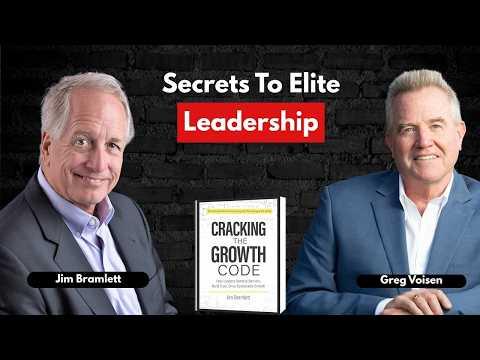
In this episode of Inside Personal Growth, Greg Voisen sits down with serial entrepreneur, executive coach, and author Jim Bramlett to discuss his latest book, Cracking the Growth Code. With over 40 years of experience in transportation and logistics and a career spent launching eight successful companies, Jim has identified a universal pattern that separates dominant companies from those that eventually stall.
Many leaders are experts in their industry but have received little to no formal training on how to engage employees or build a scalable culture. Jim’s mission is to bridge that gap with his Aligned Leadership Operating System, a practical framework designed to help leaders achieve sustainable growth without the burnout of the perpetual “hustle.”
The conversation begins with Jim’s fascination with the Amazon story. While Wall Street spent years criticizing Jeff Bezos for burning through cash, Bezos remained laser-focused on one thing: the customer.
Jim notes that while mid-sized companies may not have the multi-billion-dollar buying power of a giant like Amazon, they can apply the same core philosophy. Most companies focus internally on quarterly earnings and profit margins. In contrast, dominant companies look outward, engineering every process around what the customer truly wants.
According to Jim, every successful organization must master four universal pillars. If a business owner can excel in these areas, growth becomes a byproduct of the system rather than a result of sheer luck.
In a world where time is the most valuable currency, convenience is king. How easy is it for a customer to do business with you? Jim challenges leaders to look at their friction points. If your competitors are more accessible or faster to respond, you are losing ground regardless of your product quality.
Jim offers a counterintuitive take on pricing: it’s not about being the cheapest; it’s about being competitive and, more importantly, transparent. “We buyers want to know what we are spending in advance,” Jim explains. He points to the frustration consumers feel with “resort fees” in hotels or “hidden quarters” on discount airlines. By being 100% upfront about costs, a small business builds a level of loyalty that a larger, “nickel-and-diming” conglomerate never can.
Jim believes user experience is the pillar most under a leader’s control, yet it is often the most neglected. UX isn’t just about a website; it’s about the entire journey. It’s about the courtesy to call a customer if you’re going to be late for a quote. It’s about meeting commitments. When leaders fail to prioritize UX, they leave the door wide open for new competitors to step in and fill the void.
Trust is the foundation of every long-term business relationship. This involves warranties, guarantees, and the consistency of your brand. In Jim’s view, small and mid-sized businesses have a unique advantage here—they can be on a first-name basis with their clients, creating a bond of trust that scale-heavy corporations struggle to replicate.
One of the most profound segments of the podcast focuses on why leadership fails. Jim introduces the concept of “Hand-Me-Down Leadership.” Imagine a stellar accountant who gets promoted to manager. Because she was never trained in leadership, she leads exactly the way she was led—which often results in a “Command and Control” style. This micromanagement and intimidation are the primary drivers of employee disengagement.
Jim argues that management (organizing tasks) and leadership (inspiring people) are fundamentally different skills. To crack the growth code, leaders must transition into a Coaching Leadership style.
Citing Gallup statistics, Jim points out that disengagement costs the global economy hundreds of billions of dollars annually. Only about 30% of employees are truly engaged at work.
“It’s not the employee’s fault they aren’t engaged; it’s leadership’s fault,” Jim asserts. The fix? Radical responsibility. Leaders must stop avoiding difficult conversations and start engaging their teams. Jim suggests that 80% of business challenges are people-related, and the solution lies in Reflective Inquiry.
Instead of telling employees what to do, a coaching leader asks:
When employees come up with the answer themselves, they are infinitely more committed to the outcome.
For those feeling overwhelmed, Jim doesn’t just offer theory; he provides a roadmap. His book, Cracking the Growth Code, includes a 30-day action plan and a 90-day roadmap.
The first step? Start listening. A leader’s job is to be an active listener who pays attention to emotions and body language. By “coaching the person, not the problem,” leaders can unlock the untapped brainpower of their organization and pave the way for sustainable, long-term expansion.
Connect with Our Guest, Jim Bramlett:
➥ Book: Cracking the Growth Code
➥ Buy Now: a.co/d/0fk2gF3c
➥ Website: jimbramlett.com/
LinkedIn: www.linkedin.com/in/jimbramlett1/
Continue Listening