

with Jim Bramlett
May 12, 2026
Inside Personal Growth
Listen on your favorite platforms
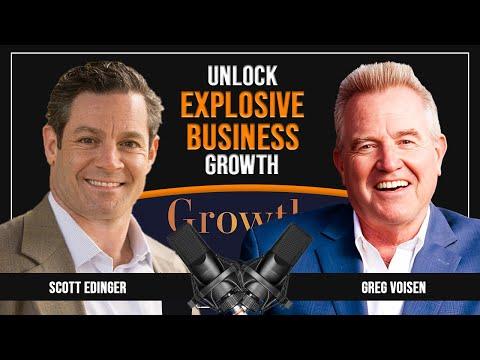
In this insightful episode of Inside Personal Growth, host Greg Voisen sits down with Scott Edinger, a business growth consultant, speaker, and the author of The Growth Leader: Strategies to Drive the Top and Bottom Lines. Together, they explore how businesses can achieve sustained growth through the intersection of leadership, strategy, and sales. In a world where businesses constantly strive for market dominance, Scott underscores a critical message: growth is not just a sales challenge but fundamentally a leadership issue.
One of the central themes of Scott’s discussion is the need for leadership and sales alignment. Too often, companies focus on the tactical aspects of sales—like closing deals—without acknowledging the strategic role that leadership plays in enabling sales success. According to Scott, growth happens when leaders create an environment where their sales teams are not just selling products but delivering value. This value-driven approach is what differentiates successful companies from those that struggle to grow. Scott poses an important question for business leaders: Are you selling what you want to whom you want, or are you selling whatever you can to whoever you can? The answer to this question determines whether sales efforts are strategic or merely transactional. In today's competitive landscape, it's no longer enough to have an exceptional product or service. Sales teams must be equipped with a clear strategy that aligns with leadership's vision and organizational goals. The sales process, Scott explains, is essentially the execution of a company's strategy in the marketplace. Every interaction with a customer or prospect is an opportunity to demonstrate the company’s value proposition. As a leader, it’s your responsibility to ensure that your sales teams are empowered to execute the strategy effectively.
Scott is adamant that growth must be viewed through a leadership lens. He challenges the conventional wisdom that sales and leadership are separate functions. In reality, they are deeply intertwined. Leadership sets the tone for how a company approaches the market, and sales teams are the ones who bring that strategy to life in front of customers. Scott shares an important statistic: only 14% of CEOs are actively engaged with their sales teams. This low level of engagement reflects a widespread belief that sales is not a strategic function but merely an operational necessity. Leaders often prioritize innovation, product development, and finance, while neglecting the importance of sales strategy. However, Scott argues that this mindset is flawed. Sales should be viewed as a critical component of a company's strategic plan, and executives must actively participate in shaping the sales experience to ensure it delivers long-term growth.
Scott introduces the concept of the "butterfly effect" in leadership, where small actions by leaders can have significant downstream effects on sales performance and overall growth. He points out that if leaders are dissatisfied with what they are seeing from their sales teams, the first place to look is in the mirror. The behaviors that sales teams exhibit are often a direct reflection of how they are led and managed. Scott advises leaders to focus on removing what he calls "sales stigma"—the idea that sales is merely about distribution and not a source of differentiation. By treating sales as a strategic differentiator, leaders can change the way their teams approach the market, resulting in improved performance and greater customer loyalty. It’s about shifting the mindset from distribution to differentiation, where the way salespeople interact with customers becomes a key reason why the company wins deals.
In The Growth Leader, Scott introduces the Five Flags Framework, a simple yet powerful tool that helps leaders develop and execute a clear go-to-market strategy. The framework is built around five key questions that every leader should be able to answer:
Scott emphasizes that by answering these questions with clarity and precision, leaders can create a strategy that aligns their entire organization around a common goal. This not only drives sales but also ensures long-term, sustainable growth.
Scott Edinger leaves listeners with two key takeaways from his book:
To learn more about Scott Edinger and his insights on leadership and growth, visit his website here and follow him on YouTube, LinkedIn, and Twitter/X. You can also purchase his book The Growth Leader: Strategies to Drive the Top and Bottom Lines on Amazon.
You may also refer to the transcripts below for the full transciption (not edited) of the interview.
Continue Listening