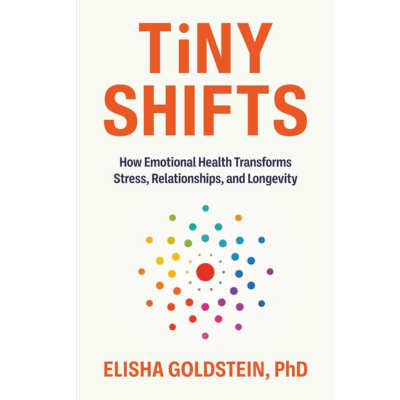
 In this episode of Inside Personal Growth, Greg Voisen sits down with Dr. Elisha Goldstein, a renowned psychologist and pioneer in the field of mindfulness and emotional health. After nearly fourteen years since their last recorded conversation, the two reunite to discuss a crisis that has only intensified in the digital age: the “overwhelm loop.”
The focus of their discussion is Dr. Goldstein’s powerful new book, Tiny Shifts: How Emotional Health Transforms Stress, Relationships, and Longevity. In a world obsessed with bio-hacking, productivity apps, and physical optimization, Dr. Goldstein argues that we are missing the most critical pillar of health—our emotional well-being. This conversation is an invitation to stop adding more to your plate and start making the intentional, microscopic pivots that lead to lasting peace.
The Myth of Modern Optimization
During the interview, Greg and Dr. Goldstein reflect on a common phenomenon: people who do everything “right” but still feel miserable. They cite health experts like Peter Attia, who have mastered the pillars of exercise, sleep, and nutrition, only to realize that without emotional health, the structure of a “good life” eventually crumbles.
We live in a time of unprecedented “fracturing.” Our nervous systems are under constant assault from pings, alerts, and digital demands. Dr. Goldstein explains that this isn’t just a mental annoyance; it is a biological state of chronic high alert. When we live in this state, we lose our “choice window”—the ability to respond to life’s challenges with wisdom rather than reactivity.
Understanding the “Overwhelm Loop”
At the heart of Tiny Shifts is the concept of the “Overwhelm Loop.” Dr. Goldstein describes this as an umbrella term for the modern condition. It consists of four distinct elements:
-
Thoughts: The racing mind and “monkey mind” that can’t stop planning or worrying.
-
Emotions: Feelings of inadequacy, irritability, or deep fatigue.
-
Biology: The physical tension, spiked cortisol, and bracing muscles that signal a fight-or-flight response.
-
Actions: The reactive behaviors we take, such as snapping at loved ones or overeating.
The loop is self-perpetuating. To break it, Dr. Goldstein introduces his signature 4-R Method.
The 4-R Method: A Toolkit for Real-Time Change
Unlike complex psychological theories, the 4-R Method is designed to be used in the heat of the moment. Dr. Goldstein shares a personal story of being scammed on social media—a situation that triggered intense shame and anxiety—to demonstrate how these steps work:
-
Recognize: The first step is naming what is happening. By labeling the “overwhelm loop,” you move blood flow to the prefrontal cortex, the part of the brain responsible for regulation and perspective.
-
Release: This is a somatic move. You can’t think your way out of a body-based stress response. By lowering your shoulders, softening your eyes, and exhaling, you signal to your nervous system that you are safe.
-
Refocus: Once the body is slightly calmer, you can ask a “supportive question.” Instead of asking, “Why am I such an idiot?”, ask “What do I need right now?” This points your brain toward helpful answers.
-
Reinforce: This is the most overlooked step. Through “emotional tagging,” you take a mental snapshot of the moment you felt a shift. By acknowledging the win, you wire the neurons together, making the next “tiny shift” easier to achieve.
Finding Meaning in 90,000 Hours
A significant portion of the podcast explores our relationship with work. With the average person spending roughly 90,000 hours of their life working, Dr. Goldstein emphasizes the importance of “Job Crafting.”
He explains that purpose isn’t some grand, elusive destination. Rather, it is the alignment of your daily actions with your core values. If you value connection but work behind a computer all day, a “tiny shift” might be sending a voice note instead of an email or taking five minutes to truly inquire about a colleague’s life. These small pivots transform “doing” into “meaning,” preventing the emptiness that so often accompanies high achievement.
Healing the “Not Enough” Wound
In a vulnerable moment, Dr. Goldstein discusses the childhood roots of emotional health. He shares his own “not enough” wound—the unconscious belief that he had to overachieve to be lovable.
This theme resonates throughout Tiny Shifts. When we live from a place of perceived inadequacy, we become obsessed with the “next shiny thing,” believing it will finally make us whole. The book teaches readers how to provide themselves with the compassion and support needed to heal these wounds, allowing for a sense of peace that doesn’t depend on external accomplishments.
The Power of Tiny Shifts
The message of the podcast is clear: you don’t need a total life overhaul to find happiness. You need the courage to make intentional pivots. As Dr. Goldstein notes, “Neurons that fire together, wire together.” By consistently choosing to recognize, release, refocus, and reinforce, you are literally rebuilding your brain for resilience and longevity.
Whether you are struggling with the loneliness epidemic, career burnout, or simply the feeling of being “constantly pinged,” this episode provides the practical tools needed to reclaim your life.
Connect with Dr. Elisha Goldstein
Our Guest, Dr. Elisha Goldstein:
➥ Book: Tiny Shifts: How Emotional Health Transforms Stress, Relationships, and Longevity
➥ Buy Now: https://elishagoldstein.com/
LinkedIn: https://www.linkedin.com/in/drelishagoldstein/
➡️Instagram: https://www.instagram.com/drelishagoldstein/
➡️Facebook: https://www.facebook.com/drelishagoldstein
➡️Youtube: https://www.youtube.com/@drelishagoldstein
You may also refer to the transcripts below for the full transcription (not edited) of the interview.
[fusebox_transcript]











Leave a Reply