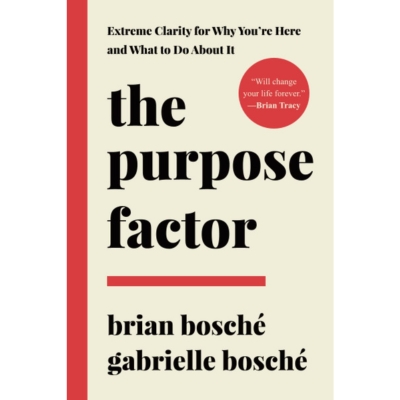

In this episode of Inside Personal Growth, Greg Voisen sits down with Gabrielle Bosche, the powerhouse co-founder of The Purpose Company and bestselling author of The Purpose Factor: Extreme Clarity for Why You’re Here and What to Do About It. If you have ever felt like a “kid lost at Costco”—wandering through careers, side-hustles, and hobbies hoping to stumble upon your life’s meaning—this conversation is the definitive roadmap you have been waiting for.
Gabrielle Bosche has moved far beyond the cliché, well-intended, but often destructive advice of “just follow your passion.” She has dedicated over a decade to studying the science of fulfillment, developing a rigorous, systematic approach that has helped over 120,000 people—ranging from Fortune 500 executives and presidential campaigns to elite US military units—find what she calls “unreasonable certainty” in their life’s direction.
The Problem with “Passion”
We live in a culture that treats purpose as a lucky accident. We are told that if we just think positive thoughts or wait long enough, our “calling” will eventually tap us on the shoulder. Gabrielle Bosche challenges this passivity. She notes that for many high-achievers, the quest for purpose often feels like a “backfoot” struggle—always reacting to the next job offer or the next crisis.
In fact, Gabrielle points out a linguistic trap: the dictionary defines “passion” as a “barely controllable emotion.” Basing your life’s work on a fleeting feeling is a recipe for inconsistency and burnout. True purpose, she argues, is an “inside job” that requires a specific sequence and system. It is about moving from “random acts of kindness” to “intentional acts of purpose.”
The Four Pillars of Your Purpose Factor
During the interview, Gabrielle Bosche breaks down the proprietary framework that allows individuals to experience fulfillment on demand. Purpose isn’t a single “aha” moment; it is the intersection of four distinct “buckets”:
1. Natural Advantage
These are the proclivities you were born with. You can often see these in children—the child who is a natural “Recruiter,” rallying everyone on the playground, or the “Overseer,” who insists on order and systems. Understanding your natural bias toward certain roles allows you to stop fighting your nature and start leveraging it.
2. Acquired Skills
This is the “what’s in your hands” element. It encompasses your education, your professional training, and the tangible tools you have collected throughout your career. Whether you are a “Strategist” who reverse-engineers problems or a “Protector” who ensures the safety of a team, your skills are the packaging through which your purpose is delivered to the marketplace.
3. Pull Passion
This is perhaps the most transformative shift Gabrielle offers. Instead of asking “What do I love?”, she asks, “Who is your hill?” and “What problem are you designed to solve?” A Pull Passion is the specific injustice or challenge in the world that you feel an obligation to address. It is the cause you are willing to sacrifice for.
4. Origin Strength
Most people try to hide their past struggles or “scars,” but Gabrielle Bosche views them as a source of authority. Your “Origin Strength” is the superpower you developed to survive hard times. Whether your past taught you to be “Adaptive” in the face of chaos or “Resilient” in the face of loss, these experiences provide the unique insight needed to help others who are currently where you used to be.
Purpose as a Decision-Making Compass
One of the most practical takeaways from this episode is the concept of the Fulfillment Factor. Once you take The Purpose Factor assessment, you receive a data-driven “purpose statement.” This isn’t just a feel-good quote; it is a filter for every decision you make.
Gabrielle emphasizes that personal development is ultimately about making better decisions. When a new job opportunity or a business partnership arises, you no longer have to guess. You simply ask: “Does this allow me to give the best of what I have to help others?” If the answer is no, you have the clarity to walk away. This approach turns purpose into a tangible toolbox for the modern economy.
From Transactions to Transformation
As the conversation shifts to the corporate world, Gabrielle Bosche explains that we have moved past the “Come Join Us” economy. Today’s workforce is part of a “Personal Purpose” economy. Employees—especially the younger generation—want to know exactly where they fit into a company’s mission.
She shares a moving story of an HR director whose perspective was transformed after realizing his purpose was rooted in a traumatic past event. By connecting his daily work—hiring and providing jobs—to that core event, his mundane tasks were transformed into a life-saving mission. This is the power of personalizing the mission. When an entire organization aligns individual purposes with a collective goal, profitability and engagement skyrocket.
Living Your Legacy Now
The episode concludes with a powerful call to action: Purpose is for now. It is not something to be put off until retirement or until the kids leave the house. By identifying your unique “Purpose Factor,” you stop being a “recovering Type-A manic” and start living a life by design. Gabrielle Bosche’s mission is to ensure that everyone realizes they are worth the pursuit of clarity.
Connect with Gabrielle Bosche
To take the assessment and discover your own purpose statement, visit the links below:
-
Website: brianandgab.com
-
LinkedIn: Gabrielle Bosche
-
Instagram: @gabriellebosche
-
The Book: The Purpose Factor: Extreme Clarity for Why You’re Here and What to Do About It
You may also refer to the transcripts below for the full transcription (not edited) of the interview.
Welcome back to Inside Personal Growth. This is Greg Voisen, host of inside Personal Growth. And I have Gabrielle Bosche. Is that how I say it, right?
00:00:10:02 - 00:00:11:10
Speaker 2
Bosche Yeah.
00:00:11:10 - 00:00:28:11
Speaker 1
Yeah. We're going to be talking about the purpose factor for the second time, because the first time, ladies and gentlemen, something happened to my recording equipment. So I will admit that right up front. But it's so nice to have such a lovely face across to me.
00:00:28:11 - 00:00:37:24
Speaker 2
Well, I don't mind at all. It is we had such an amazing conversation, truly. And I think it's just a sign that we needed to to have another one. So I'm thrilled to be back. My friend.
00:00:38:10 - 00:01:01:16
Speaker 1
Well, for all of you who don't know, Gabrielle, this is the book. It's called The Purpose Factor. It's been out for a while, but there's also a purpose factor assessment. They're just doing a program for the kids. Look in the show notes below, we are going to have a link to the website, which you guys should all know called Purpose Company.
00:01:01:23 - 00:01:28:12
Speaker 1
It's called Purpose Company dot com. That's where you'll want to go. And you can learn everything about what's going on. You can take the assessment from there and so on. But I'm going to tell them a bit about you. She's the co-founder of this with her husband Brian, and he should take some credit here, too, called the Purpose Company, where they both kind of worked on this idea.
00:01:28:12 - 00:01:41:00
Speaker 1
Brian had this dedicated themselves to helping individuals and organizations discover and live their purpose. And together they've trained over 100,000 people. Is it more than that now.
00:01:41:15 - 00:01:43:24
Speaker 2
Or just about 120? Yeah.
00:01:44:11 - 00:02:12:03
Speaker 1
120. Wow, That's amazing. It's pretty groundbreaking. So the purpose factor framework and their purpose factor assessment, which I've taken, I've also administered to quite a few people, is really something that I'm excited to let my listeners know about. So please go to that website, click that button, because it's going to be your awakening to kind of a new world.
00:02:12:04 - 00:02:42:13
Speaker 1
Once you take it and you hear what it says about you. The book is a bestseller and it's really about getting extreme clarity for why you're here and what to do about it. So Gabrielle's created what many consider the clearest, most actionable process ever developed for discovering purpose. And there's a lot of them out there. So all I'm saying is to say that this one, in my estimation, is the best because it reveals so much.
00:02:43:17 - 00:03:09:22
Speaker 1
She's been at this for a long time. She actually published her first book when she was 17 years old, and her work earned endorsements from most impressive names around Simone Biles and Louis Howells and all kinds of famous people John Maxwell, Malcolm Gladwell, Dave Ramsey. So she's a sought after TEDx speaker. She's all over the place, you're going to say.
00:03:09:22 - 00:03:36:09
Speaker 1
And what I love about her approach is just how practical and science based it is. It's not just about finding your passion. She developed a systematic approach for discovering your exact purpose and building a life around it so that is really it. Well, let's start off with this. You know, before we dive into this purpose factor book, I kind of want to hear your story.
00:03:36:09 - 00:03:55:08
Speaker 1
What drew you and Brian to dedicate your lives to doing this? Because now that you're in it, you're in it. There's no way getting out. So that's Ray and you and you got to love what you do every morning when you wake up. And I can't imagine two people just waking up like the two of you guys and going, Wow, we just love what we're doing.
00:03:55:08 - 00:04:03:16
Speaker 1
So tell us a little bit about the background and why you guys wrote this book and and in itself, the purpose factor to the assessment.
00:04:04:05 - 00:04:27:00
Speaker 2
Yeah, I mean, so much of what we do is, is because we wish someone had done it for us. We, like many people in their twenties, were walking around trying to find their purpose. I kind of felt like a kid lost at Costco, like looking for my purpose. Like, are you my purpose? Are you my purpose? So in college, I studied politics, political science and religion.
00:04:27:00 - 00:04:43:21
Speaker 2
So the two kind of things that you're not supposed to talk about at Thanksgiving, I decided to double up on those. And really it was for one main purpose. And that was because I wanted to change the world. I was one of those young people like many are, that went into college and said, How do I make sure that my life actually means something?
00:04:43:21 - 00:05:07:20
Speaker 2
And getting into politics and getting into the nonprofit space and politics in particular, I felt like I was much more of the problem than than the solution. And through that, trying to find meaning externally, I realized that I couldn't look to my parents, I couldn't look to my partner, I couldn't look to two institutions. I couldn't really even look to my peers to say, What do you think my purpose is?
00:05:07:20 - 00:05:34:15
Speaker 2
It was going to be an inside job. And I felt like I tried everything. I did the Eat, Pray, Love thing through your app. I started businesses, stopped businesses, and I really was trying to find something that I felt was really true. And I had a really hard time with a lot of the advice, very well-intended advice that people give you when it comes to finding your purpose, like it'll just happen or, you know, just, you know, find something you're passionate about and you'll never work a day in your life.
00:05:34:15 - 00:05:56:18
Speaker 2
And and I tried a lot of those things, and there were lots of starts and stops and and I got to this place where very similar to Brian, we were kind of having this moment simultaneously that we realized that if the importance of finding your purpose, which is beautiful advice to give someone is go find your purpose. Something that important should have a system and a sequence for it.
00:05:56:18 - 00:06:19:09
Speaker 2
So, so I and Brian really took the scientific method and applied it to purpose discovery. We said, Is there something that people could replicate in duplicate and actually follow through on that We could experience fulfillment on demand because, Greg, you know this, most people aren't walking around saying, What's my purpose? They're usually saying, I don't know what's next for me.
00:06:20:03 - 00:06:39:20
Speaker 2
I need to work on my personal development. I'm not where I thought I'd be at this time. Usually they're symptoms of not finding purpose. It's usually not purpose itself that people are looking for. And and so we started to study who were the folks who had broken through, the ones who had gone from the stuck and lost to the found and clear.
00:06:39:20 - 00:06:59:07
Speaker 2
And we noticed that there were these kind of four key buckets that we kept coming back to that when we when we looked at popular religions, when we looked at social psychology, positive psychology, when we looked at Stoke philosophy, when people were talking about purpose, they kind of had four things that they talked about. They talked about something natural.
00:06:59:08 - 00:07:16:03
Speaker 2
So something that kind of comes naturally to you that you show up to this world and you have a proclivity, an interest, a bias towards something. The second thing was something learned, so something that you do with your hands. Rick Warren talks about that a lot of what's in your hands. Like, what do you currently have as a skillset or an insight?
00:07:16:03 - 00:07:50:16
Speaker 2
What do you have access to something according to purpose. There is always something I'm sorry, something around passion. Passion was always there. It was always part of the conversation, but we didn't know where it landed. And then the final thing was something about coming of age like your origin story. So when we kind of found those four things, we spent quite a bit of time and research took us about a decade to really reverse engineer how those four elements work together and then ultimately helped us inform the Purpose Factor book, which you held up and the purpose factor assessment, which is about a 20 minute assessment that it takes to get clarity on who you
00:07:50:16 - 00:07:52:07
Speaker 2
are and what you're supposed to do next.
00:07:52:23 - 00:08:15:06
Speaker 1
Well, it is very well laid out, and I have taken it and again, I've administered it. So for everybody listening it, it is like a light that shines on you when you read it and then you get to see this. But I think people out there listening today who might be displeased or unhappy with where they are, they're challenged.
00:08:15:19 - 00:09:00:03
Speaker 1
They need to understand that. I want to ask you about something, because this isn't semantics. It's purpose and meaning. It's being curious and being in flow. It's, you know, the flow Genome project that Steven Cutler has been on this show so many times speaking about. I think when you're have a purpose, you understand these elements. So, you know, what I wanted to find out is you mentioned that being like a recovering type-A manic do it all yourself, which I think in our world, many people who are listening, who we have a lot of LinkedIn listeners, it's about achievement, right?
00:09:00:05 - 00:09:23:07
Speaker 1
It's about are you enough in the world kind of condition us around? You know, we've always got to do more. We've got to be more. And at what point can we be happy? What I find is when you find that purpose, when you've done that through curiosity, when you stay in flow, you literally can be much happier, much more joyful.
00:09:23:14 - 00:09:40:04
Speaker 1
So how did your own struggle with this? Because you struggled. You just mentioned that you were struggling, shaped the framework that you eventually created, and were you solving your own problem first to get to solving everybody else's problem? Mm hmm.
00:09:40:06 - 00:10:01:08
Speaker 2
Yeah. Without without a doubt. And and I think that that's the crux of of really anything of meaning is, is how do you help someone else with something that you've been through and so many people are looking around for What's my thing? What, what direction should I go after? What kind of business should I start? What what hobbies should I pursue?
00:10:01:08 - 00:10:22:18
Speaker 2
What passion should I go all in on? And one of the easiest ways to start is to say, How do I help me? Five years or five steps ago? Because your story is your authority. The thing that you've been through gives you unique insight into how to overcome the challenges and pitfalls that someone's either experiencing currently or certainly will experience in the near future.
00:10:23:01 - 00:10:45:18
Speaker 2
And that was very much mine and Brian's own experience as well. I think we had a fairly condense experience of trying to figure out what was next for us, where some people, it takes decades. For us, it was it was about five years of turmoil really, of of going after I mean I'm I'm so type a that really my my hobby is if it didn't have a trophy attached to it, I wasn't interested.
00:10:46:02 - 00:11:09:19
Speaker 2
So everything was oriented towards having certainly I think a desire to be seen. I think that's a big part of what causes achievers to achieve. And and there's nothing wrong with that. I think in this world we talk a lot about ego being the enemy. And I think when it's an unfettered and unfiltered, it certainly can be. And we've seen that in many different, many different veins.
00:11:09:19 - 00:11:29:13
Speaker 2
But but I think at its core and I see this primarily with achiever is is that ego is the desire to be seen. Now we get to choose what are we seen for. Is it being seen for giving back, being present, being a great partner or parent, or are we being seen for just our treatment which are, you know, here today and gone tomorrow?
00:11:29:22 - 00:11:51:08
Speaker 2
And and so I think that journey that Brian and I both went on, you know, individually. And then we then we met and essentially started working together. You know, immediately we when we came together, we realized what could it look like to accelerate so that way we can no longer be in suffering. Now, suffering isn't something that we want to avoid entirely.
00:11:51:08 - 00:12:06:00
Speaker 2
Suffering is is actually necessary. We're doing a lot of research right now about the role of conviction in decision making. And and so conviction, the way that we see it, is the unreasonable certainty that what you're doing is right. And we said, do.
00:12:06:00 - 00:12:31:17
Speaker 1
You believe, though, Gary, that if I can call you that. Yeah. That it suffering is a choice that we make. I know. Look, John, Max was very you guys, you and your husband are very ingrained in it, very strong spiritual then. And spirituality brings in a big point. There's Christianity, there's I have people that are Muslims and Jews that listen to the show, everybody across the board.
00:12:32:04 - 00:12:56:06
Speaker 1
And what you find is more people moving toward a spiritual ness than religiosity. Yeah, okay. And it it's because they're seeking their own path. What your assessment does is it helps them find their own path and open the door to, you know, there's many ways up the mountain you can go as a Christian, you can go as a muslim and go to other.
00:12:56:13 - 00:13:23:13
Speaker 1
But in your case, you know, you were looking at patterns. You were seeing what made this purpose important for people. And it was and it wasn't just emotional or philosophical, but something that you could actually systemize right. And I like the fact that it comes out in the patterns that it does because it makes logical sense. It's almost scientific, yet spiritual.
00:13:23:13 - 00:13:42:24
Speaker 1
At the same time, I would say it's blended together. Yeah. And and how did you and Brian kind of come about it that because you were working with Fortune 500 companies, military leaders, presidential campaigns, all kinds of things. And to actually bring this together must have been quite an undertaking.
00:13:43:11 - 00:14:07:20
Speaker 2
Yeah, it certainly was. And and I think the the it all really came together when we were working with our corporate clients and working with the US military because they kept coming to us saying, hey, how do we engage our employees? How do we recruit motivated people to show up at work every day? And in Brian, my husband and co-creator with this kept saying, I think it comes back to purpose.
00:14:07:20 - 00:14:39:09
Speaker 2
I think if people don't have meaning, then they're not going to find fulfillment. And it doesn't matter how much money that you that you pay them. And we saw that in some of the data and certainly we saw that anecdotally with many of our Fortune 50 clients. But Brian really came to the table and said, hey, I think that we if we create something that's really tangible for people, that it's not just kind of the fluff and the close your eyes and think positive thoughts, it's this is something that we could actually turn into job descriptions, recruiting tools, leadership and mentorship frameworks.
00:14:39:09 - 00:15:06:24
Speaker 2
If we could turn it into something tangible, then I think we could really get this thing to to take off and in it, and it certainly has. And so I think when you reverse engineer, where we were coming from was the business, the business world realizing that this couldn't be just an assessment that was a mirror, it had to be an assessment that was also to a toolbox that then helped empower people to make key decisions, learn not just about themselves, which every assessment will do that and tell you a bit more about yourself or confirm what you already know.
00:15:07:06 - 00:15:25:16
Speaker 2
What we really wanted to do with the purpose factor assessment is to give you a tool to make decisions moving forward because the way that we see it is personal development. All of personal development is about making better decisions. And if you don't have a lens by which you make effective decisions, then you will be on a backfoot the rest of your life.
00:15:25:16 - 00:15:45:23
Speaker 2
And so if you have a framework to determine just really two things, number one, is it aligned with my purpose or not? Everything, the duality of life really comes down to that. And so we decide if we can give someone a tool to make intentional, effective and hopefully quick decisions that that are aligned with their purpose. And we're we're going to give someone a tool that they can use the rest of their life.
00:15:46:17 - 00:16:17:02
Speaker 1
Well, there's many ways that coming about making a decision. But I would say when you listen to some of the most successful people, Steve Jobs, Warren Buffett, Bill Gates, these kind of people who've built huge businesses, they'll say, listen to your intuition. So I call it the internal Yoda. But the only way to get to that Yoda is to be in a spot where you can hear or feel or see this voice that speaking to you about that decision, right.
00:16:17:02 - 00:16:37:08
Speaker 1
About, okay, I need to get some guidance on this. Yes. I have all this input from all these other places. But in the end, you know, like I say, if you're the one making the decision, you got to pull the trigger, right? Like I do this or I don't. Now, your purpose factor kind of breaks down into this natural advantage.
00:16:37:08 - 00:17:05:17
Speaker 1
You call it acquired skills, pull, passion, origin, strength, if you would, because I took it and mine came out like, I mean, it it wasn't so much an eye opener, but it was confirming. It said to inspire excitement around a cause to stand up for what's right. Okay. Well, obviously, to do this podcast show, I bring on a lot of people like you and I'm helping the world.
00:17:06:15 - 00:17:32:16
Speaker 1
What I think is sometimes where they're not clear more clarity by the knowledge and wisdom they're receiving from listening to people like you. So if you would walk us through those four pieces and why isn't just knowing your passion or your natural talents and skills enough So now you know it? Now you've got to do something with it.
00:17:33:00 - 00:17:34:02
Speaker 1
Okay? Yeah.
00:17:34:13 - 00:17:58:21
Speaker 2
Yeah, yeah. Now, knowledge of your purpose is certainly a responsibility. And. And that's really the intention behind the assessment is to again, give you a framework and an understanding of what to do now that you know what will help you experience fulfillment on demand. So the first element is your natural advantage. So that's what you kind of come to the world with a natural proclivity and natural interests where you just tend to do things.
00:17:58:21 - 00:18:21:08
Speaker 2
So under each of these four different elements, we have five different archetypes underneath. So when you take the assessment, your particular results of one out of 625 different possibilities and combinations. So it truly is very uniquely designed to you. And what you just read off is, is your purpose factor statement. So we actually give you a purpose statement at the beginning of the assessment as well.
00:18:21:08 - 00:18:40:02
Speaker 2
You basically get a 49 page book about you, and that's what we wanted people to do as a reading through. The assessment is for them to not just feel seen and to feel understood, but to be empowered to not just know the good stuff. But we talk about the blind spots and the things that you should be prepared to to address or have conversations with.
00:18:40:02 - 00:18:57:08
Speaker 2
One of my favorite things is when people will take the assessment and then switch it with their partner and then highlight with grain all the things that they knew about their partner and highlight in yellow, all of the stuff that they didn't know about their partner. And it's a really beautiful. We've seen leaders and managers and and employees do that together too.
00:18:57:17 - 00:19:16:15
Speaker 2
But natural advantage is really important because you can actually see it in your young kids. And so what we love to do is to encourage parents. Now we have Virgin that's 13 and up that you can start to see what is the natural tendency of my child? Are they a teacher? Every time they learn something, they translate it and can't wait to tell you everything that they've just learned.
00:19:17:00 - 00:19:37:21
Speaker 2
Are they a recruiter? They're just a natural kind of entrepreneur, getting everybody on board, setting the vision, getting everyone excited. Are they the overseer that they're like, I'm really, you know, organized. I want to make sure that everything has kind of a place at a time and a system. And and so helping people really understand early on what is the role that they tend to play in life and work is really helpful.
00:19:37:21 - 00:19:59:13
Speaker 2
So that's natural advantage. The second thing is acquired skills. That is, the skills and abilities you've learned through life experience and education. So what is it that you can actually apply your purpose with? And we're really the only purpose, assessment and experience that orients around how you can apply it in the marketplace, because we didn't see purpose as something you volunteer into.
00:19:59:19 - 00:20:22:08
Speaker 2
You can apply your purpose no matter if you're retired or working full time, staying home with kids or leaning big companies. And we wanted to make sure people understood that there's there's important work in front of you and you have an opportunity, I believe, an obligation, to bring your purpose to work. So we talk about what are the different ways that you can do that through the five different archetypes as an acquired with acquired skills, it could be a protector.
00:20:22:08 - 00:20:39:21
Speaker 2
So protectors could have anything between, you know, health care experience to be an attorneys, to be managers or stay at home parents. We were working with one woman who was an executive assistant, and she took the assessment and it came out that she's a strategist and she started crying. She was like, I don't see myself as a strategist.
00:20:39:21 - 00:21:15:15
Speaker 2
I, you know, help support the CEO. And and she had a moment because when she read the description, knows exactly what she does as she anticipates needs you reverse engineers problem. She gets direction and feedback and she said I never saw myself as someone who had that kind of skill set to give to the marketplace is beautiful. The third is your pull passion, and this is the one that most people have a misunderstanding, or it is this term passion that we were kind of talking about, where the dictionary definition of the word passion is a barely controllable emotion, which is is certainly very interesting when you start to think about how we give that is
00:21:15:15 - 00:21:43:05
Speaker 2
advice freely just to go follow your barely controllable motion. We think the most useful definition of of passion and we started to mention here a little bit about suffering. But that the second definition of passion is the death and suffering of Christ. And so when you look at even some of the ancient Greek texts, when we start talking about passion isn't just this high emotional experience, it's also to what are you willing to sacrifice for?
00:21:43:20 - 00:21:55:23
Speaker 2
So if you're not willing to sacrifice for, is it really a passion? So we call it pull passion, that passion that pulls you. So this is the problem in the world that you want to solve. So you could be an injustice equalizer. Someone who knows.
00:21:55:23 - 00:22:01:05
Speaker 1
Yeah. Pardon me. That's what mine came back as. Injustice. Equalizer.
00:22:01:05 - 00:22:01:14
Speaker 2
Yeah.
00:22:01:19 - 00:22:32:01
Speaker 1
And so I do have a nonprofit. I work with the homeless. I'm. I'm trying to equalize in it my own sense. But I'm drawn to the fairness and, you know, that's what it is. So I identify very heavily with that whole passion in and if in and what I was is I'm a recruiter with a messenger skillset so rally people in justice equalizer and I read what my passion was.
00:22:32:01 - 00:22:59:24
Speaker 1
But the point is, is that I want to let people know is that it gives you a confirmation of who you think you might be to actually take action. Now, one of the things is that you, you guys added to it was the origin strength piece that really fascinated the idea that how we've overcome hard things becomes how we help others, right?
00:22:59:24 - 00:23:36:10
Speaker 1
Yes. So the origin strand for me was adaptive. Okay. Yeah. So I learned to thrive through constant change. And I think this is important for people to know. Some people run away from that. It's like they don't deal well with change and it feels really deeply personal. Right? So how do you help people reframe their struggles as strengths rather than as scars when they literally take this assessment and they see it and they're still struggling?
00:23:36:19 - 00:23:40:05
Speaker 1
But, you know, how do you help them look at that as a strength?
00:23:40:14 - 00:24:04:11
Speaker 2
It it's so important that people have context to their pain and to turn that pain into purpose. And you really only can do that when you realize it's about others. So purpose is the best of what you have to help other people, plain and simple. It's the best of what you have to help other people. When we make purpose about us and our likes and our dislikes and and all of that, we're missing it.
00:24:04:11 - 00:24:28:18
Speaker 2
And in reality, it really is who we can be for someone else. And as I mentioned before, you're you're most likely going to be for someone else what you wish someone was for you, the mentor, the parent, the friend, the boss, the cheerleader, whatever that looks like. And so when we when we looked at Origin story, if you read the book, The Purpose Factor works to talk about origin strength, which is which is how really the hard things that you've been through.
00:24:28:18 - 00:24:47:10
Speaker 2
Well, when we created the assessment, we wanted to create something certainly that was more geared towards companies because we wanted to make sure that was appropriate for our h.R. And compliance purposes. But what we actually found in that process is the importance of it doesn't actually matter. The thing that you've been through, it matters what strength it gave you.
00:24:47:23 - 00:25:08:20
Speaker 2
And so it doesn't matter if you had a childhood illness or your parents got divorced or you had a major family, any of those things could create a very similar kind of superpower at the end of the day, which is how you overcome hard things. And we know this from brain sciences. These neural pathways are heavily ingrained. And so how you do one thing is how you do many things.
00:25:09:06 - 00:25:31:20
Speaker 2
And so what we started to find is there ten that with you being an adaptive strength, that means that something in your past caused you, when hard things happen, you now know to to overcome. You want to shift and change and move forward. So that's a superpower. But of course there's the kryptonite right? Where where every single time you have something that's a superpower, you have to pay attention to what's on the other side of it.
00:25:32:07 - 00:25:51:20
Speaker 2
And so we started to see leaders and executives and parents and students realizing, oh, wow, this hard thing I've been through, it's actually given me strength. So that way when I come to a team, I know I'm adaptive. So, you know, when Greg comes in and is going to say, Hey, let's shift and change and let's take this different direction, well, he's just in his strength right now.
00:25:52:10 - 00:26:13:20
Speaker 2
And and that really gave people context to, again, what everyone brings to the table, but also to for you to lean into it, to realize that what might be perceived or misunderstood in some cases as a coping mechanism is actually something that one looked at and utilized can be a really wonderful strength that we can optimize for in the future.
00:26:14:12 - 00:26:44:04
Speaker 1
Yeah, as you said, the duality of things. Right? And I think that when we look at even how we come to how people see us in the world, how we see ourselves in the world, yeah, this assessment actually allows you to see yourself with your strengths and how to actually then move forward and do something really positive. And you emphasize three critical questions Who were you meant to help?
00:26:44:04 - 00:27:07:17
Speaker 1
What problem are you designed to solve? What solutions are you prepared to deliver? And these kind of feel like a shift from purpose, from the abstract to actionable, which is what I was just talking about. Take and move this to action. Could you walk us through how those three questions work together to help somebody get their action plan?
00:27:08:00 - 00:27:35:15
Speaker 2
Mm hmm. Yeah, It's so important. So the first question is, who is your hill? And I think a lot of times we look at what is my why? But, but I would actually challenge your listeners to consider who is your hill. We will do far more for other people than we will ever do for ourselves. And so looking at who are you most drawn to help say mentioned oftentimes you five steps or five years ago but it's it's a person that you or cause that you feel uniquely qualified and called to help.
00:27:35:24 - 00:27:59:11
Speaker 2
And my mom used to say all the time, if you see something, you need to say something. And I know the TSA took an I swear I wish I had those royalties, but there is a reason that you see something, Greg, that I don't see and I see something that you don't see is is I believe that when you have insight that you that when something becomes more visible to you, that you have a responsibility to actually do something with it.
00:27:59:24 - 00:28:16:19
Speaker 2
And and so the first thing that we have to focus on is who is it that you feel most called to help? We were working with a national news anchor and he was going through kind of this what do I do next in my career? And and he'd been in the political arena and then he'd also done some sports.
00:28:17:00 - 00:28:34:02
Speaker 2
And so we asked him a simple question. We said, okay, let's just imagine there's a bar. You're standing across the street, there's two bars on the other side of the street, and one bar is a bunch of politicos and people who, like, love talking about who's getting elected and who did what. And then the other side is a bunch of sports fans, and they're just like, you know, who's on your team?
00:28:34:02 - 00:28:53:21
Speaker 2
And like, talking about all all the sports stuff? Which one do you want to go into and hang out at? I said, Oh, easy. The sports guys were like, Tell us more. And so he talked about the relational component of it, the historical meaning of of of different sports history. He loved that stuff. He he loved the community and the camaraderie.
00:28:53:21 - 00:29:18:05
Speaker 2
He he loved that component of it. And so that's actually where he ended up going into his current. He's been very successful at it. And and I think often times we our hearts are I want to help everyone. Like when I ask people, many people come up to us after we speak at conferences is or do podcast like this and and or come to some of our seminars and they're like, oh God, like before I'd give my talk, they say, Oh, I know what my purpose is.
00:29:18:05 - 00:29:35:23
Speaker 2
Amazing. Tell me what your purpose is. And they go, My purpose is to help people. And I'm like, awesome. And I'm like, waiting for the dot, dot, dot. Right? And I'm like, Well, they're like, What do you mean with what? Right? I'm like, Oh, so you want to do my taxes? Don't help me move. Like, there are lots of things you can help people when.
00:29:36:01 - 00:29:36:11
Speaker 1
They want.
00:29:36:11 - 00:30:04:02
Speaker 2
Remove, you know, and it's not random acts of kindness. It's it's intentional acts of purpose. And so the first question we have to help people identify is who are you qualified and called to help quite simply and and and you can learn very quickly by serving and by helping them. That's that's really the first one. The second is what problem are you called to to solve Everything is about solving problems, whether you're the president of the United States or a barista, everything is about solving problems.
00:30:04:11 - 00:30:28:02
Speaker 2
So when you get clear about what number one, what size of problem do you want to solve? Very important. You may be very motivated by solving really big, complex problems is an injustice equalizer. I know that you are where you're like the bigger the problem. Like I see this problem everywhere and justice equalizer is actually unique in that you see duality where you see a big problem, but you see an individual that you want to kind of solve that problem through.
00:30:28:06 - 00:30:45:12
Speaker 2
It's it's a really fascinating archetype. So knowing what size of problem, very important because if you're in a job, I was working with them with a leader and he was like, Cap, I'm I'm working on this really cool mission. It was like going to really cool stuff in outer space and it was amazing. It was about preserving the planet.
00:30:45:12 - 00:30:59:23
Speaker 2
And he's like, I'm just not motivated. I said, Well, what do you mean? Like, this is such a cool I'm motivated. This is a really cool project you're working on. And he said, It's just too big. It just doesn't feel real enough. So we needed to shift his perspective and actually he started working on that. Things were a bit more tangible.
00:30:59:23 - 00:31:16:24
Speaker 2
He didn't need the big problem. He needed this, the smaller problem to feel more fulfilled. The next thing is what type of problem. So number one is size of problem number two, the type. And that's where we help you identify it through. Pull passion is what kind of category of problem do you like solving? So for you, Greg, you're looking at the fairness piece.
00:31:16:24 - 00:31:25:21
Speaker 2
You walk into a room and the first thing you're going to solve for is, is everyone being represented here? Does everyone have a seat at the table? Does everyone feel safe and see? Very important.
00:31:25:21 - 00:31:58:18
Speaker 1
Are they included? That's what I usually use. I'm I'm a big inclusion, right. So even when I do board meetings or meetings and I'm I'm working with companies, it's about is everybody being heard? All right. So that's an injustice equalizer. Yes, it is. Yeah. So I get that. And I think that when people take this assessment, if they really clearly dig into it, they'll find that it is a roadmap, a way to give you a roadmap.
00:31:59:07 - 00:32:22:18
Speaker 1
And like we're talking about, you said design, and then you say, what solutions are you prepared, delivered and and then so that's the next step in this process, right? So it's like I looked at the size I now, so I see what it is I like to do. Now let's let's go to the solutions there. You're prepared to deliver.
00:32:23:07 - 00:32:27:00
Speaker 1
How can you do that? Is that something you can guide them through for a second?
00:32:27:03 - 00:32:50:12
Speaker 2
Yeah, absolutely. It's it's identifying what what do you again, what's in your hands right now. So looking at what do you have access to? What do you have experience and and when you do, you have the capacity for. So it's kind of like the American Idol problem, right, where a lot of times people have a desire to sing or dance or, you know, do all those things, and then you kind of watch the judges look at some of these people who are who are auditioning and they're like, this isn't for you.
00:32:50:12 - 00:33:09:09
Speaker 2
You probably have some other skill sets, right? Right. John Maxwell likes to say, where were their friends when they were ending up on on these shows? And and so that's what we mean is there are some solutions that you're immediately equipped to to serve into and to solve. And so, again, what is in your hands? Is it the relationships that you have?
00:33:09:09 - 00:33:30:12
Speaker 2
Is it the access? Is it the time? Maybe maybe you're in a season life that you have more time than than than maybe others? Is it the particular industry that you're a part of? So the solution is really the packaging of your purpose, because again, you can know your purpose and not use it, and that is one of the largest injustices I think in this world, is when people have clarity that they can do something, but then they don't.
00:33:30:18 - 00:33:46:19
Speaker 2
And it's usually a how problem. I don't know how to get started. I don't know how to how to position myself. And then I don't know how this thing is going to work. So answering some of those questions is is really, really important. So the solutions pieces is really key to be able to look at how do I apply.
00:33:46:19 - 00:34:07:10
Speaker 2
And so the first thing that you need to do is how do I apply it? And what I'm doing right now, human nature is, is we're addicted to change. So oftentimes what we'll do is I can't find my purpose right now. I need to quit and, you know, move to another country to start another something. And the reality is, you have the ability right now, someone in front of you, you can serve with your purpose.
00:34:07:10 - 00:34:24:05
Speaker 2
You can and you should. And I believe that that you must. And so asking yourself a series of questions of who can I help right now? How can I solve a problem for them according to my purpose? And then what do I have the ability to do right now? And that's a perfect way to apply your purpose today.
00:34:24:17 - 00:34:56:10
Speaker 1
Well, you know, I used to be in an industry that was transactional based and I got paid based on transactions. And what I found is when I move from transactions to transformation, I got more meaning and more purpose than just another transaction, another sale, another commission, another whatever. And I think that if people can look at it today, they're dealing with this pinnacle of complexity.
00:34:56:17 - 00:35:27:24
Speaker 1
Everything seems to be very, very challenging no matter what you do. And I think it's the the purview, the glasses you put on and how you see the world. We are living in some of the most challenging times, but also some of the most exciting times that we've ever lived in. Now what you did is the assessment revealed to me in my particular case, the fulfillment factor, and it said that I'm most fulfilled acting with confidence to effectively communicate and inspire.
00:35:28:15 - 00:35:58:18
Speaker 1
So this to me feels like a decision making compass for me, right? It's like, okay, I've been doing this work, but now how can I expand it? What could I do next with it? Right? And I'm already looking at what's the next step here? What could be more relatable to audiences other than just a podcast? Okay, so how should somebody use this fulfillment factor when facing either major life or career choices?
00:35:58:18 - 00:36:06:18
Speaker 1
Because this fulfillment factor can actually guide you toward something that enhances or move you completely in a new direction?
00:36:07:05 - 00:36:32:08
Speaker 2
Yeah, it certainly can. And really comes down to answering the alignment question, which is really two parts. The first is in my current situation or job or relationship, how can I give the best of what I have to help others? And when considering a new opportunity, it's does this new opportunity, idea or relationship allow me to give the best of what I have to help others?
00:36:32:08 - 00:36:52:24
Speaker 2
Because oftentimes our brains will look for confirmation bias. We've all done it where we're like, Oh, in this relationship, of course I can give my best because they need me, right? Or in this job opportunity or business business partnership, you know, of course I can give the best of what I have. And often times we we try to kind of fit this square peg into the round hole.
00:36:52:24 - 00:37:16:20
Speaker 2
But but, but when it really comes down to it, when you're talking about that intuition, that inner knowing, when you spend some time truly reflecting it, it becomes quite obvious when you start to see, Oh, does this opportunity truly give me the opportunity to give the best? Because that's what it's about, is how do we give our best, not what's what's left, not the rest, but truly our best to help other people.
00:37:17:21 - 00:37:51:21
Speaker 1
So to speak, with our listeners because we have a lot of LinkedIn listeners and you got a little middle managers, ceos, h.r. People that listen to this show, you see, you've seen entire organizations go through this fortune 500 company military units going through this process together. So first question, gaby, is what changes and how does the collective purpose clarify and transform not just the individual but the whole team in the whole organization?
00:37:51:21 - 00:38:15:02
Speaker 1
Because what what happens, you know, and people are trying to get alignment to work toward a common cause. Now, you could say, Well, I just a guy on here who was the one of the chief executives at Patagonia, you can say, Well, Patagonia, yeah, everybody wants to work at Patagonia because the culture is great and whatever. But he had to go slog through other companies before he got there.
00:38:15:10 - 00:38:48:03
Speaker 1
Right. To have a culture which then embrace the individual purposes of people. Because Yvon Chouinard always said, Well, if you're a surfer, go surf, right? It's like you. You need to have this flexibility. What have you seen happen inside companies with CEOs and top executives who see that not only do the individuals benefit, but the companies profitability goes up exponentially when they provide this opportunity for people to explore their own purpose and live their purpose.
00:38:48:12 - 00:39:09:18
Speaker 2
Yeah, it's it's pretty incredible. I mean, one of the first things that happens is that the team becomes more cohesive. So when the Air Force brought us and they said, Hey, we're having a hard time connecting with this new generation and we would love to have you come in and help us really figure out, you know, what's wrong with them and how do we connect.
00:39:09:18 - 00:39:36:02
Speaker 2
And and that's really where we discover the importance of of helping purpose personalize the mission. Because every organization and certainly more missional organizations know what their mission is. And you can take for granted that you have a big mission. The military certainly has a a very, very clear one. But we worked with many missional organizations, from universities to nonprofits to religious groups that have a big mission.
00:39:36:02 - 00:39:58:14
Speaker 2
And yet there's still something missing where people are wanting to know, where do I fit in this mission? We've moved past this Come join US economy. Now we're in the personal purpose economy. People want to know where do I fit in all of this? And so one of my my favorite experiences we're working with at National grocery chain and one of the young men in the executive team, he was the newest to the team.
00:39:58:14 - 00:40:28:09
Speaker 2
We asked him what moment or series of moments most shaped your perspective. It's one of our most favorite questions to ask when we have a time to do it at executive retreats and and he shared the story of how when he was in college, he walked in on his roommate attempting to take his own life. And that moment he said he ran over and took the gun out of his mouth and got him a job that at the time he was a bagger at this national grocery chain and and helped his friend and roommate get back on his feet and find meaning and work.
00:40:28:09 - 00:40:40:16
Speaker 2
And he said now, as a director of h.r. He said, i never realized that. Why i get so much fulfillment in h.r. Is i realize that giving someone a job could maybe save their life one day.
00:40:41:10 - 00:40:42:15
Speaker 1
Wow. Wow.
00:40:42:15 - 00:41:03:12
Speaker 2
And there wasn't a dry eye in the room, as you can imagine. And this was a team that they had great culture, knew each other well, but but this individual went on to have a very meteoric rise in his own personal career. But the team became one at that point because they realized, oh, when when I want to motivate this team member, I now know for him it's so much bigger.
00:41:03:12 - 00:41:10:02
Speaker 2
It's not about more money, it's how do you have a deeper impact. And so those are just some of the conversations that we get to have with teams.
00:41:10:17 - 00:41:33:15
Speaker 1
That's awesome. That story is really, really moving and I hope all my listeners realize that when you find, you know, you go, you find your purpose and you're really living your purpose and you're helping others in the process and you have more meaning and you're happy that really a miracles can happen. I mean, just literally, truly it's going to happen.
00:41:34:00 - 00:42:01:11
Speaker 1
So in wrapping up, Gabby, what miracle would you like to happen for the listeners that are out there today that just heard what we talked about, They know about the assessment now they can go get a copy of the Purpose Factor book. But you as an individual and your husband, you know, you're working with John Maxwell in this huge organizations now and helping them deliver the purpose factor and use it with their coaches and so on.
00:42:02:01 - 00:42:21:09
Speaker 1
What would you impart today around how you could help somebody not only find this purpose, live this purpose, but then leave, or I should say live a legacy, not leave a legacy. Live their legacy. What would you talk about?
00:42:22:00 - 00:42:46:11
Speaker 2
Yeah, I think one of the most important things we have to give to this generation is an understanding of worth. Because if if you don't know your worth and you don't know what's worth it and so many individuals will say, yes, I want to find my purpose, but they don't know if it's worth it at the end of the day, because something happens when you find your purpose, you now have the empowerment of responsibility.
00:42:46:11 - 00:43:05:04
Speaker 2
You now have you now have knowledge that you didn't have yesterday. The first line of our book is you can't unknow what you're about to discover. And that's because once you find your purpose, it's like someone put in a new set of contact lenses and you just see the world very differently. But many people don't want to have that kind of responsibility.
00:43:05:04 - 00:43:22:02
Speaker 2
Maybe they're saying, you know, I'm I'm okay with just being okay. And so being challenged to think what's more and what's out there. The second group of people and I think most of those are here, your listeners, which is, you know, I want to know what's next for me. And I'm tired of being on kind of a hamster wheel of achievement.
00:43:22:02 - 00:43:41:09
Speaker 2
I'm tired of jumping to the next thing, the next job, the next opportunity, the next relationship, and hoping that next thing is going to fill what's inside. And I know that was where I was at for many, many years. And so I would encourage them to to sit down and be more intentional and not let the next job, opportunity or relationship be the thing that determines your purpose.
00:43:41:09 - 00:43:59:05
Speaker 2
But for you to live a life by design, to live a life with intention. Were you saying I now make decisions? One of my favorite things is when people take the purpose factor assessment and then they go into a job interview and they get to craft the job based off of what most fulfills and why? Because they now have data to make those types of decisions.
00:43:59:05 - 00:44:30:11
Speaker 2
So that would be my hope and my prayer. And hopefully the miracle is that, number one, that they know that they're worth it, that this life of purpose is worth pursuing. It's not something that they're going to get to when the kids leave the house or when things slow down or when they retire. Purpose is for now and then number two is to to lean into purpose as a decision making mechanism as to use this as a framework by which you can determine what direction to go, what to say yes to, what to say no to, and then really how to experience what we talk about all the time at the Purpose Company is how
00:44:30:11 - 00:44:33:12
Speaker 2
to experience fulfillment on demand.
00:44:33:12 - 00:44:58:17
Speaker 1
Fulfillment on demand. That's a great way to leave this, because fulfillment in meaning is what almost everybody is looking for. And I think you used the word many times during this podcast is commitment. And I think after you discover this, you take this assessment however you get there, right? Whether you take the assessment or not or read the book or not.
00:44:58:17 - 00:45:31:14
Speaker 1
To my listeners, once you have this epiphany of what it is, it now does take action. It also takes a commitment. And sometimes I will say there are some sacrifices. It's okay. But you have to look at sacrifice in a different way. You have to look at it as, what am I sacrificing for? And to right, so that you realize, well, maybe you have to spend a little bit more time away from your family to help the homeless, or you've got to do some other things.
00:45:31:21 - 00:46:08:11
Speaker 1
So this is a unselfish commitment, right? This is selfless and in the sense that you are giving of your 100% fully and committed to this. So I really appreciate you. And Brian, for all my listeners, here's the book, The Purpose Factor for Non Estate to you. Blessings to you. Thank you for everything that you guys are doing especially and look forward everyone this she's got this cards coming out that families can use to find purpose you don't have to be so digital.
00:46:08:17 - 00:46:34:08
Speaker 1
She mentioned that to me at the beginning of the show so keep track of the website, look below to the links that I give you in the show notes. And if you're listening to this on Spotify or iTunes, please go to the website. We'll have it available for you again. And that website I'm going to mention it one more time is Purpose Company DOT com just go to purpose company dot com.
00:46:34:18 - 00:46:37:00
Speaker 1
Thanks Gabrielle Thank you.
00:46:37:20 - 00:46:39:14
Speaker 2
Thank you so much. I appreciate it.
Sign up to receive email updates
Enter your name and email address below and I'll send you periodic updates about the podcast.











Leave a Reply