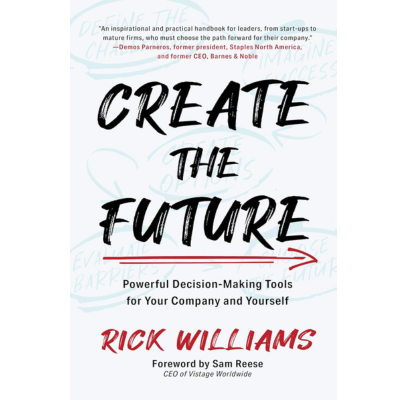
Podcast 1280: Create the Future: Powerful Decision-Making Tools for Your Company and Yourself by Rick Williams

In this episode of Inside Personal Growth, host Greg Voisen sits down with leadership expert and author Rick Williams, whose book Create the Future: Powerful Decision-Making Tools for Your Company and Yourself offers a practical, human-centered approach to making better choices—both in business and in life.

Rick’s message is clear: the future isn’t predicted, it’s created by the decisions we make today.


Meet Rick Williams

Rick Williams brings decades of real-world experience into his leadership philosophy. He is a former management consultant, founder of an award-winning real estate development company, and has served on multiple boards of directors. Today, he works with leaders who want access to high-level decision-making tools without relying on expensive consulting firms.

His work focuses on helping leaders slow down, ask better questions, and create environments where smart decisions can emerge naturally.

Learn more about Rick’s work at Rick Williams Leadership.


The Core Idea: We Create the Future Through Decisions

At the heart of Rick’s philosophy is a simple but powerful idea:
every meaningful future outcome is the result of decisions made under uncertainty.

Many leaders believe their job is to have the right answers. Rick challenges that assumption. Instead, he emphasizes that leadership starts with asking the right questions—and being open to the possibility that your first instinct may be wrong.

This mindset shift alone can dramatically improve how leaders approach complex challenges.


The Create the Future Decision-Making Framework

Rick introduces a practical framework that leaders can apply daily:

Ask → Discover → Learn → Decide

Rather than rushing to conclusions, this process encourages leaders to:

  • Clearly define the decision that needs to be made

  • Ask thoughtful questions and listen deeply

  • Learn from diverse perspectives and experiences

  • Make an informed decision aligned with goals, values, and risk tolerance

This approach helps leaders avoid costly mistakes while creating clarity in moments of pressure.


Leadership Lessons from Sailboat Racing

One of the most compelling parts of the conversation comes from Rick’s experience as a competitive sailboat racer.

On the water, decisions must be made in real time—often with incomplete information and changing conditions. Leaders must balance preparation, teamwork, strategy, and decisive action. There’s no room for ego, hesitation, or ignoring input from the team.

Rick draws a powerful parallel between sailing and leadership:
great leaders prepare carefully, listen to their team, and act decisively when it matters most.


Why All Ideas Matter

Another key insight from the episode is Rick’s belief that all ideas are worth hearing.

This doesn’t mean every idea is implemented—but when leaders create psychological safety, teams are more willing to share insights, challenge assumptions, and surface better solutions. Innovation thrives when leaders acknowledge that they may not have all the answers.

The result? Stronger teams, better decisions, and more resilient organizations.


A Real-World Example: Leading Through Crisis

Rick also shares a powerful case study of organizational transformation during the COVID-19 pandemic. By bringing leadership teams together, using collaborative exercises, and focusing on shared goals, a traditional in-person conference business successfully reinvented itself as a digital platform.

The takeaway is clear: when leaders involve their teams in meaningful decision-making, even crisis can become opportunity.


Why This Conversation Matters Now

Today’s leaders face unprecedented challenges—from AI-driven change and economic uncertainty to shifting workforce expectations. Rick’s approach offers something rare: a calm, thoughtful method for navigating complexity without panic.

His advice is refreshingly simple:

  • Slow down

  • Listen more

  • Accept uncertainty

  • Make decisions with intention


Explore Rick Williams’ Work


Final Thought

Leadership isn’t about certainty—it’s about choosing wisely when certainty doesn’t exist. As Rick Williams reminds us, the quality of our future depends on the quality of our decisions today.

If you’re a leader, entrepreneur, or professional navigating complexity, this conversation—and Rick’s book—offer tools you can apply immediately.

You may also refer to the transcripts below for the full transcription (not edited) of the interview.

[00:00.5]
Welcome to Inside Personal Growth podcast. Deep dive with us as we unlock the secrets to personal development, empowering you to thrive. Here. Growth isn't just a goal, it's a journey. Tune in, transform and take your life to the next level by listening to just one of our podcasts.

[00:20.0]
Welcome back to Inside Personal Growth. This is Greg Voice and the host of Inside Personal Growth. And for all of you watching on the screen right now, with YouTube on the other side of the country, I'm here in Encinitas, California, close to San Diego, is Rick Williams, the author of a great book we're gonna be talking about Create youe Future.

[00:43.0]
He's in Boston. Good day to you Rick. How you doing? Hey, I'm doing great. Great to hear from you. Well, it's good to have you on the show. You and I did a pre interview and I was really impressed with what you are talking about in your new book.

[00:58.1]
But I'm going to let the listeners know a tad bit about you. Rick. He has got this new powerful book Create the powerful decision making tools for your company and yourself. Rick brings remarkable blend of experience, to our conversation today.

[01:19.4]
He's a former management consultant with Arthur D. Little from founder of an award winning real estate development company and he served on multiple boards of directors. And when you go to his website, RickWilliamLeadership.com that's RickWilliamLeadership.com you can find out a lot about this.

[01:41.9]
But what makes Rick really approach truly unique is how he's distilled decades of top tier consulting wisdom into practical, accessible methodologies that leaders can use without paying millions of dollars or consulting fees.

[01:57.8]
So in this book, Create the Future, Rick presents a structured five step process which we're going to get into for making the critical decisions that shape our organizations and our lives. So we're going to give that to you today for free. But we'd like for you to buy the book.

[02:14.5]
So click down below at the link and buy Rick's book. You'll see it's going to Amazon. We'll also have a L to Rick's website. His approach is built on three powerful convictions. That we create the future through our choices, that we can learn from others and that our decisions should express our goals and risk preferences and values.

[02:37.9]
So what I've kind of found compelling about Rick's work is his emphasis on Create the future thinking, which is this discovery and learning process that helps leaders step back from certainty and ask better questions and make more meaningful decisions.

[02:56.5]
And boy, in today's ambiguous, uncertain world, this is what we all need. So through our conversation today, we're going to explore Rick's methodology, dive into real world examples like transformations of IDG during the COVID 19, and discuss how leaders can build high performance teams and become creative engines for innovation.

[03:21.1]
Well, Rick, welcome to the show. It's a pleasure having you on. And before we dive into this, you were with a consulting firm. Then you did this real estate gig, and you distilled this wisdom into Create the Future.

[03:39.2]
Can you share with us kind of a pivotal moment or experience that made you realize that leaders needed a methodology, they needed a book, they needed your consulting. And what compelled you to write this book now?

[03:56.8]
Well, Greg, after hearing all of this, I'm going to go surfing or something like that and leave all of you. Surf in Boston? Is there any surf in Boston? I'm thinking about where you are, but, you did such a great job of talking about, you know, who I am and this and the principal takeaways from my book, Create the Future.

[04:23.4]
I don't think I have any, anything left that I have of any value to say to anybody. I think people should just, you know, I, I'm going to rest on what you said. I'll fold my cards right now, but answer your, answer your question. Well, don't do that, because that's going to make for a very boring podcast. This is supposed to be a dialogue.

[04:45.3]
Anyway, to answer your question, I, so first of all, I, as you said, spent 10, 12 years consulting with very high level people, both in the private sector and the public sector, and then founded and ran a company for many years doing real estate investment and development.

[05:06.2]
And I, went through a period of going back and saying, okay, what do I, what, what do I want to do now? And I kind of went back to very senior level executive advising and started again writing. I've always been a good writer.

[05:23.2]
I've written a lot of articles, been published all over the world on how to be a more successful leader. And, you will appreciate this. People eventually say, and I've also been doing a lot of speaking and this sort of thing. People will say, okay, Rick, but have you written a book?

[05:42.2]
Yeah, I have now myself. Well, okay, I, mean, if I haven't written a book, does that mean you shouldn't be paying any attention to me? I mean, why are you even asking a question like that? And I think I've written lots of books, but you Know, you can't buy one on Amazon, they're sitting on somebody's shelf somewhere.

[06:00.6]
But anyway, so I thought about well what do I have to say that would really, that would be worth putting the effort in, that would contribute to the leadership dialogue. And as I thought about it and I spent some real time thinking about this, I realized that in most of the times that people were asking, me and my consulting teams to come in and help them, they were really asking for help and making important, important decision that was before them.

[06:40.5]
What should they get involved with buying this company or what business should they be in? Or a lot of the work with, very high level government regulations. Should they be going with this regulatory approach or that regulatory approach?

[06:57.4]
And they didn't often, though sometimes they did, but they didn't often say, Rick, we really want you to come in here and help us make this decision. But that in fact is what they were doing. And as I look back at it, I said, you know, if, if you're a company, a leader of any organization could be a nonprofit or a government agency or mid size or smaller company that doesn't have a half million dollars to spend hiring an outside, big outside consulting firm, Deloitte McKenzie or someone like me in a former life, Bernstein, you know, you don't have the sort of methodology, and principles easily available to you that the big consulting firms are going to bring in when they are working with clients like that.

[07:46.7]
And so that's what this book is about. And as you said, I hope, and at least anyway I hope I'll say it as well as you said it, but anyway, it's based on the principle that you do create the future for your company and actually for yourself as well, but you create the future for your company by the choices you make today, by the decisions you make today.

[08:12.3]
So what create the Future, the book, does it provide you? It's really in some ways a guidebook, a handbook with the principles of decision making and the steps you should go through.

[08:29.2]
I recommend that you go through when you're faced with a difficult decision. And you mentioned that there are five steps and I can go through them in a minute, but yeah, we will. But you know, that is a good summation of what you've written.

[08:45.2]
I love the joke about the fact, well, should I hire you because you haven't written a book? No, you should hire me anyway because I have experience, I have wisdom, I've been here, I've been in the trenches, I've Done this, and that's a good thing. You know, I'm reflecting on a couple of things right now.

[09:02.7]
You know, we're. We're living in a time where you have to look at ambiguity, you have to be flexible. You know, we have all this Six Sigma stuff that everybody can follow and try and make decisions. And I think a lot of that is, And I was telling you about Dr.

[09:19.9]
Jim Lore. People are trying to actually connect to their inner Yoda. You know, what's inside, where am I getting this? And you have this amazing background as sailboat racing.

[09:35.7]
And I know another guy who sailboat races, and he went for a gold medal, and he started a company called Goalscape. And I do know that being someone who has commanded or, worked with sailboats, you said you'd be writing.

[09:52.4]
Everything I know I learned about leadership from a sailboat. I would say there are so many lessons from a sailboat or climbing a mountain or doing anything that you could teach people. It's about teamwork. It's about being able to determine where the winds are and the direction you're going and all that.

[10:11.3]
Can you share a specific moment on the water that fundamentally changed how you think about leading high performance teams, because, Marcus Barr led a team to the Olympics. They got third place, and he then created this software company that helps people reach, their goals, because that's how he did it.

[10:34.3]
He turned what was on paper in the sailboat into actually a software that helped people do the same thing that sailors do. Yeah. Well, okay. Given that you're in San Diego, I have to tell you that I have wanted to do, what.

[10:51.1]
They've changed it a little bit now, but used to be the Ensenada race, which is a race along the coast down to Ensenada, Mexico. And I've tried a couple of times to kind of make the connection of, getting on a boat and doing that, but haven't managed to actually make it work for schedules and everything else.

[11:11.9]
But anyway, someday I'm. I hope to actually do that. You know, I. I have been racing, my sailboat, a sailboat that I own for, gosh, a long time, more years than I probably want to admit.

[11:27.4]
Right. And I. What I have found, I don't know that it's so much one particular learning ex. Incident of learning experience. But, what happens is that, when you're the leader of a company, you have to think in terms of today, tomorrow, next week, a month, a year from now, two years, even three and four years from now.

[11:55.0]
And you have to be thinking and planning over different timeframes. And I say that you need to have a strategy that talks about how you compete, a business model about how you're going to make a profit, et cetera. Sort of the elements of being successful in a business.

[12:13.3]
Well, on a sailboat, and I'm agreeing with you, it's the same principles that would be if you're, you know, an Indy 500, you going to, or even, even a racehorse at the Kentucky Derby, I, I'm assuming it's all the same, but it's.

[12:30.7]
How do you be really good at putting something together that involves a lot of other people? And on a sailboat you have to, you know, get the right boat for the competition. You're, you're for the sailing, your competition you're going to be in.

[12:46.8]
You have to recruit a winning team, you have to put the right sails on the boat. There's a whole lot of stuff I could say about that. And then you have to train the team and you have to train the team. Absolutely. Train, absolutely. And so these are all sort of preparing things, boat sales team, et cetera.

[13:11.1]
And then when you get out to do a race, and it may be a race that's a one day race or a five day or even a 20 day race, you have to have a strategy for, develop a strategy that you're really clear about. How are we going to race from Newport, Rhode island to Bermuda, going across the Gulf Stream.

[13:30.9]
And it's an incredibly complicated process of doing that. How are we going to, how are we going to plan against the wind? So over three, four, five days, the wind pattern shifts. So you, you know, I'm not going to get into how you do that, but you, you have to be sailing against the, the changing winds.

[13:50.2]
And so you have to have a strategy and then you have to have a way, you know, a boat that it's capable of, your team is trained to be operating absolutely top performance for the whole time you're doing the race right. And that, and that is just getting started.

[14:06.5]
You haven't even started the race yet. And then during the race you're executing on your plan, you're keeping your team focused and motivated. They got to eat and sleep and all this other stuff. You are faced with having to make very important decisions.

[14:23.5]
Okay, do we tack here? Do we cover that boat? You know, what about this wind? It's not doing what we expected to do. What do we do now? So it's that Decision making under fire, on the water. And all of those are. And the team that's on your boat, and this is so important, the team that's on your boat are human beings that they have their own hopes and fears, they have different personalities.

[14:50.0]
How they fit into all of this and being able to keep them, it's not just focused, but getting the people, given how they are different from each other, engaged with the whole process of winning the race is exactly what you're doing every single day in your company.

[15:10.2]
And is it one of those things, getting the egos out of the way? We have to work as a team, so kind of have to remove the egos that might pop up and make somebody else angry or upset at one another. Especially if you're doing a five or six day race and you got a couple of people out there that are pissed off at one another because they did something wrong.

[15:30.4]
I think Rita McGrath said it in a book. She was on this show, a famous, professor trying to remember which university she's with. But she said, you got to see around corners. And I always thought the seeing around corners thing is preparing for the future.

[15:47.5]
It's like looking to see what's coming at you. So you know, whether you're relying on wind patterns from the weather service that's feeding it to you through your squawk box, or you're looking at the map that you've got.

[16:02.6]
All those things have to be coordinated together to execute if you're going to win, if you're not going to win and you're just going to sail and you're going to casually sail down, doesn't really make a hell of a lot of difference. But if you're actually trying to win, every one of those little things makes a difference in the speed and how fast you go and how much food you put on the thing and how much weight you've got in the boat, everything.

[16:27.2]
So I get that it's like a Formula one vehicle. It's the same kind of deal, you know. So I think that we should talk with the audience about create the future thinking process. Now you say ask, discover, learn, decide.

[16:49.5]
Now, it seems deceptively simple. Okay, it does. Yet you say that it's transformative, right in nature, which it is. But I think anybody who's got curiosity needs to have the big ask and they have to want to discover and they have to want to learn.

[17:08.6]
And then after they take that learning, they have to make the best probable decision there is. Most CEOs are curious. Just by nature, they're curious. So can you walk us through a real world scenario where this four step approach prevented a leader from making a costly mistake or revealed an opportunity that would have otherwise been missed?

[17:34.2]
Because they use this create the future thinking. Wow. Okay, I have to confess with you. I'm going to think about how to answer this question because I'm going to answer it first by talking about what I think the power is in that ask, discover, learn, decide, process.

[18:01.7]
Because you're right, it's easy to say that. And you could say, well, like what in the heck does that even. Why would that be of any value to me? Why'd I write a book to tell people that? I can just tell them that. But that's not true.

[18:17.7]
You guys, everybody out there, you gotta get it right. Exactly. So, so let me just, let me just pause on, not pause on, but just talk about this for one second. So first of all, I am surprised at how hard it is for people to ask a simple question, which is, what is the decision I have to make?

[18:41.5]
My job as a leader is to make decisions. And the idea that ultimately you have to make a decision about something having to do with whatever the challenge facing you, I want to put on the board that getting the fact that that is the goal you're driving towards is a very important concept to get clear about.

[19:05.4]
And so then I go back to the beginning part of it and that is, I know you know this, but Jack Welch was famously said, I don't need to be the smartest person in the room. I don't want to be the smartest person in the room. What I need to do is ask smart questions and.

[19:24.8]
And surround myself with smart people. Yes, and surround myself with smart people. Exactly right. So put those two ideas together that ultimately your job as a leader is to make decisions. And the way that a smart leader begins is not by shooting their mouth off about, what they think, but by asking a question.

[19:48.2]
And you're asking a question and you're discovering what you find in that answer. It's discovering, you're discovering by listening. You've got to listen to what people are saying to you. Now often what happens is, you know, you might be, want to hear from your director of R and D, and that person is going to come in and give you information that's going on, where the technology is at the moment.

[20:13.4]
You are trying to make a decision about whether you allocate funds to his project or whether, you know, whatever he's doing is going to come along in a timely way to support the product you want to launch, that's fine. So he may not be coming in with exactly the right information, but you will learn information if you let yourself listen and discover what A, that person is saying and then B, what the implications of that are for what you are trying to figure out.

[20:45.2]
So it's ask, discover, and then what am I learning? What did I actually learn from listening to this? And then integrate that into your thinking and then decide. That's the step. Ask, discover.

[21:01.4]
What did I learn here? How does that change my thinking? And then make a decision? And that's not. The whole book is not about that, but it is a recommendation I'm making for sort of the normal way you do things when you have, any normal problem, dilemma, challenge decision you have to make.

[21:26.6]
First of all, think about what do I actually have to decide here? Am I the right, do I have to decide this or should somebody else be deciding this? Okay, what is it that has to be decided? And then go back and ask questions. What, what can I, if I ask this person, you know, how do they, what do they think is happening here?

[21:45.8]
And then learn from what they're saying and then, and then, discover from what they're saying and then learn and integrate that into my own thinking as it influences the decisions I'm making. That's how the process should work.

[22:02.0]
And it can work. It's something you can use every single day of your life. It's just. Yeah, I think it's circular in nature. Right. In other words, if you start with ask and you go to decide and you have the discover and the learn in between, you're hoping that you're making a more educated decision.

[22:22.8]
Right. You know, in the insurance world they call it predictive analytics. In many worlds they call it predictive analytics. So I'm taking data, I'm talking with that person, like you said, from R and D.

[22:39.0]
I'm talking with somebody else from sales, I'm talking from somebody else here. I'm getting input. That's where my learning is and discovery. And then I'm making my decision. And I'm hoping that decision is going to further the company, further the employees, and make this place a better place.

[22:55.5]
Now the interesting thing was I had a gentleman on here yesterday, was a, he does a leadership consulting as well. And I want to run this by you real quick because I wrote these down. So he, at 14, he came from India, he studied under the Dalai Lama, actually was taking classes from the Dalai Lama.

[23:19.5]
Okay. And his perspective is quite unique, but one that I think the listeners actually might want to hear. Then I want to take this and lead into all ideas or good ideas, which is your most powerful guidelines.

[23:34.9]
The first thing he says is that he learned all rules are my rules. So give up control. All rules are my rules. Give up to two. Two, I am responsible for everything. Three, this is the way the moment is.

[23:51.6]
There is no other way. In other words, we can't change is the way it is. Four, he goes into more spiritual stuff. I'm not the body, I'm not the mind. So in other words, he's removing himself from the situation. And, those were some lessons that I thought were unique from a spiritual standpoint.

[24:12.8]
But to actually get to the most powerful guidelines that you say, all ideas are good ideas. Now this is where this is leading to. If you can tap in into this intuition. So Warren Buffett and Bill Gates and Steve Jobs, every quote that I pulled up because I wrote a book on intuition, okay, Was listen to your intuition.

[24:40.1]
Those are the ways that I made the fortunes that I made doing what I was doing. So with that in mind, it seems like this must be changing for leaders who are used to being kind of the smartest people in the world in the room.

[24:59.5]
What advice do you have for leaders who struggle to create the psychological safety where team members feel free to share unconventional or ease in crazy ideas? So the idea emanates from intuition.

[25:17.3]
It comes down through me. I share my idea and then, pardon me, but Rick, you say, well, Greg, that's the stupidest effing idea I've ever heard. Right? All right, so how many people who are inventors or whatever have heard that yet?

[25:37.2]
Then their idea goes on to make billions of dollars or whatever it is? Tell us why all ideas are good ideas. Well, okay, so there's both, as both a acknowledgement, a celebration, I think that all ideas are good ideas.

[25:56.4]
And then the question which you're also raising is, what is your responsibility as a leader to allow, permit, encourage a flourishing of ideas that you and the other people you're working with can, can gain value from.

[26:15.5]
Right. So I, I, I'm going to go back to, another, another point that I try to make in that. And that is that it. I, I think one of the, one of the fundamentals that I have to accept as a leader is that I, might be wrong in what I'm thinking.

[26:35.3]
I might be wrong in my first instinct about What I think we should be doing here, I might be wrong in how I've thought about dealing with this problem all the way up to this exact moment. I might be wrong. Now, let me ask you this.

[26:53.1]
I'm sorry to interrupt, but this is an important point you're making. How many leaders that you've worked with over all this big career, when you first started working with them, before you started working with them, ever thought their ideas were the wrong ideas?

[27:13.2]
Probably very few. Yeah. And what did you do, Rick, to help them understand that maybe there was a better idea, that someone else had a better idea? Yeah. No, I. So, to be really clear, you know, on my sailboat, when we're out in the middle of the Atlantic Ocean, the team on the boat is depending on me to make decisions.

[27:40.4]
To make decisions. Here is what we're going to do, and they're going to act on that. They're going to carry through and launch a spinnaker or tack the boat or take the spinnaker down. So as a leader, I have to be prepared to act with great confidence.

[28:01.2]
And I hope. I do know. I hope I make the right decision. But my job as the leader is, in fact, to say, here's where we're going. Here's what you have to do to make sure we do this properly, et cetera, et cetera. That is my job as the leader.

[28:18.8]
I'm not in any way taking away from that when I say that as a leader, I also need to have in my mind as I walk into the meeting that my instinct for what we should be doing might be wrong. And at the end of the meeting, I'm going to make a decision.

[28:38.2]
I am. As my job as the leader, I will make a decision. Are we going to sell this product or raise these funds or whatever it is we're going to do? Are we going to do it? I will make that decision. But when I start this discussion, I will.

[28:56.1]
I will be. I will. I will make a better decision. If at least in the back of my mind, I'm saying, I'm going to be open to hearing what other people have to say. And I'm going to consider that as part of my decision making. That is going to be saying, that's the part I was trying to get at with you.

[29:16.8]
Yeah, you were open because, look, and you go back to the command and control days of being in corporations. It was my way or the highway. As things have evolved, you and I are not that far apart in age. We've Seen changes in the area of fuzziness.

[29:35.3]
I'm just going to call it fuzziness, but the opportunity to have inclusion, the opportunity for others to be heard. It wasn't like I just made a decision. Now, you guys follow it and walk off the cliff with me if that's what happens.

[29:50.4]
There's gotta be a better way. And I get that. So you emphasize that few decisions are inherently right or wrong. They're only right or wrong in relation to the goal, the risk preferences, and the values.

[30:08.9]
So how does this perspective change the way leaders approach their difficult decisions, particularly when their board or team members have firmly held convictions? Or I should say, conflicting views.

[30:24.6]
Right. It's like, okay, I, got a guy over here. He's going to be a pain in the ass to me, but I got to hear him anyway. But I'm really not going to listen or do anything to what he has to say because he's just conflicting. Because he wants to be a pain in the ass. Yeah, well, no, I think there's a really good point.

[30:43.8]
I'm just going to just say one quick thing, and that is that, the way, in my book, the way the leadership team exercises are set up, it's kind of assuming you're in a conference room with a whiteboard and people have come together to talk about whatever, you know, what would success look like, for instance?

[31:07.8]
And I just want to say, so it gets said very clearly that if I'm the leader, I'm making two recommendations. The first one is sit down in your chair and have somebody else standing at the whiteboard.

[31:26.0]
So it's, you can be a participant and not the one who's sort of judging what gets written on the whiteboard or not. The second one is, I think it's very important that everybody who speaks up, you acknowledge what they've saying.

[31:41.6]
And I think it's important that whoever is standing at the whiteboard write something about what they said on the whiteboard. Now, whether you're literally, using a whiteboard or not is not relevant. But acknowledge that what they've said because that then, assigns value to it.

[32:00.7]
That that was important, that what they said and what they've said has been heard. The other, I'm just going to say one more quick thing about this. And often there are people who, you know, for any number of reasons, they tend to be not, you know, we all know that the hyperactive.

[32:16.7]
I want to, I want to hear, I want you to hear what I have to say. There are Other people who are not like that. And it's important that you say, well, Mary, what do you think about this? You've had a lot of experience here. I think we should understand your perspective on that.

[32:33.1]
Encourage people to participate, even though they may, for any number of reasons, including just their personality, be less forthcoming about. I have a great idea and I want to make sure it's up there on the whiteboard.

[32:49.4]
As the leader, you also should be, should be encouraging people to come in and validating what everybody's saying. I agree. I mean, now, you know those whiteboards are frequently used by expensive consultants that the CEO has hired.

[33:06.1]
Yes. To be the third party to write it on the board so they could be heard. I heard it said this way, though, Rick. And maybe this will put it in. You know, no matter what you've done all your life, whether you've used profiles or assessments to determine where people are.

[33:22.6]
So let's say you use the disc. You've always got the eagle in one quadrant, right. You have the owl in the other quadrant. You have the parrot in the other quadrant. And you have the dove in the other quadrant.

[33:38.3]
Now, when you think about those birds, right. Legal is the CEO, he does have very little attention. And before you know it, he's flown away. He's like, I'm gone unless. But what it's been said to me is you let the parrot talk because the eagle is getting information regarding that.

[34:01.1]
Now, I know that analogy may sound weird to you, but an owl is somebody who kind of sits there and takes it all in. Right. And so each one of the personalities of those birds are in the room. Okay. So my question for you. Yes. You're including them, you're taking their information in and you're assessing it in this decision making process.

[34:23.4]
That's part of the discovery. The discovery is, you know, you're taking it in. So I have a question for you because I told the listeners we'd get here and I don't want to run out of time. You had this story of Muhammad Ali transforming IGG into a digital platform company during COVID 19 in relation to our.

[34:42.3]
In, using whiteboard exercises. Just what you said, what made those collaborative sessions so effective when many traditional strategic planning processes failed? And what can you learn from how we engage this team during such turbulent times?

[35:00.9]
I mean, let's face it, COVID 19 was horrible for almost every business. But, you know. Right. Yeah. So, it's actually an amazing, amazing story that, I got to know him during COVID and then we talked about this afterwards of what he had gone through.

[35:23.9]
It was actually during the time I was writing the book. So IDG is by far the world's largest convener of technology companies. Technology as it advances, that they, prior to Covid, were running conferences literally all over the world where people would come in that those conferences are where they'd make the announcement of the, you know, the next spec technology launch in the market.

[35:52.8]
They're meeting all these people and they were basically were a conference company, a very large international conference company. I know now he was. And he was asked to come in and become CEO of the company very shortly before COVID And what he was saying is, gee, yeah, we're doing all these conferences.

[36:14.4]
What we have is we have access to all of these people. We could become more of a digital platform that, through our digital platform, allows people to connect with each other and have that as a valuable, revenue and profit contribution to the company.

[36:33.5]
And when he first started talking with the senior people at the company, they said, you know, we're kind of coasting along doing these conferences. What we do, what we know how to do. You know, I don't know, should we really do that? And there was a lot of sort of reservation about doing it.

[36:51.1]
Covid shut them down as a business. And what he did is he then said, hey, guys, our survival depends on this. Let's get together and talk about what we can do at this point. And so he brought people together in these whiteboard exercises of, gee, what are our capabilities?

[37:11.6]
What are the options we really have? What can our customers. Our customers would see value in what we could offer them? Where do we see our strengths and weaknesses? What do we want to look like, look at. So he did a whole series of these leadership team whiteboard exercises, developed a strategy for relaunching the company as a digital platform.

[37:36.3]
Not, not as in person conferences, but as a digital platform. Right. You know, they worked it through during COVID got it launched during COVID and they've come back to be fabulously successful as a digital platform, company that they weren't before.

[37:53.9]
And he, the way he did it was to bring leadership, the senior people together to talk about who they were, where they wanted to go, listen to them, formula. I mean, he was not a domain expert in this. He had worked, I think, for McKenzie.

[38:10.5]
I think he'd been a partner of McKinsey before he, became CEO at the company. So it was a fabulous, example. It's a Great example. Bring the people together in the organization to learn from each other, hear what each other is talking about, overcome their own fears about, you know, gee, where we are and what can we do, and then come up with a plan that created an entire new company and value proposition for the company.

[38:40.4]
Well, and also think about this, Rick. People don't really realize it, but, idg, and I knew him really well, because I did a lot of consulting in that space. They basically saved their customers hundreds of thousands of dollars when they went digital.

[38:58.8]
So the end result, while it might have been tough to go through the process to get to the other side, it was the right decision to make. You and I here today on Zoom, was a result of COVID Prior to this, there was no Zoom.

[39:16.9]
There were other platforms, but they weren't very good. So when you think about the companies that have been born as a result of it, it is fascinating. And you look at the companies that are thriving, all these places that you've got Uber Eats and all these things that are running still today.

[39:37.7]
The Dash one. So it's really very cool. Now, look, I, want to talk about, these leaders in this rapid technology change. We're in the midst of an AI revolution, probably the best way to put it.

[39:56.4]
And as you look at the challenges facing leaders today, rapid technology change, economic uncertainty, generational shifts in the workforce, boomers aging out. How does this create the future?

[40:12.0]
Methodology. Help them navigate all these complexities, Rick, that seem pretty unprecedented now. They seem unprecedented. I'm not certain that they are. So what advice would you give a leader who feels overwhelmed at the pace of change?

[40:30.5]
And hopefully they're not paralyzed. But if they paralyzed, what about the future? Should they choose to do? Wow. Profound question. Big question. You knew you were going to get one like that, so I slipped it in there before the end of the show.

[40:51.6]
Yeah, now I'm agreeing with what you're hinting at. That. I mean, think of what people went through during the Depression and the Second World War and the Civil War. I mean, yes, we've been through enormous change, before, and we're going through another era of change.

[41:13.1]
So I'm not saying, it's not frightening in many ways. Exciting, challenging, certainly, but it's not like we, you know, we are human beings, but we will learn to adapt to what's going on.

[41:28.5]
So I would argue that My contribution to all of this is simply to say you're going to be constantly faced with difficult Decisions you have to make. And there are five steps you can go through.

[41:48.7]
Again, I'm not going to repeat them all here. And they don't require, they don't require that you every time, get your leadership team together, your board's a director, and do all these. In my book, there's like 25 or 26 leadership team exercises you could do.

[42:05.3]
But what I do suggest is. Can, we pause there for a second? I think sure, go ahead. Those leadership exercises in your book are really critical, whether you only use part of them or all of them. I know for many leaders listening today, they're going to say, I don't have time to put all my leaders through.

[42:24.5]
That's a bunch of bullshit. Just pick out one or two of Rick's leadership exercises and I'm going to encourage all the people who are LinkedIn that are mid level managers or high level managers right now. Use Rick's book as a tool, almost like your reading club.

[42:43.6]
Give it to your top executives. Go buy cases of these at a time and use the exercises in the book to help your leaders be better decision makers. You will fundamentally shift. Like Rick said, he's given you a gift where you don't have to spend a half a million dollars.

[43:00.2]
Here, you can spend whatever the cost of the book is. 18.95, $21.95. I don't know what the price of the book. It doesn't matter. The point is you can spend $200 and you can have this at your fingertips. The other thing I'm going to encourage him to do, Rick, before you answer this really tough question to answer is you can go to Rick's website.

[43:22.5]
So it's rickwilliamsleadership.com you can contact him, and I guarantee you that via Zoom. If you want to do a session with Rick and your top leaders, he'd be more than happy to do a session with him over Zoom, for you guys to learn how he's applied this.

[43:41.9]
Obviously there's a fee for that. You can discuss that with Rick. Now, Rick, back to the podcast because the commercial's over. How are you going to help these people who are dealing with this and they're feeling like, I can't do this anymore, you know?

[43:59.6]
Yeah, no, I, I, I, I think it's, I'm just going to echo what you said, which is, you know, first of all, calm down, take a breath, walk around the block, get on your sailboat or whatever it is you do to, go fishing a little bit.

[44:16.7]
You know, calm down. And I, I, I'm agreeing with you 100%. Nobody is going to go through 25 exercises. I'm not in any way suggesting people do that. But you just had to fill the book.

[44:32.6]
What? Well, no, the problem is that or the reality is that people will have different stress points, depending on what their particular situation. It may be that they haven't thought carefully about what the barriers to executing on the plans that they have are.

[44:54.5]
So there are exercises about how you think about the execution risks. They're team exercises on that. What I found in talking with people, after the book was written is that, one, people are not really clear about what decisions they have to be they have to make.

[45:16.9]
And getting clear about what do I actually have to decide here is almost counterintuitive to a lot of people. I don't know why it is, but it is true. And as another example, it's turned out to be that the idea of thinking about what success would look like, what do we really want to have happen if we're going to say this is a great success, is a very powerful, unifying concept for people to work on.

[45:47.8]
So, I mean, I'm just picking two examples of those. So it's, now it may be that, you know, somebody needs to fundamentally work on why is there, why is there an opportunity and is it going to be lasting or not?

[46:03.7]
Do we really understand, Are we just reacting to, you know, the impulses of the moment? So figure out what is the thing you have, what is the problem you have to, most importantly address today and spend your time focused on that, make sure you get that right.

[46:19.3]
And, and anyway that's, and take a walk around the block or, and just relax, pause to take the time to get it right. Well, I think the advice you give is so practical in nature, yet when people are caught in the throes of either teamwork or decision making, and they've got time constraints and they've got everything else, I think frequently what happens, Rick, is that they, they basically choose to, you know, what is that old statement?

[46:56.2]
You probably remember it. No decision is a decision. Yeah, right. So how many times do you think in a corporation there's just no decision, and they figure they go on to next, but the problem's still there, but they've just moved, to what they think is the next higher priority decision that they need to make because they didn't have time to weigh out all the other things regarding that decision.

[47:22.1]
And then when they see There's a whole in basket full of those decisions that are still sitting there, right? And they've postponed them because they. Another one came and it was like, oh, my God, this one's more important. Or, this one's more important. And I remember David Allen.

[47:39.0]
David's a good friend of mine, getting things done guy, right? The guy that's written all the books on getting things done. And he says, you know, when something comes across, your transit on your desk, the question is, you need to make a decision.

[47:54.1]
The moment comes across. Now, I know there aren't very many people that do this. It's like, oh, crap, another piece of paper. Put it over there. Put this one over here. I'm busy doing this thing. Maybe I'll get back to this tomorrow for. You know, it's not tomorrow, it's a week, it's a month, it's whatever, until that one raises its ugly head.

[48:12.6]
So I think you bring a very good perspective to this, because if you're sailing a boat, you can't take that decision and put it to the side. It's got to be made now. Right? And that's the thing.

[48:28.8]
They don't feel like they're sailing a boat. They just feel like they're drifting. So the reality is they're not so concerned. I hope I didn't take that out of perspective, but. No, no, Yeah, I agree with you 100%. Yep.

[48:44.2]
Right. It's degree of urgency, degree of concern. How's this going to affect X, Y, or Z? Their minds in the neural pathways are firing, and they're going, ding, ding, ding, ding, ding. They're going, all right, I got to go to this one over here.

[48:59.5]
That one over there. So I think in our world today, because you and I grew up before all this, pardon me, technology existed, you know, we didn't have things dinging at us. We didn't have this. I, mean, we go back to the day of.

[49:15.6]
Before the fax machine. Before there was a fax machine, you actually had to handwrite letters. There was an email. Right? All of those things. When you think about the progression of stuff, you can see why people feel overwhelmed. So I.

[49:32.9]
An author was telling me the other day, he was 82 years old, Warren Farrell. He said, I used to teach this course. Now you get this. And this course is about relationships. He's the big guy on Role Mate to Soulmate. And, John Gray have written books together.

[49:50.4]
Men are, from Wars, Women are from Visa. This guy, and he said, you know, Greg, and he had to explain during the podcast, you'll get this. He said, I got this letter. And he said, for all of you listening, that's when we had to write a letter and hand stamp it and post it.

[50:08.5]
And he said the letter came from the CEO of Walmart saying how great his course was, that he really needed to bring this into corporate America to teach about relationships. The funny part about the podcast was he had to remind the people on my show that there was a time when people used to send letters through the mail.

[50:33.0]
It was the only way they could communicate. So parting words. Greg, do I have a minute to tell you just a very brief story on you do that point? Yeah. A very close friend of mine passed away a couple of weeks ago now who actually lives in Los Angeles.

[50:55.4]
And this week I got a, email from his brother. And his brother is going through his personal effects and this sort of thing. And he sent me a copy, actually took a picture of a copy of a handwritten note I had sent to my friend, gosh, I don't know, five years ago, I don't know, maybe even 10 years ago, basically thanking him for being such a good friend.

[51:25.6]
And it was a, card that I'd written. And he said that Jack, my friend and his brother, had put this card with the most important things to him because he had cherished it so much.

[51:41.8]
And I almost cried just because, it was just something I wanted to say to him as a close friend who I've known for many years, some years ago. And, you know, we really don't understand the impact we have on other people in our lives most of the time.

[52:03.5]
And I think it's just a message to me that kindness and thoughtfulness and caring has to be part of. I mean, I just want to be part of my life and how I'm living and dealing with other people.

[52:19.8]
And I didn't have any idea the importance of this was to my friend Jack when I did it. You know, nobody hardly even asks for your address anymore. So when you and I hang up, I'm going to ask for your address. I'll tell you a really quick story because that was a great story and congratulations for you taking the time to actually write your friend a handwritten note.

[52:44.3]
So quick fast forward here. I told you about Compassionate Communications Foundation I chartered when I started it. I started it around the idea of healing people with life threatening illnesses because my eldest son had leukemia.

[53:02.8]
And I knew that if people would write notes. So I was bold enough, I knew a friend who knew? A friend. I went to Hallmark Cards in Kansas City and I said, hey, will you guys donate money and design the cards and put them in boxes and we'll make sure that people get these cards?

[53:19.3]
And they did. And we expanded this nonprofit into a card writing where people were handwriting notes to people they didn't even know, saying, I hope you get better. I'm encouraging you. Whatever the encouragement note was with a postcard inside that would come back from the patient saying, thanks for your note.

[53:40.3]
And we pre addressed them, pre stamped them, put em in a little box. And the box literally sold for like $25. All pre addressed, pre stamped. Everything was ready to go. And you would receive this kit and you'd go write these people because you'd see them on a spindle on the computer and you go, oh, I want to send one to Mary.

[53:58.4]
I want to send one to Bob, or I want to send one to here. My point to that was this. There was a guy, who did a study, he's still with us, very old now, about the power of distance healing. And he tracked where notes of inspiration and encouragement and thoughts that were being sent.

[54:21.0]
Just the power of your thought, of your energy actually helped transfer their lives. I bet you you remember Bernie Siegel, right? Oh, yeah. So Dr. Bernie Siegel used to tell people to watch funny movies and while they were getting cancer treatments, and when they did, their endorphins would go up, their oxytocin would go up, their body would heal.

[54:43.7]
They'd walk out of there feeling way better than they did before. My point to this story was there is something very tangible about you handwriting a note to someone. That's where all this is going and the power in a handwritten note.

[55:00.2]
And I just want to tell my listeners, I want to encourage them because we're still on right now. Write handwritten notes. If you're a leader, do something special for one of your friends. Go buy him a dinner and handwrite him a note.

[55:15.5]
Send some flowers to Mary. I remember the videos and you do of Herb Kelleher walking around Southwest Airlines giving out M&MS. And saying I love you and hugging people and kissing people. You know, it goes a long way. Yep, it goes a long way.

[55:32.6]
That's what helps build a good team. Right? So for you, as somebody who's helping people make decisions, I think what you've said today is so extremely valuable. With such high levels of wisdom, Rick, I'm going to highly recommend that people out there go to Rick's website, see it below here in the show Notes.

[55:53.5]
Get the book. You don't have to do all 26 exercises. Do a few of them. It'll work. Contact Rick. He really could help you. Anything that you want to say that would help somebody right now shift a mindset and improve their decision making ability tomorrow.

[56:11.3]
What's one thing I would say? Slow down. Approach it from the point of view that what you're thinking today might not be right, you might be wrong. Take the time to listen to other people and you'll make better decisions for yourself and your company.

[56:30.7]
That is good advice. Namaste to you, my friend. Thanks for being on Inside Personal Growth. We'll make sure that this podcast gets promoted all the way to the top. Thanks, Greg. Great being with you. Thank you for listening to this podcast on Inside Personal Growth.

[56:48.8]
We appreciate your support. And for more information about new podcasts, Please go to InsidePersonalGrowth.com or any of your favorite channels to listen to our podcast. Thanks again and have a wonderful day.

powered by

Leave a Reply

Your email address will not be published. Required fields are marked *

Inside Personal Growth © 2025