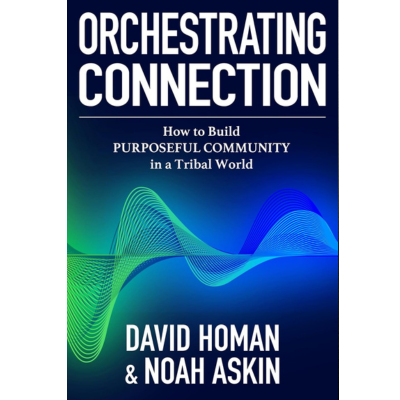
 In this episode of Inside Personal Growth, we welcome David Homan — classical composer, community builder, nonprofit leader, and author of the groundbreaking book Orchestrating Connection: How to Build Purposeful Community in a Tribal World. David is also the visionary behind Orchestrated Connecting, a global ecosystem of over 2,300 purpose-driven connectors who are reshaping how trust and generosity flow through human networks.
David’s life journey is extraordinary — from overcoming a debilitating illness at age 12, to leading an arts nonprofit through the Madoff crisis, to becoming a respected “connector of connectors” across family offices, venture capital, philanthropy, and global impact communities. His experiences shaped a framework that blends empathy, intention, and accountability into one powerful philosophy: connection doesn’t happen by accident — it must be orchestrated.
⭐ The Power of Purposeful Connection
During our discussion, David shared how meaningful relationships are built not through transactions or networking tactics, but through listening, vulnerability, generosity, trust, and gratitude. These five principles create a true foundation for relationships that last and grow.
He emphasizes that reputation is the strongest currency we have. Overpromising and underdelivering damages trust — while accountability strengthens it. In David’s world, keeping your word isn’t optional; it’s the standard that elevates entire communities.
One of the most moving parts of our conversation was David’s story about supporting a friend who had just lost his father. What began as deep listening evolved into an orchestrated set of connections that brought healing, support, and compassion to a grieving family. It’s a real example of how purposeful relationships can create life-changing moments.
⭐ Why Most People Don’t Feel Like They “Fit In”
David also shared openly that for much of his life, he never felt a true sense of belonging. It wasn’t until he built his own community — intentionally, person by person — that he discovered what meaningful connection actually feels like.
His message is clear:
You don’t find your people. You build your ecosystem.
⭐ Introducing SOAR Connect — The Future of Relationship Management
One of the most exciting parts of the episode was David’s unveiling of SOAR Connect, a new platform designed to help people understand, strengthen, and ethically expand their real-world relationships.
SOAR stands for Strength of Authentic Relationships, and it redefines how we think about a CRM. Unlike traditional tools that track emails and deals, SOAR tracks:
-
Relationship strength
-
Time invested
-
Level of trust
-
Meaningful interactions
-
Hidden opportunities within your network
And it does this with deep integrity, privacy, and user-controlled access — a major contrast to the data extraction model of most tech platforms today.
Listeners can sign up for updates and the upcoming beta at soarconnect.ai.
⭐ Why This Conversation Matters
In a world overwhelmed by noise, speed, and digital shortcuts, David reminds us of something timeless:
Human connection is still the most powerful force we have.
Whether you’re a leader, entrepreneur, creative, coach, or simply someone trying to build a better life, the principles David shares will shift how you show up, collaborate, and create value.
⭐ Connect with David
-
Book: Orchestrating Connection: How to Build Purposeful Community in a Tribal World
-
Website: orchestratedconnecting.com
-
SOAR Connect Beta Sign-Up: soarconnect.ai
-
LinkedIn: David Homan
You may also refer to the transcripts below for the full transcription (not edited) of the interview.
[00:00.5]
Welcome to Inside Personal Growth Podcast. Deep dive with us as we unlock the secrets to personal development, empowering you to thrive. Here. Growth isn't just a goal, it's a journey. Tune in, transform, and take your life to the next level by listening to just one of our podcasts.
[00:20.2]
Well, welcome back to Inside Personal Growth. For all of my listeners, David, they, know me. I've been a, a friend of theirs for as long as I can remember. After 1270 podcasts and about 50,000 downloads a month, we are blessed.
[00:39.7]
But this has also been a 19 year journey. So sitting with me on the other side of the screen, and for those of you who are listening on Apple, or Spotify, you don't see us, but you hear us. You're in for a real treat today. David Homan is joining me from.
[00:57.4]
You're in New York someplace, correct? I am. I'm bright in the heart of Manhattan. Manhattan couldn't want it any better. I'm really thrilled to have him on. A really good friend of mine recommended David to come on the show and be on there.
[01:14.5]
And he is someone in my estimation, through his book Orchestrating Connection. You'll see it right there. We'll also put a link, look in the show notes below to Amazon for you to purchase this book. We'll also put a link to his website in the show notes below and I want you all to go to that website.
[01:34.6]
And, the website address is pretty easy. It is orchestrating, connecting. Orchestratedconnecting.com orchestratedconnecting.com There you'll see methodology, events, conferences, member login.
[01:56.7]
You'll also see, information there about David himself about this book. So please go there and do that. So David's the author of this book. It's a 2025 USA bestseller that reveals his proven strategies for building authentic relationships at scale.
[02:18.6]
We all need help with that and I think David's somebody that can do that. He's built a community of over 2,300 global super connectors, including family offices, venture capitalists, impact investors, CEOs, founders and change makers from every corner of the world.
[02:36.0]
In 2024, he launched Soar Connect, a tech platform designed to revolutionize how we build trusted relationships in the digital age. His journey is a diverse one. It's really impressive. He's a former nonprofit CEO.
[02:51.9]
He raised millions for the arts while navigating his, organization through the Bernie Madoff crisis. Today, through his firm, Orchestrated Opportunities, he partners with family offices, startups and nonprofits to create strategic ecosystems focused on mental health, climate change, social justice, and investing in women.
[03:14.3]
And here's something you might not expect. David, is also recognized classical composer with seven albums to his name. You can literally ask Alexa to play his music. And the latest creative projects, explores this, devastating journey of a composer losing his mind to Alzheimer's.
[03:34.8]
Today, we're going to take a deep dive into the science of the art of connecting and how to reframe who you are to build trust at scale and create relationships that matter. Well, David, welcome to Inside Personal Growth. This is where people come to learn this kind of stuff, and I'm excited because you're going to teach me today.
[03:55.9]
As an interviewer, even after 1200 interviews, I think your approach to this is really fascinating. So, really, what got you? We talk about, in our faith as being both guys who are Jewish mavens.
[04:11.7]
And I always say, hey, everybody comes to me because I'm the maven, right? They know my Rolodex is the biggest they can always get. Because I've done tons of work for nonprofits. I've raised millions of dollars for nonprofits. It's like, hey, here's a guy that knows everybody. He can connect me with somebody who can make a donation to XYZ charity.
[04:30.7]
And I want to know what inspired you to write Orchestrating Connection? Was there a specific experience in your life, or it was just the culmination of the music and the arts and working for nonprofits and family offices, so. So that you could really take a deep dive?
[04:47.6]
Because you're one of the only people that I've had on this show that doesn't talk to Orchestrating Connection as an activity associated with a gain over another person. Well, I would say first, Yuri, I'm really grateful for you having me, for our mutual friend Larry making that introduction.
[05:10.8]
For me, the world is only strong, trusted interests. I don't understand a world where it's not a given gift, because if you take something from somebody, they remember it, and at some point, you build up a negative reputation. And since the world is all this study for me of power, how people work, who takes the call, who takes from others.
[05:35.1]
I believe that in the end, those you have taken from you have to be accountable to, or as we build more purposeful community, we can make those people more accountable. And all this theory comes from two really, really hard parts of my life.
[05:51.4]
I don't believe that you form grit and resilience from things being like flowers and, like, running around in Daisy. You know, pads. Like, I think that life happens. You figure out a way to navigate through it, and then you're faced with a choice at each major obstacle you overcome.
[06:08.1]
Do you want to be a victim and a martyr, or do you want to be resilient enough, you can help other people through it now that you've been there. And so for me, I got really sick when I was 12. Bedridden. 6th grade was a blur. I remember hospitals and needles.
[06:24.8]
I don't really remember going. I survived whatever mysterious illness we had. And then I never felt I fit in in any social circle I was in until about 15 years later. And that coincided with taking over an incredible organization focused on the arts.
[06:42.9]
And then, as you mentioned in my intro, those assets were all lost to the Ponzi scheme of Bernie Madoff. So here I was as a CEO with nothing in the expensive city of New York, trying to figure out what my steps were. Having friends, having a career, having a lot of success, but not understanding the larger purpose than the fact I loved what I did.
[07:05.0]
And all that culminated in taking everything I'd been taught and turning it completely on its head. So you and I, as members of the tribe, as mavens, Right. What you were taught in Jewish philanthropy is that you stick with your tribe. You talk to the people who know people who know your cousins, who connect like you, who look like you.
[07:23.5]
And that works to a degree, until you realize that in whether it's a Jewish circle, a Catholic circle, a Muslim circle, an art circle, a climate change circle, everyone who knows each other can't leverage or build more. It's all duplicative.
[07:38.5]
And really these little fiefdoms of people who are incredibly generous, incredibly important, but nothing new comes out of interacting with them. And so I was disgusted by it, by my prospects, by the likelihood I could keep this organization alive, by what my career would be.
[07:58.2]
And I did something completely antithetical to what I had been taught, which in the, you know, the way we joke about it, for those of us that are Jewish, you know, I inverted Jewish geography. Instead of going to people focused on the arts, focused on Judaism, I was like, all right, well, I'm not going to go to that gala honoring this person.
[08:16.1]
Like, Alan Dershowitz was an incredible man and an incredible philanthropist. I met him 15 times this year in events. I'm going to go to the Women in Climate Change with them, the Investing in Black and Brown Founders event, the VC event for fintech and Mid Cap Banks.
[08:32.0]
And I went Everywhere I was not supposed to go. So you switched up everything, right? David, I think, you know, I'm remembering back a conversation with Steven Kotler, the guy who wrote all the books on flow. And one of the things that Kotler said to me, he's been on the show five or six times, was if you really want to shift the neuro pathway of your brain, read something or do something completely different.
[09:01.6]
In other words, go out and read an Architectural Digest magazine. Because you just never read an Architectural Digest magazine. Right. That isn't something that I do. But if you want to get a new perspective, you do. In your case, you said, hey, I'm going to go out to this tech workshop and I'm going to see new people over here.
[09:23.7]
But you're also going to bring, and I want to bring this into this. This orchestrating is so intentional. It suggests harmony, coordination and creativity. The other part is, I want to talk about is this unity principle, this vibratory kind of attunement that occurs when you're around the proper souls.
[09:46.4]
Now that's very, very spiritual in nature, but it is part of who I see you are. So what does this metaphor mean for you personally and how does it shape the way you view human relations? Because you know, when you're very intuitive, when you're very intentional, when you're very creative, when you're working together in harmony, actually the only thing that can come from that is beauty.
[10:13.2]
And the beauty has to be in a way in which you orchestrated these connections to actually do something that you potentially didn't even know was possible.
[10:28.5]
The harmony of this is the most important part and there's a reason why. And this, you know, to clarify, you know, people often think of this as, conducting or composing. Those are different for me. Right. A composer, which I am in my professional life, I write a piece.
[10:43.8]
People have to follow what I say. A conductor, I'm going to lead something. You have to follow what I do. An orchestrator, you set something up from its core principles for other people to follow. It's much more of a humble role.
[10:59.1]
When somebody orchestrates a movie score, in many cases that's not the composer, that's somebody who takes what's there and rearranges the parts to be more harmonious together. And so when you orchestrate people, what you're doing is you're figuring out the different roles they'll have with each other to have that harmony.
[11:18.8]
And in many cases, somebody who's the, you know, the first cellist then becomes a different instrument, a different way to show up in each setting, each community, each interaction that you create and that gives people. You know, we all have these different roles.
[11:34.5]
In some cases we're an alpha. In some cases we're a follower. In some cases we're not welcome. In other cases, where the quick calls, you say no, you move on. Like, we're not all the same. In every way, we show up. Therefore, when you're building community, which is what my focus and my study has always been, it's giving people permission to show up differently for different people, but with intention and purpose.
[11:57.2]
And that's what creates that harmony, you know. So because you have such a diverse background, and as my listeners are hearing your words, they know you're a musician. They know you've been a leader. You had a, nonprofit, you're philanthropic in nature.
[12:17.3]
So those worlds have influenced who David Homan is. And it also is influencing how people connect. And I think probably one of the ways. You just talked about a cellist, you know, there's always a first chair in all orchestras where there's somebody who's kind of the leader.
[12:37.4]
Right. He's the one that the rest of the people besides the conductor are getting cues from. He or she. I don't want to leave out she. How is it that this connection either there's a kind of a failure to connect is what I'm going to say.
[12:57.9]
In other words, where was that occur in your estimation? I know that's a roundabout way of getting to the question, but I hope. No, no.
[13:08.9]
Do you remember, the show Greg Meet the Goldbergs? Yeah. Did you ever see it? Yeah, yeah, I never saw it. I saw the last 20 seconds of it. Pardon me. I'll just say I thought it was a stupid show, but the point was I just.
[13:25.5]
I saw it maybe once or twice, and it was just kind of really silly. I. So, yeah, but you know what? Millions of people watched it. Oh, I know. Thirteen million people, though, would. Would, tune in at 8:57 Eastern and wait for Modern Family at 9:00'.
[13:43.6]
Clock. And the people who watch Meet the Goldbergs are people that I know generally. Everyone who I know mostly love Modern Family, but that doesn't make one more valid than the other. Right. Okay. And so. So there are so many different perspectives and so many different ways that people can or should connect.
[14:02.5]
But the problem is, we would stereotype. We would make something tribal. When that focus is, did you, like Meet the Goldbergs or did you watch Modern Family? Or for you, was it neither. We tend to pigeonhole. And all of this comes from what is the hardest thing for most people to do, which is to open with vulnerability and to be curious.
[14:24.4]
And the minute that you can take. And these are two of the founding principles of a methodology. They're not inherently obviously things I came up with. It's just that when you study how people interact and how you get past that first layer, there's generally one thing that actually builds trust quickly.
[14:41.3]
And that's not a transaction. It's not the right circumstance. It's not being able to sit in yoga retreat. It's your why. It's where you are at this moment, where you are feeling vulnerable and whether you feel you can share it and whether somebody is curious enough to actually help build again.
[14:58.5]
We'll go to that word harmony that, that with you. And it's incredibly hard to do well because most People are either used to saying they're staying shtick over and over again or they're just not willing to take that risk because they fear the judgment of what happens when they actually say how they are more than they feel the passivity of simply not sharing and saying, hey, the weather's good, today's good, my work's going well, my kids are great.
[15:27.2]
And the answer for all that is that's never true. I hope it is. I agree with you. Well, but everyone's kids is going through problems. It's. It's something that we need to address more, avidly and directly. And, and I think the book and your videos that you've got, your website and who you are as a person makes you so great to have this platform to deliver this message.
[15:56.5]
So one of the things that you said is, you've described connection. I'm going to say connection, collaboration. But in particular connection is something that, that needs to be designed. Now most people out there, the only thing they think about is, well, is my CRM full.
[16:16.8]
Did I get an email to message to this person? Have I called them back? Am I going to make a transaction? So you could say in one sense, well, that's design. And you said it shouldn't be left to chance. So what does it mean to orchestrate connection versus simply in my estimation, the other is prospecting and networking.
[16:41.3]
So when people go to these events, I don't care if it's B and I or whatever it is, I don't belong to any of those events. And I'm not saying I'm proud of it, I just don't I don't feel like I fit in. It isn't where I want to go to make a connection, not the kind of connections I want at this stage in my life.
[17:00.1]
So tell me, how do we as individuals design, not leave this to chance? And we know we've orchestrated this versus simply network? This is a million dollar question. Yeah, I don't know if I'm going to give the million dollar answer.
[17:17.5]
Maybe I give like the $800,000 answer. We'll see if I get there. So, it's incredibly complex and incredibly simple. The simplest version is if you could actually say what your purpose is and be able to advocate for yourself when the right people around you hear you, they champion you, and you get more from it.
[17:36.1]
That's what the magnification, that orchestration is. If you can actually do enough self work to say, this is what I'm passionate about, this is what I need, and then you've delivered enough value to the people in a community, not a network, then you have people constantly helping you because they're describing who you are, not what you desire or what you want want.
[17:57.5]
Well, so Simon, that's the simple version, right? So Simon has pushed your why, Gabriel Boes was just on here, the purpose factor, which I think you know these people because, look, you're a connector. Anyone that I would mention, you probably already know, I believe in the assessment that Gabriel, or Gabriela Bosch does at the purpose factor.
[18:22.3]
I think there's so many people that don't know it, so in essence there's no awareness of it. So how do they orchestrate anything if they don't even have an awareness of why they're here? So to get to that, that self actualization, that self transcendence, which is what those incredible luminaries are for your why and purpose, right?
[18:43.2]
That's what you work towards. Networking. You focus on working through people to get to what you think you need in connection. You worked at building with people to get to a goal that is honestly impossible to visualize till it happens.
[18:59.8]
But with a decade of running my intentional community, I could give tens of thousands of examples of what has happened through my network. Because people started with generosity, vulnerability, curiosity, gratitude, and making a diverse network.
[19:17.1]
And they focused on how they could be of service, but with letting everyone know their intention and purpose or what they were working to figure that out as. And so the difference in what the book that my co author Noah Askin and I have written about compared to Sinek and Huberman and Grant and All the people that really are the pioneers in this, Malcolm Gladwell as well, according to the term connectorite, all of these wrote about a very core part of it.
[19:45.9]
I didn't write about a theory, I wrote about an actuality. And that was what this network that I built because I wanted a rule system for our friend to introduce you. He has to say, despite everything you've done in this world, Greg, that he would leave my children with you or he can't make the intro.
[20:05.1]
And I put that standard up there from the very beginning, 10 years ago, that everyone on my network would be a high integrity, action oriented, natural giver. And you are judged by who you put in front of me. Not that I am somebody, but if I'm going to trust them to put somebody else in front of you, there has to be a higher standard.
[20:24.1]
And people don't hold each other to that high standard or work to elevate it together. They simply figure out if they're a peer or they relegate or don't engage. And they miss so many opportunities because they don't think of the network around them as being able to become an intentional and purposeful community.
[20:44.0]
And what I would argue, Noah and I would argue is it's the only thing that makes the world actually beautiful is the community around you. Not when things are great, but when they fall apart. Well, but I think, David, I don't think I know, people who make transactions, okay, Transaction versus a connection.
[21:10.4]
They're looking at a dollar sign. They're looking at, hey, I've got to meet my quota or my goal. You're asking people to expand their consciousness, to look at the way they show up. And you give Five principles of connection.
[21:27.2]
And I think we had a touch on that one is listening. Trust, vulnerability, generosity, and gratitude. Okay, Which of these do you think is the hardest for most people to practice and why?
[21:42.5]
So let's just use an example. You can tell a story because I think people love stories. You know, sales people, marketing people in general have a thrust to get something accomplished to earn the organization and themselves a commission, revenue, wherever you want to do it.
[22:10.2]
We know this is the glue that holds all these things together. On the other hand, we're looking at a huge shift in consciousness to be able to look at it the way you look at it. Okay, I agree with you.
[22:27.4]
Although you have thousands of listeners on the other end of this that need to get how important orchestrating connection is. So which of these is the most hard artist principle? So the answer for that is vulnerability.
[22:43.8]
Okay, but let me, let me just unpack a little bit of what you said at the end. For people to understand, right, the world needs to work based on currency. We all need money, we all need more money. We need that to make our lives work, to give ourselves food and security, health.
[23:00.0]
And we believe happiness in that we spend most of our time earning money. And Those are the things, These are the commodities everyone understands. Then you think about who you work with, who you went to school with, who you grow up with, who you go to conferences with, who you speak with.
[23:18.9]
Those are relationships. These that, that's the triangle for me. Relationships sit above those two commodities. We look to trade to get ahead in life. And we don't value the relationship as much as we should because we don't see it as a currency.
[23:35.5]
But when we start to understand it as a commodity, then it takes away this frou frou. Well, like I need to make my sales quota. Why should I listen to this guy about building community? Because I can go back to it a thousand ways. Is here's where I met this billionaire family office.
[23:50.5]
Here's how I raised money for my startup. Here's how I got this deal through for one of my clients. Here's how I got access that you couldn't buy because I focused on each person, gave them value. By giving them value, they gave me collectively back a greater value.
[24:07.3]
We just don't look at this way or describe it this way because we're looking for the transactional result. What we want is something to be sustainable, which means we have to have the relationship stay even when the transaction occurs. How do you help people, David?
[24:23.4]
Just out of curiosity, because I'm so enthralled by what you're saying, I find and even myself in my history as a very avid marketer, very successful salesperson over the years, someone who in essence didn't really understand this.
[24:48.5]
I mean I understand it more in the middle part of my life, but I understand, and I think one of the mistakes that everybody on this globe makes because they want to be good, down underneath they want to be good, but they over promise, they never follow through on the commitment they made to the other person.
[25:13.3]
To me this is the quickest way to ruin a relationship and to ruin trust. Trust. And was your number two listening? Was your number one. What comment would you give our listeners today about wanting to be good but also knowing the boundaries in which they could work?
[25:39.1]
Your reputational value, Greg, is the one thing you cannot buy, right? No One could do it. People tried. Billionaires have tried. They, they rise and they fall based on what they do, not what they say. Right?
[25:54.7]
So if you can't do what you're going to say, don't say it. And if you can't do it, own up to it, with that transparency. Right? And it is really that simple. I built a reputation in my community for taking every call, for making every intro I can for being transparent when I cannot.
[26:11.8]
Being transparent when somebody won't take the intro. Why, if I can? But when you do it right, thousands of times, you build a reputation where now the work isn't being done by you, it's being done for you. Because giving isn't a zero sum game of the more you give and you give and you give, the more you have to keep giving.
[26:33.5]
But that's how most people who would be described as connectors feel. It's because we don't put the value on the relationship we are giving. Okay, and going back to that initial question, right, what's the hardest one? It's the one that builds that trust. If somebody is vulnerable and says what they need, and then you're able to take an action or get them to somebody who helps them with what they need, you build trust so much more quickly than what, how you would do it if you just worked alongside them.
[27:05.4]
When you can solve somebody's problem, they can't solve themselves, you're able to take what you didn't view as this currency and literally just provide it to somebody else. You just have to be vulnerable enough to share yourself what you're going through to give somebody else the permission to do the same back.
[27:24.4]
Good point. And, with that, I want to springboard to something you said five, 10 minutes ago, which was you said that genuine connection begins with curiosity and listening.
[27:41.9]
I, want you to talk about a time when deep listening basically completely changed how you related to someone or to a group. One of the things that is.
[27:58.3]
And look after 1270 podcasts, I should know more than anyone, although I make the mistake, I listen a lot because that's my role. My role is to ask questions and listen, and get to the deepest level possible.
[28:16.0]
So what happened to you? When was one of these times in your life or story where just your ability to be curious and connect? Because this goes back to Steven Kotler. He said the number one thing is you've gotta be curious, and then from your curiosity, you're gonna find things you like, and then you're gonna develop a purpose, and then from that you're gonna look at your vision and then from that you're gonna develop goals.
[28:40.8]
And he thinks he has a sequence. But it all starts with curiosity and listening. And the listening is two parts. It's listening inside to this inner voice, this one that's intuitive. And it's also listening to the words of David Homan, who's speaking to Greg, to say, hey, I've always said when you write a book, what you want to do.
[29:08.7]
And I got this from somebody else, but I believe it's true. It should be written as if you and I are sitting in a movie theater sharing a bag of popcorn and you're talking to me about the movie on the screen. Yeah, I love that metaphor.
[29:25.0]
For me, it's always like my mother talking to your mother across the kitchen table being like, so what does Greg do? What are those, 1270 podcasts or any of them any good? And I'd be like, I don't know, hopefully 1271's good. And then my mom is like, you know, I'm so proud of my son for doing this.
[29:41.0]
And your mom goes, what does that mean? What's connecting? And like, if they get it, then you actually achieved something. That's the way I always looked at it. I love, I love the movie analogy of watching the popcorn version of your life, and sharing it. Although I did that with my 8 year old the other day and he put so much butter on, I just like, I had to hold my hand like this during the rest of the movie and just like not have it like ruin my coat or my jeans.
[30:07.8]
You know, so the fair answer to your question is I've always been really good at this. But I was so scared to say something back for fear of how I might be seen or heard or responding in a way that maybe is provocative or evocative.
[30:25.4]
And you know, about 15 years ago, I finally stopped caring what people thought of me. And I began to have that boldness to just say, here's what I think you need. And I was out of a spirit of generosity and I was actually able because of the way that I work and the network that I was keeping building endlessly, I was able to be more helpful than I thought.
[30:49.9]
So one of those catalyst moments, I was with a friend of mine. I don't want to mention her name or her son because this is a personal story, but I was with this woman running, she ran a multi billion dollar family office. She's what we would call in the world of this an Alpha.
[31:05.9]
She sat down with me. She had 30 minutes. She asked if it could be 20. And I said, well, if you don't have the time right now, that's, that's totally okay. Like, is there something else you have to attend to? And she pauses. I mean, we only interacted at one event at their offices. And she looks at me, she's like, I.
[31:24.6]
I don't know how to solve this situation. And I go, okay, well, let's not meet to meet. Like, how can I help? And her jaw dropped and she's like, well, I don't, I don't know if you can help me. I was like, well, then you just have to tell me. So I sat and she told me something.
[31:39.7]
And I said, to be honest, I don't think this is what you're asking. This is what I heard you say. That's where the deep listening skill comes in. Yeah, this is what I heard you say that you're not really able to say. And, I said, I think this is what your son. Cause it was about her son. I think this is what he needs, and I think this is who he needs to meet.
[31:59.3]
And I said, you should have let me talk to him and introduce him to one of my most trusted friends I've known for, at this point, like 15 years of my life. And I made the intro. I can get her on a phone any second of any day and no one else can because I helped her kid because of the opportunity I had to work with her, to pitch her to build this Alpha relationship.
[32:26.1]
I threw it out the window because she was going to shortchange her meeting after feeling an obligation to meet me based on who introduced us when really she needed to be a mom. And I helped her kid. Wasn't sure I could know the situation, but.
[32:41.7]
But I made an impact because what she needed was the pause to be supported. She didn't expect the result from him. Interestingly, you mentioned that, I was on with a very prominent author who's written a lot of books on spirituality.
[33:00.7]
And, he had a book signing. And what happened is no one showed up. And he took a little bit of a Buddhist perspective. He was at Powell Bookstore in Portland and the manager said, well, you might as well go back to your hotel.
[33:19.0]
He said, but I flew all the way here from Midwest and there's supposed to be people here you promoted. Well, there's no one here, so, see you later. So as he was walking back to his hotel and I'm telling this story because I thought it was so fascinating. He reflected on emptiness, and his reflection came to is.
[33:43.7]
We've always try and fill the void with something, and it's so hard for us to deal with emptiness, to deal with the concept of there's something empty and it's okay. It's a time for reflection.
[33:59.5]
It's an opportunity to think. I think when your client, this woman, had an opportunity to reflect on what you said, she also had an opportunity to think in a whole new perspective, a whole new way about how she was going to navigate this situation.
[34:20.4]
And this brings me to you spent years helping others. That's what David does. I see that in his body and his eyes and his mind, and, help others form meaningful connections, like you did with this woman.
[34:40.1]
What has your own journey been like? And where were there moments when you struggled to find that same sense of belonging? Until I founded Orchestrated Connecting, I struggled every day with that sense belonging, that is being.
[35:00.8]
Since I was 12. I, still struggle with it, but I don't struggle with it for the same reasons now. Because I didn't find my tribe, I built my community. All I did was say, I love making introductions, I love building relationships.
[35:19.1]
Everyone thinks I'm an extrovert. I'm, not. I'm empathic. But I. I like quiet. I like solitude. I don't want to be the life of the party, but I'll be the life of the room I've curated. Because I thrive on making people better with each other.
[35:35.7]
And until I started to say that and to own that truth, very beginning of that journey was 15 years ago, before I really took. It took him about five years to get to the point where I could say, I. I have something. I should build something. There's something here. Because every time I went to all those random events, I found one person.
[35:53.7]
And it wasn't like the super attractive person at the bar or the keynote speaker everyone was trying to meet. I look, Greg, I'd probably see you, like, talking to some author that was on your podcast at 200 in at that point. And I just see that's a connector.
[36:09.3]
That's, somebody who builds trust is curious. They're not trying to scan the room and figure out who's better. They're just in a deep conversation. They're there to meet and see how it happens. And I kept finding those people. And the Kalos story for founding Orchestrated Connecting was getting this call and this friend saying to me, I don't actually know what you do in your day job, but to me, you're this connector of connectors, and you're my first call.
[36:33.8]
I was like, what does that mean to connect connectors? Then I realized that everyone builds their ecosystem, and they might be in it, they might dominate it, but it's finite. And if I could simply connect those circles together, I would maybe be onto something magical.
[36:52.4]
And in doing so, I created the most important community for my own life. Because I built trust among the trust makers. I named the things that they all knew but never had said out loud. And then I unapologetically built a rule system where if you take from somebody in my network, my network no longer will engage with you.
[37:13.9]
And I built a power based on integrity, not based on finance, not based on access. Because what I wanted to do was solve the problem. I found in philanthropy and investment in everything, which is a whole bunch of people endlessly were sure what they were doing was better than anyone else.
[37:32.7]
And as long as everyone did what they did with them, everything would be great. And look at the state of the world right now with all this wealth, with all this philanthropy, with all the impact investing, look at what it is. It is still a bunch of people in power maintaining control.
[37:50.7]
And every substantial change that has happened to alter that for the better has come from a collective of people wanting something bigger than themselves. And that's been my mission, to make relationship value valued. And in doing so, I found the deepest, most important friendships of my life, including with people who I barely know, but show up for me when I need to because they're part of a community.
[38:17.0]
Well, David, you obviously are operating at a much higher level, than I'm going to say many of the people in a. In our current administration. There doesn't seem a, cohesive ability to unify anywhere, to create orchestrating connections in any way, shape or form.
[38:44.5]
It's about command and control and power. And so what you're also asking people because you've facilitated countless gatherings and orchestrated networks that create impact. What I'd like to know, and I think the listeners would, is do you have one story that best captures the spirit of orchestrated connection in action?
[39:08.7]
You told the one about the lady in the office. Yeah, I think that's good. But I also think. No, I just want to add this, is that people who are listening right now, at this point, if they're still listening to this podcast, they want to make a difference.
[39:29.9]
They have a purpose. They're not just there to take without giving. The whole concept of you saying to that person, hey, If I see you doing otherwise, you're out of my group, of my network, of my whatever you're calling it.
[39:50.1]
I think that's admirable and brave and very encouraging. But if you took the average model that exists today in our world of what people think networking and orchestrating connection is, it wouldn't be anywhere near close to what yours is.
[40:14.5]
You know, Greg, I love that you understand this and I'm grateful for our ongoing friendship and, you know, to keep finding ways to support you as I've learned more of what you need. Everything that I've done has been to solve a single purpose and what the way I framed it.
[40:31.5]
It's still crazy controversial, not the way it used to be. But I want to hold people accountable in how they manage their relationships. Doesn't mean they have to be perfect in their lives. I am far from it. But if I say I'm gonna do something, I'm gonna do it.
[40:46.5]
And if you say you're gonna do something for somebody in my network, you better do it or this isn't the network for you. And people are so afraid to put limits around it. What I say, I'm protecting. Do you not wanna be in a network where everyone is accountable right now?
[41:05.1]
The way, the way the weight of our world is about people who don't have an accountability to anyone else, right? They have an accountability to themselves over promising and under delivering. Don't say it at all if you can't do it. But as I've aged, I'm a bit older than you.
[41:22.9]
I've realized that this has been the de facto for so many people so long that they just say something to be able to get something thing right.
[41:38.5]
They do. But Greg, you or I don't associate with them, right? Because they've proven it to us or people that we trust. And everyone has these trusted circles. What we don't do is we don't draw the line is we think by not drawing it we have more opportunity.
[41:53.6]
Right? And I advocate that we have less. So would you say, would you say, David, that the key to the perpetuation and success of orchestrating connections, of This whole concept is really one of the key points is accountability.
[42:16.3]
It's accountability, but it's opportunity at the same time. I get it. My whole theory of change is that you have to have people be selfless and selfish at the same time. And if you can design something where the psychology is, I keep giving to this because I keep getting from it.
[42:33.4]
I keep feeling guilty. This is the Jewish guilt Part of my inverted Jewish geography. And, by keeping feeling like I need to give more, I'm going to keep getting more. You create a cycle when you have accountability at the core, where you actually get what you need out of something. Right?
[42:48.7]
It's just, it can't be you and I interact and something changes with my book sales. It has to be you and I interact. And then somebody who knows your cousin who's friends with my co author in Irvine just north of you, says, hey, Greg's a great guy, you should really, really dig in and help him more.
[43:04.9]
And this whole circle is impossible to visualize, but once something happens, right, so I'll give you, I'll give you a story that's the, that's in the book. It's one of the most meaningful things I've ever done in my life. And as I am on the stepstones of losing my father, it's even more meaningful because I was able to help give one of my best friends, who's one of my founding advisors, to my startup, Val.
[43:29.2]
I was able to help give him closure. So here, here's this quick story. So just to set the stage, I moved in, to an apartment building in Jersey City, answered a Google group ad with some guy saying, hey, my kid grew too fast.
[43:45.5]
If you want three month old clothes now, come get them. I write back, I go, he knocks, he answers his door. This guy hands me some baby clothes and he's about to shut it and he pauses and he goes, you know what, congratulations, bud.
[44:00.7]
Why don't you come in? He offers me a craft like beer that's been aged and bread pudding. I don't drink anymore, but bread pudding and craft beer were like the weight of my heart. He becomes one of my best friends. I get to know his daughter, his wife, he gets to know my family.
[44:17.1]
It's my daughter's first best friend in life. And then one day I get a call and he goes, my dad's dumb. And I go, what happened? He goes, well, he was back home in Indiana and he, he, he had a heart attack.
[44:34.0]
And, and I'm, on, I'm on a flight back. Can you help with my kid? I was like, I mean, I knew his dad. Like, I was in tears and like the thud of thunder. Suddenly losing your dad. And so he flies on the Sunday, and it's a very memorable Sunday and I'll tell you why in a sec. So he flies on this Sunday to go get his father to come back to bury him.
[44:54.5]
And that was the day the Eagles won the super bowl for the first time. And his dad was a die hard Eagles fan. So on the plane as he shared this, he's somebody who's a master of vulnerability and purpose.
[45:10.5]
As he shared this, people on the plane or listening to the game when the Eagles win, it's like his dad's spirit was there helping the Eagles win for their first time ever. And about two months later I was with my buddy Jonathan who was one of the founding members of my network and I tell him the story because it's just been, it was just sitting with me and he goes, I got you.
[45:35.8]
I was like, well what do you mean? He's like, tell me more about this guy. And I go, well my friend Sunit every day writes that he's grateful. Who he's grateful for, what he's grateful for. And he goes, okay, I got you. A couple weeks go by. And he goes, I'm going to drop this off at your building.
[45:52.8]
And he drops off a sign poster by the entire Eagles team with notes from many of these players who were told, hey, my friend's friend, right, A friend's friend. I never met the person who did this act of generosity. It was his friend walks on as West Virginia and this player, incredible player, incredible man, incredible dad named Najee Good went to his teammates and he said, hey, one of our die hard fans died, while we were winning and his spirit was with us and all these guys thought, am I gonna lose my dad?
[46:29.0]
If my dad was with me, would he have seen me finally win? Like they all went to that moment and so they wrote that on the poster and they all signed a football. And to this day the mantle of where my friend lost his father has the beautiful photo, one of the last ones taken of his dad Tieran and then that football and that poster, so intangible, unfathomable how that can happen.
[46:56.4]
And I didn't even make the ask. Somebody heard me, asked a friend who's. And then later on we all got to meet at a conference down in D.C. it was ironically like three days before COVID hit and the world shut down. And that moment that I quote orchestrated gave a sense of purpose and belonging to people that everyone in this world would want to meet.
[47:23.1]
But I never have to ever worry about not being close with because of how we came together. So like that's the spirit of this network. Yeah. It also involves a mega millionaire family office and a Super bowl champion ring bearer and a major chief growth officer at little old me going hey, this thing happened.
[47:42.0]
Can you help my friend? Well, the best way that I've heard it put, David, is it's like the interconnection and the tapestry of life. You know, if we look at a weaving between all of the. You just purely mentioned it and then it happened.
[48:00.4]
So putting that out into the ethers helped get this poster, helped get the football, helped give you something that you could give to the son of the father that died because he was there in spirit.
[48:16.2]
And I think when we start to recognize that this tapestry runs so much deeper. There's 8 billion people on this planet. You never know what mentioning or asking could do. Right? So for the listeners out there, again, for all of you who are still listening and you've made it this far, you're in for a treat here, because I know that most of them, they want to build more purposeful relationships, whether it's at work or it's in their life.
[48:51.2]
What are a few small practical steps that they can start with today that actually could help them? What shift do they need to make in their perspective, in their thinking, in their consciousness, to enter a world that's not the other world, that allows them to truly move in here and feel freedom from the capture of the other world because they've been longing for this freedom.
[49:27.2]
I see orchestrating connection as freedom. Yeah. I mean, I feel so encumbered by this monster that. Of what I've built that keeps getting bigger than my time or finances can manage. But that's a good problem to have because it means I could help thousands of people to tens of thousands to maybe when my startup fully launches in a few weeks, maybe millions.
[49:48.2]
We'll see. So I'm going to explain the what, and then I'm explain the why for these few steps. Number one, think about the three people in your life who were catalysts with their introductions, who helped get you where you are, and call them up and say thank you, and then ask what you can do to help.
[50:07.8]
It's a very simple thing. People don't do it. When somebody calls me up and says, hey, I want to just thank you for something, and they thanked me, they say, hey, like, you got me this job, you got me this investment, you got me this person. I met my best friend. And then instead of saying, oh, and by the way, I got this debt, could you look at it?
[50:26.0]
If they say, what do you need? They elevate to my top 10. And that spontaneity that comes from, you know, somebody was just thinking of you, it's not just accidental, it's about being top of mind and not Based on some LinkedIn algorithm pushing your article, your feature to the top.
[50:44.6]
Call somebody up, you have access to several of them and say why you're grateful and ask what they need and then try to accountably help them if you can. That's the, that's the hardest one to do because it takes time out of your day, you don't think you should spend, but you've already built that commodity.
[51:01.4]
Now you need to turn it into a new currency again. The other part of that, that's a really good, a really good prescription. Next one, somebody you don't know at an event, not just at a random coffee shop or in line for the bathroom at like a sports game, but like somebody that you don't really know.
[51:22.6]
Get to know them and offer help. You'll be surprised how often it was the exact person you were supposed to talk to. But our psychology went, maybe I should talk to this person that's standing with the two people I know. Walk to the person who doesn't look like you, talk like you, breathe like you look like you, and just say, here's who I am.
[51:42.8]
I'd love to help you. How, how can I help you? What, what do you need? And then try to do. If you can do that, you gain insight into what several people need. The entire multi billion dollar world of advertising is trying to figure out what you need and sell you it.
[52:00.2]
So if you can get somebody by building trust to tell you it, you have an advantage above everyone else. Those are the two most practical things. The third one, just to give the quick three, is ask somebody who you trust that's not your best friend or your closest person how they would describe you.
[52:20.4]
Pay attention to the what they don't say that you wish they did. And then work on describing yourself and acting in a way that describes that better to the next person that you ask. Because when we watch that movie of ourselves you mentioned, Greg, it's not how we see ourselves, it's how other people see us that move our lives forward.
[52:41.3]
And I used to think I was this connector of connectors, this ecosystem builder, this composer, CEO. And I didn't realize I was a systems thinker. I didn't realize people thought I was a pioneer and a thought leader in relationship value and reputation.
[52:58.4]
And I certainly didn't think I was a systems thinker till everyone says you've built a psychological framework that works with the most hard to reach set in their ways I know what's best connectors on the planet. And you say to them, here's your truth and my truth sits, above their truth.
[53:15.8]
And they go, what do you need? And I didn't see that. I'm great at this and I missed the boat for five years till other people told me it. So you gotta get outside perspective. You have to add diversity and you have to create generosity and gratitude to those who have helped you.
[53:34.1]
And you will literally take your system and make it that much bigger within a week. I really appreciate how you framed those three scenarios and those questions. I think those are great, starting points for our particular listeners.
[53:52.7]
I want to thank you so much for being on the show, sharing your years of knowledge and wisdom. Again for my listeners, the book is Orchestrating connection. Click this link below where you're going to see it at Amazon.
[54:11.0]
To be able to buy the book there, also go to orchestratedconnecting.com there you're going to see the book, the events, methodology about and member login. So now you've mentioned this twice and I'm going to give you a minute to speak about this project you're launching.
[54:33.0]
What is this? How is it going to help the listeners and how might they get involved in helping you? So my startup is called Soar Connect. SOAR stands for Strength of Authentic Relationships. No CRM works for me.
[54:51.9]
I don't know anyone that has it. There's lots of tech, there's a crowded space that for me doesn't solve the problem. So what I've built, which will launch an MVP form by end of November, is a personal CRM, that helps you understand who you know and the strength of how you know them based on the time you've spent with them.
[55:10.0]
And then combined with that is a very sophisticated search that helps you look at public data and understand who they may know or what they may know that could help you without you having to remember that you know them. You know them well, you haven't seen them since college, but now they're the CEO of a, of a, Mars Rover company and your friend needs a connection into space.
[55:33.0]
And so the whole idea was how do you build something that maintains trust where everyone's data is private and personal to them. And then how do you do that in an ecosystem where the more you connect with trust, the more you gain with permission, access to each other's NETWORKS.
[55:49.0]
Not a first degree LinkedIn, but something built really on data privacy and the ethics of how AI and human interaction can augment each other. So that's what I'm building. I've raised almost a million dollars for this. The MVP will come out soon.
[56:05.1]
People can sign up for the beta testing which will happen early 2026 on SoarConnect AI. But the larger goal is I want to meet everyone who's been trying to solve this problem. I believe I've built the right solution, but I don't want to be that type of person who creates the problem that made me found orchestrated connecting in the first place, which is I have the solution.
[56:27.6]
Everyone should do what I'm doing. I want to solve the problem and I want to do it with the ethics and integrity to get rid of takers, selfish a holes and all these people who use their power to diminish others. And I want to elevate society through a tech that makes us all quote, soar together.
[56:46.3]
I really appreciate you giving your overview of Soar. So for my listeners, go to soarconnect.com to sign up. There'll be an MVP at the end of this month, but the beta won't start until January, February.
[57:04.3]
Continue to watch and learn about it. I will definitely be on that list. I will definitely sign up at Soar Connect, because I'm very interested in knowing the design. It'd be interesting to see how this design works and learning about it.
[57:20.9]
Thank you, thank you again. Namaste to you. Thanks for being on my show, and sharing your wisdom, David. And again for everybody, the book link below. Website link below. Also the link to soarconnect.com to sign up for the beta testing, in January of I'm going to call it the software because that's the best way I can put it.
[57:47.5]
But cloud based software which will help you make more meaningful connections in your life. Thanks so much. It's been such a pleasure Greg. I really appreciate you having me. Thank you for listening to this podcast on Inside Personal Growth. We appreciate your support.
[58:04.5]
And for more information about new podcasts, Please go to inside personal growth.com or any of your favorite channels to listen to our podcast. Thanks again and have a wonderful day.
Sign up to receive email updates
Enter your name and email address below and I'll send you periodic updates about the podcast.











Leave a Reply