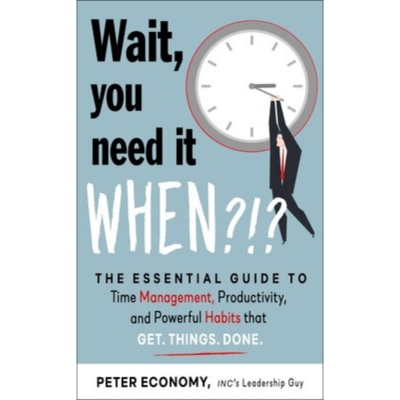
In this episode of Inside Personal Growth, Greg Voisen sits down with Peter Economy, the world-renowned “Management Whistler” and prolific author, to discuss his transformative book, Wait, You Need It When?!: The Essential Guide to Time Management, Productivity, and Powerful Habits That Get Things Done. If you’ve ever felt like your calendar is a battlefield and your to-do list is winning, this conversation is the tactical briefing you need. Peter pulls back the curtain on why traditional “busyness” is the enemy of true progress and reveals the specific, high-octane habits that allow world-class achievers to stay calm while the clock is ticking. Prepare to challenge everything you thought you knew about your workday.
The Myth of the “Busy” Badge of Honor
One of the most profound takeaways from Peter’s conversation with Greg is the deconstruction of “busyness.” Many professionals wear their packed calendars like a badge of honor. However, Peter points out that being busy is often just a mask for poor prioritization. In his book, Peter Economy explores the psychology behind why we say “yes” to tasks that don’t move the needle. We are often driven by a “pleaser” mentality or a fear of missing out, which leads to a cluttered schedule and a fractured mind. The podcast dives into how to shift from a reactive state—where you are constantly surprised by deadlines—to a proactive state of flow.
The “Wait, You Need It When?!” Philosophy
The title of the book itself comes from that universal moment of panic when a supervisor or client drops a massive project on your desk with an impossible deadline. Peter explains that these moments are often the result of a breakdown in communication and a lack of established boundaries. To combat this, Peter suggests a “tactical pause.” Before diving into a frantic work session, ask the clarifying questions that define the true scope of the work. Often, what is presented as “urgent” is merely “important,” and by identifying the difference, you can protect your peak energy hours for the work that actually generates results.
Building Habits That Actually Stick
A significant portion of the interview focuses on the “Powerful Habits” section of the book. Peter Economy isn’t interested in fleeting “life hacks.” Instead, he focuses on neurological wiring.
-
Habit Stacking: Peter discusses the concept of attaching a new, desired habit to an existing one. If you want to start a daily planning routine, do it while you drink your first cup of coffee.
-
The Power of “No”: One of the most productive habits you can develop is the ability to decline low-value requests gracefully.
-
The 2-Minute Rule: If a task takes less than two minutes, do it immediately. This prevents small “open loops” from cluttering your mental space.
Energy Management Over Time Management
We all have the same 24 hours in a day, but our energy levels fluctuate. Greg and Peter discuss why “Time Management” is actually a bit of a misnomer. You can’t manage time; you can only manage yourself within it. Peter emphasizes working with your biological clock. If you are a “morning lark,” your most cognitively demanding work—writing, strategizing, or deep analysis—should happen before noon. Leave the “shallow work” like emails and filing for your mid-afternoon energy slump. By aligning your tasks with your energy, you achieve more in four hours than most people do in eight.
The Role of Mindfulness in Productivity
It might seem counterintuitive to suggest “slowing down” to get more done, but Peter Economy is a firm believer in mindful leadership. He argues that a stressed brain is an inefficient brain. When we are in “fight or flight” mode due to deadline pressure, our prefrontal cortex—the part of the brain responsible for logical decision-making—shuts down. By practicing mindfulness and staying present, you can approach problems with a more balanced perspective, leading to creative solutions and fewer errors that require time-consuming re-work.
Final Thoughts: Reclaiming Your Sanity
The conversation between Greg Voisen and Peter Economy serves as a vital reminder that we are human beings, not “human doings.” Productivity should be a tool that grants us more freedom, not a leash that keeps us tied to a desk. Whether you are a CEO managing a massive team or a freelancer trying to juggle multiple clients, the principles in Wait, You Need It When?! provide a blueprint for a more intentional, effective, and peaceful professional life. It’s time to stop reacting to the clock and start commanding it.
Our Guest, Peter Economy:
➥ Website: petereconomy.com
➥ Buy Now: a.co/d/07GcLeUo
➡️ LinkedIn: www.linkedin.com/in/petereconomy/
➡️ Twitter / X: x.com/bizzwriter
You may also refer to the transcripts below for the full transcription (not edited) of the interview.
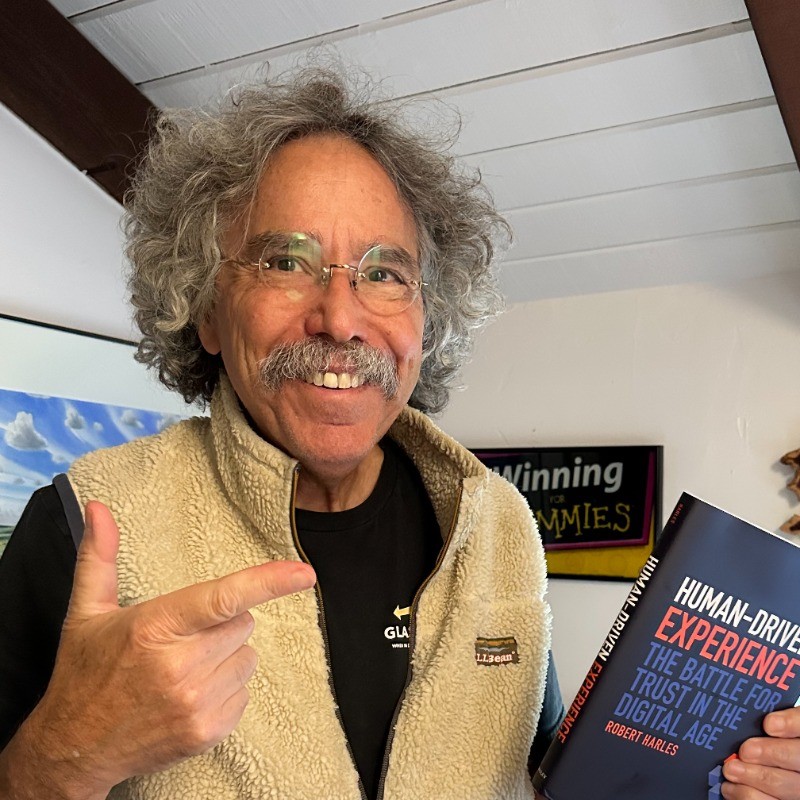
Welcome back to Inside Personal Growth. This is Greg voisen the host of Inside Personal growth and that fuzzy man to the left of me over there with that great hairdo and those glasses is Peter Economy. Peter lives in La Hoya. Good day to you, Peter. How you doing?
00:00:17:03 - 00:00:20:07
Speaker 2
Hey, Greg, It's great to be back. Thanks so much for having me.
00:00:20:12 - 00:00:55:12
Speaker 1
Was great having lunch with you the other day in Encinitas. And for all my listeners, just to give you a little bit of background, we're on podcast 1309. I think it is. Wow. Peter and I did a podcast back in June of 2020, Podcast 791 called Wait, I'm the Boss. Question Exclamation question The Essential Guide for New Managers to Succeed from day one with Peter Economy.
00:00:55:12 - 00:01:24:00
Speaker 1
So he has written a lot of books, Peter, on the Let my listeners know a little bit about you, but go to Amazon, get a copy of this book. This book is going to help any company or any manager who's listening here today. Peter's Wall Street Journal, best selling business author, ghostwriter, developmental editor and publishing consultant with more 135 books to his credit and more than 3 million copies sold.
00:01:24:15 - 00:01:51:11
Speaker 1
The book we're going to talk about today. Wait, I'm working with. Ah, wait, You need it? When? Question question was published also by a career press. He's got several under that. He also helped create unlearn let go of past success to achieve extraordinary results. Everything I learned about life, I learned in dance class. And the list goes on.
00:01:51:20 - 00:02:20:01
Speaker 1
He is the leadership guy on income and for more than a decade has served as associate editor of Leader to Leader magazine published by Francis has Balloon and for those of you who don't know, she is the lady who led the Girl Scouts. They just did a documentary on her. And she's a phenomenal she is now deceased, but a phenomenal woman in philanthropy.
00:02:20:12 - 00:02:43:17
Speaker 1
Peter taught management for three five creativity and innovation as a lecture at San Diego State and on the National Advisory Council of the Art of Science Learning and also the founding member of the Board of Sports for Exceptional Athletes. He's a graduate of Stanford with Majors in Economics. With a name like that, why would you major in anything else?
00:02:44:05 - 00:03:11:24
Speaker 1
And human biology. Peter, as were too closely linked with some of the nation's top business leaders, including Jim Collins, Francis has a blind burial rally. Peterson Guy Kelly McKinney, Guy Kawasaki and the list goes on. Ken Blanchard there, they're all there. Well, Peter, welcome back again. And if you want to learn more about him, just go to Peter Economy.com.
00:03:12:08 - 00:03:16:05
Speaker 1
That's Peter economy dot com. Um.
00:03:17:16 - 00:03:19:18
Speaker 2
Yeah, that was okay. It's time to wrap it up.
00:03:19:18 - 00:03:47:14
Speaker 1
It was quite an intro, but but I love the work that you're involved in and I think anything you we can do today in this fast paced world to kind of help people become better at managing. I say that we've I think I told you when we had lunch, I think it's a pinnacle of complexity that we deal in today between all the devices and things that distract us and everything.
00:03:47:14 - 00:04:14:01
Speaker 1
People are focusing on attention. And I want to welcome you back to the show because been a long time. It's been six years. You opened this book with a reference to a Broadway show called Rent and an idea that we all have 525600 minutes in a year. Okay. That's what we were just talking about, time. And I think if we took off our watches, we'd be a lot better off.
00:04:14:01 - 00:04:28:13
Speaker 1
But really only about 950 useful minutes per day. So what was the personal moment or experience that made you say, I need to write a book specifically about time management?
00:04:29:20 - 00:04:58:08
Speaker 2
Well, yeah, I'm glad you asked that question, Greg, because, you know, every book is different. Every book has a different motivation. Every book comes from a different place. And, you know, ultimately I'm looking mostly to serve people in business, you know, leaders, often leaders, but people up and down the organization in every position. And then people, you know, in art, in the workplace, people who are doing, you know, work in their communities, doing volunteer work, whatever it may be.
00:04:59:02 - 00:05:28:12
Speaker 2
And, you know, as a part of the articles that I write for income, I'm a leadership guy at income have written, I think more than 2000 articles there, which seems kind of crazy to me in retrospect. But one of the topics that keeps coming up over and over again is burnout. So I keep you know, I keep writing about burnout and how of how prevalent burnout is nowadays and how burned out people are.
00:05:29:04 - 00:05:52:00
Speaker 2
And, you know, I was wondering I was thinking about that. Why is that the case? You know, why are people so burned out? And sure, I mean, we live in a super complex world today. I mean, it's much more complex than it was in our grandparents, you know, days. They probably thought their whole world was complex, too. But it's got nothing on our world today.
00:05:52:00 - 00:06:11:10
Speaker 2
But anyway, so I was thinking about that. And I think what happens is, is that people feel that they have to get more done. In the last time. I think there's this real pressure and societal pressure and a work pressure. You know, people are in their jobs, especially nowadays with, you know, the economy. Speaking of the economy hasn't been the greatest the Peter.
00:06:11:10 - 00:06:12:02
Speaker 1
Economy.
00:06:12:22 - 00:06:35:04
Speaker 2
Putting in a plug for myself there. I'll tell you a story about Frances Cecil. Mind if I remember to get back to it? But, you know, people are under pressure and they don't want to lose their jobs. I mean, jobs are more precious than ever. My daughter, who lives in New York City, she works for Condé Nast and so many of her friends have lost their jobs, you know, in the last year or two.
00:06:36:07 - 00:06:56:19
Speaker 2
They're losing their jobs and they're having a real hard time finding another job to replace the one that they lost. So they're under a lot of pressure to work harder, get more done in less time. And I think the only way you can you can really get more done is to manage your time to have an effective time management system.
00:06:57:18 - 00:07:01:02
Speaker 2
You know, it's common sense, but it's not common practice.
00:07:01:02 - 00:07:25:20
Speaker 1
Well, you know, Sarah, who used to be Marshall Goldsmith's assistant, Right. Was on the show and did a podcast not that long ago about Frances Has. Sjoblom Going back to Frances, Yeah. And you know, she said that Frances used to ask everybody who met with her this, maybe this is the story you're going to tell. And if not, I'll let you tell the story.
00:07:26:11 - 00:07:37:20
Speaker 1
Used to say, Look out the window. Right? And she would ask people, what do you see that I don't see that you can do something about who?
00:07:38:01 - 00:07:38:16
Speaker 2
Okay.
00:07:38:24 - 00:08:02:22
Speaker 1
Right. Okay. And, you know, Sarah worked with her very closely for four years. Yeah. And she said all the people who are being interviewed kind of by her with like, take out, it's like, wow, what an interesting question. And she got it from DRUCKER Oh, well, Peter Drucker gave her that, and she used Peter Drucker because she and Peter Drucker were very, very close share.
00:08:02:22 - 00:08:34:15
Speaker 1
And I think that's about time, too, because, look, if I'm to look out the window and I need to be more creative at what it is that I need to do, how frequently is it that people are turning to kind out their look at their window and get a different perspective about their world, about time, about what they're doing, about how they can be more efficient, about who they are and I always love that from what Sarah said and where she got it now, then I hit the story right?
00:08:34:15 - 00:08:57:11
Speaker 2
Or is it? No, you didn't. Although I wouldn't be surprised if she asked me that. I don't remember asking me that, but I met with her probably four or five different times in her office on Park Avenue in New York City. And, you know, when I first met her, I had just been brought on as the new associate editor at Later to Leader magazine, which she was in charge of.
00:08:57:11 - 00:09:22:17
Speaker 2
That was still part of the Peter Drucker Foundation back then when I first met with her. But one of the first things she said to me was the economy. Economy? Where does that come from? You know it that when I first heard your name, I thought it was Peter information. If you go, it was it was more back to the economy thing again.
00:09:22:20 - 00:09:48:01
Speaker 1
Yeah, well, she was quite the woman and there is a documentary out there. We'll put a link in the show notes here to that documentary that Sarah had. McArthur had so much to do with. Now you cite striking statistics. You say 82% of people don't have any time management system at all. And that maybe doesn't surprise me because I think people are trained to skirt.
00:09:48:01 - 00:10:09:12
Speaker 1
I think they're fatigued. So this fatigue from everything that we've got coming at us is fast, is is as fast as all of our systems are. And they you know, they just I if you remember in the days we say, oh, well, computers used to double every seven months or something like that, you know, now it's down to like seven days, right.
00:10:09:12 - 00:10:35:12
Speaker 1
I mean it's just so fast. And you say 51% of the average workforce goes to a low or no value task. Why do you think so many intelligent, capable people resist putting the system in place and working on the hard goals, the harder tasks versus, you know, your I remember Frank Covey used to always be ABC, Right? Right.
00:10:35:15 - 00:10:47:19
Speaker 1
And you'd start with the C and then they would keep going to the next page, be like, okay, I'm going to move that over because I don't really want to put the effort in. Is associated with those eight goals.
00:10:47:19 - 00:11:10:09
Speaker 2
Yeah, exactly. And, you know, I think that there's two parts to it when I think about, you know, why don't people put a time management system into place? You know, I think that we're inherently optimistic. I mean, I know when I think about it myself, when I think I'm I'm overwhelmed and I'm things are really crazy. I'm optimistic that it all work out.
00:11:10:17 - 00:11:32:20
Speaker 2
It's going to abate that the this all this crazy work is going to eventually get under control. It's going to start it's going to slow down and everything will be okay. So why should I make that effort? I'm so I'm being optimistic. I'm I'm I'm hopeful that it will get better, preferably sooner than later. Yeah, but the other thing is it actually takes work.
00:11:32:20 - 00:11:57:21
Speaker 2
I mean, you actually have to do something different. And most of us like what we do. We're we're kind of in ruts where we're, you know, we have habits. We're all we all have established habits. And generally we we just continue with those habits and why something just tremendously bad happens that causes us to change it. So we just get into these ruts and so why change?
00:11:57:21 - 00:12:13:02
Speaker 2
So unless something really bad happens and there's not really a lot of motivation to change what we do. So between optimism, I hope, I think I think it'll get better and then, oh, it'll just take too much time anyway for me to to do something different. So why bother?
00:12:13:24 - 00:12:39:18
Speaker 1
Yeah, no. And I think when we work in the digital economy, it's it's harder to measure wins. So what happens is, you know, you're making tons of wins if you look back at your day, but you're not really looking at them in wins. We're in the olden days. I mean, to just go back, it was like when you had a big accomplishment because we are programed to be achievers in this world.
00:12:39:18 - 00:13:03:00
Speaker 1
You have to be because everything is moving so fast. So how do you measure wins? And I always thought that was an interesting thing. And you talk about this paradox of time, the tension between being productive and being, well, you point out that 42% of desk workers report burnout. You just talked about burnout. I think it's gone beyond burnout.
00:13:03:00 - 00:13:27:18
Speaker 1
It's it's burnout, but now it's anxiety, it's PTSD, it's loneliness. It's all of these things that everybody's talking about in the world. How do we reconcile the drive to get more done with the reality that our brains need to rest their function at their best? In other words, to stay in the flow is you and I talked about this at lunch.
00:13:27:18 - 00:13:48:15
Speaker 1
It's like, yes, we need to push the boundaries to try something new and be a little uncomfortable. But at the same time, we don't want to get too uncomfortable with something because we could fail at it. Right, Right. So talk with us about this paradox of time between well and productive.
00:13:49:01 - 00:14:20:19
Speaker 2
Yeah. So I think that there's certainly been a lot of people out there talking about the fact that you can only get you can only be really productive if you rest so or take breaks and I think we all pretty much are aware of that. But but even so, we ignore that. We tend to ignore that. I mean, I know personally many times where I've just, you know, burned the the candle at both ends until that both ends are burned down.
00:14:21:12 - 00:14:39:15
Speaker 2
And I know that I know that I need to take breaks, but but then I don't because I just feel like if I take a break, I'm not going to get it done on time. You know, my my work is very deadline driven. You know, I write books. I write articles. I have publishers who expect the manuscript by a certain date.
00:14:39:15 - 00:15:02:07
Speaker 2
I've got clients who expect the chapter by a certain date. I've got income pretty breathing down my neck, you know. When's your when's your column going to get in here? We need it, you know, that kind of thing. So, you know, I'll just start working until it gets done. But the simple fact is, is that that doesn't work if you're burned out.
00:15:02:07 - 00:15:22:06
Speaker 2
If I'm burned out, I'm not going to be as productive. I'm not going to get it done either as quickly or as well as I would if I took some breaks or just took time away. And that could be simple. It could just be getting out of your chair for 5 minutes, take going out the front door and walking around.
00:15:22:06 - 00:15:40:21
Speaker 2
Go take a walk outside, do something different, especially, you know, outside in nature. I mean, just get outside for a while. But I think everybody inherently I mean, intuitively knows this. They need to take a break. They to avoid burnout. But but most of us just end up not doing it.
00:15:41:17 - 00:16:17:15
Speaker 1
Yeah. And I think we're speaking about it, but at the same time, to drive that home, whether you take a break by meditating or walking in the park or going to the beach or going in the forest or whatever it is, it's amazing how that refresh your break, you know, in the we go back way. In the olden days, I remember writing a book with John Selby, and John was quite the studier of meditation and Buddhism and all that and he called them breather breaks.
00:16:17:24 - 00:16:23:10
Speaker 1
Oh, but if you're a member, there used to be a day when people took cigaret breaks.
00:16:23:10 - 00:16:24:01
Speaker 2
Oh yeah.
00:16:24:02 - 00:16:52:15
Speaker 1
Right. They used to go outside and smoke Cigarets. Right. And, and I'll tell you one thing, in hospitals, doctors, people that work on the staff, it's probably one of the most unhealthy groups because you'll find them standing out front. I doing a cigaret Right. And even though we know smoking's bad for us, so John and I were going into these places where people are supposed to be healthy, tell him to go take a breather.
00:16:52:15 - 00:17:31:00
Speaker 1
Break. Oh, go, go, go, go, go. Do your rather breaks. But you know, you have a compelling case that times should be treated as both an asset and a currency. And yes, I see it that way. With a name like economy, you're going to trade time as an asset. Can you walk our listeners through what shifts when someone genuinely starts valuing each hour the way they would value, let's say, a $100 bill, Let's call it $1,000 bill this time, because, you know, inflation, not economy inflation.
00:17:31:12 - 00:17:55:11
Speaker 2
Station. Yeah, either inflation. So yeah I mean the thing is, is that we know that time has value. We know that we only have so many minutes on this earth and we don't know how many more we've got. You know, we don't know if we've got five more minutes or 5000 or 500000 minutes or more, whatever. So we just don't know.
00:17:55:16 - 00:18:22:19
Speaker 2
But we know that it's limited. There is there's going to be a limit to the number of minutes that we have, and that creates value that that finite, you know, number of minutes is valuable. And, you know, I've caught myself recently. I had Tik Tok on my phone and I would catch myself just scrolling through these stupid little videos, you know, for half an hour or an hour.
00:18:23:10 - 00:18:45:21
Speaker 2
And at some point I came to the realization this is just a waste of time. My time has value. You and I'm getting older. I'm not getting younger. What? Maybe I should be playing games. I should be doing the New York Times game thing for half an hour before I go to sleep. You know, I'm in bed center watching Tik Tok videos.
00:18:45:21 - 00:19:09:06
Speaker 2
I can at least be making my brain hopefully work a little better instead of my brain just turning into mush from watching Tik tok. So anyway, it's really something that you have to internalize and real and catch yourself. You know, I know Ken Blanchard, He was a big proponent of catching, catching people, doing things right, like catch people, doing something right.
00:19:10:00 - 00:19:28:08
Speaker 2
I think you have to catch yourself doing something wasteful, you know, doing wasting time, catch yourself, wasting time, and then then reflect on that. Step back and reflect on that and see and understand that that time that you're you're wasting has value. What else could you be doing? It's sort of like you said with Francis, Look out the window.
00:19:28:18 - 00:19:32:07
Speaker 2
How could I be better using? What can I do to help the world?
00:19:32:07 - 00:19:33:09
Speaker 1
Right. Well.
00:19:33:21 - 00:19:45:00
Speaker 2
What can I do to help myself, help my family, help my coworkers, help the people, my community, the people around me? Instead of watching my Tik Tok videos. I'm sorry I'm beating up on Tik tok.
00:19:45:12 - 00:19:46:11
Speaker 1
But that's okay.
00:19:46:14 - 00:19:53:16
Speaker 2
That was a personal stake for me. Okay, well, I took it off my phone. I just got rid of it and I said, Get this thing out of here.
00:19:54:01 - 00:20:14:21
Speaker 1
So all you got rid of, like you mentioned to me, you know, you looked at your phone and when we met for lunch and you said, look at all the apps on your phone. You know, people have pages and pages of hours that you never use. You probably use the ones on the home screen. You are then, Annie, you might use some of the others, but most of them are kind of just taking up space on the phone.
00:20:14:21 - 00:20:42:09
Speaker 1
Right? Right. And so maybe one of the things that people ought to do is go through those apps and really just clear them off their phone, especially the ones are not using. And then really look at the ones that are helping you make progress. Yes. Right. Whatever it is that you do, I think Tony Robbins says people feel good when progress is occurring, when they're moving forward, when something is advancing.
00:20:42:18 - 00:21:00:24
Speaker 1
So over time, that's one of the things you want to look at. Am I advancing? Am I reading the right books? I'm to hanging around with the right people? Am I taking good vacations where I feel good and comfortable When I come back? What are the things that you like to do and really, as you said, nobody has a time management plan.
00:21:01:05 - 00:21:32:03
Speaker 1
The question is, do you even have a life plan? You know, should you should you really look at that and you introduce these clear goals. You call them collaborative, limited, emotional, appreciative and definable as an alternative to the traditional smart goals framework that everybody knows. What was missing from smart goals that led you advocate for this approach instead, collaborative, limited, emotional, appreciable and definable.
00:21:33:06 - 00:21:42:09
Speaker 2
Right? So that actually came from a friend of mine, a guy named Allen or Adam Creek. Adam Creek is Canadian.
00:21:42:13 - 00:22:05:14
Speaker 1
I know him. He's the guy that did the, you know, the rowboat guy. The first went across. Adam was on the show here, so. Oh, wow. Yeah, Yeah. There is the Olympian guy and no, I didn't he like, start down in somewhere with his boat and try and come all the way across the straits is not the same guy.
00:22:05:16 - 00:22:28:23
Speaker 2
Yeah. So yeah, so same guy. Canadian Olympic gold medalist I think is a 2008 Beijing Olympics. He's a rower. He rose crew. Right. Well, a boat with eight guys in it and a coxswain and he they won the gold medal but yeah he was in a boat with I think two other guys. I don't have it exact but they rode from Africa to North America.
00:22:28:23 - 00:22:31:08
Speaker 2
They Oh God, they were so close to him, they.
00:22:31:08 - 00:22:32:03
Speaker 1
Didn't make it.
00:22:32:12 - 00:23:00:14
Speaker 2
I think they capsized or something like just with it. I mean, they are within a day I think of of of of hitting North America land and they ended up capsizing her. So I don't remember all the details. But yeah, it's the same guy. So, you know, he he says that he came up with this new system, this clear goal system, because he felt that, you know, the one that we know, the smart framework is all it's all based on logic and rational thinking.
00:23:00:24 - 00:23:24:04
Speaker 2
It's basically a logical, rational thinking model, which is fine. But he thought there should be something different, something newer that was really tapping into people's collaborative nature and emotional nature in big projects and getting big things done. So that's what he came up with. He came up with this clear goals, and I think it is it does make more sense to me.
00:23:24:17 - 00:23:44:07
Speaker 2
It is something it's more collaborative. And that's, you know, nobody no great person Steve Jobs didn't invent, you know, create the iPhone all by himself. He had a team of people that he collaborated with. He had designers, he had software people. He had, you know, people that did every aspect of it, you know, manufacturing people, the whole nine yards.
00:23:44:19 - 00:24:03:12
Speaker 2
Yeah. It wasn't just Steve Jobs. He inspired everybody. He kicked some ass along the way, too. Yeah, but when I there. Yeah, but it took a big group of people and that's what, that's what Adam was looking for when he did the clear goals is, is it's a collaborative process. Not just. Just not me. It's weird. Not just me.
00:24:03:19 - 00:24:40:23
Speaker 1
Well, for everybody, go check it out in the book. Wait, you need it. Win would be good. Now, this next one. You devoted an entire chapter to Eisenhower Matrix the four quadrants. I think that Stephen Covey senior was probably the most one who copied this. Okay. You know, in the upper right hand quadrant, the. The left hand quadrant, the lower quadrant, you know, and in each one of those you ask the questions and you said, is it urgent versus important?
00:24:41:19 - 00:25:10:16
Speaker 1
Are people intellectually understanding the concept? Yet you point out they still overestimate urgency and underestimate importance. What practical advice do you give for someone who's consistently lives in kind of firefighting mode because they're doing the unimportant and an urgent activities, which would be the lower right quadrant of that that Eisenhower matrix?
00:25:11:12 - 00:25:39:03
Speaker 2
Right? So this was a really common problem. And you alluded to it earlier, you know, talking about doing all these unimportant things and putting those important things to the next day. You know, can't you see that we keep we keep procrastinating and, you know, we get a lot of of, I guess, reward. It's a reward thing where when you accomplish something, you feel rewarded and you want to do more.
00:25:39:03 - 00:25:50:01
Speaker 2
So the trouble is the easy things are usually the things that are not important. You know, they're they're the least important things are usually the easiest things to do. So.
00:25:50:01 - 00:25:51:19
Speaker 1
And they're not urgent usually.
00:25:51:21 - 00:25:53:06
Speaker 2
Exactly. Yeah.
00:25:53:07 - 00:26:19:15
Speaker 1
Those are what would that's what Covey would say are the C things, the Re and the way things obviously take more effort, they take more initiative. They take more of your time. And I get that sometimes you don't feel like you want to do those, right. What advice do you have to get people to move more toward the upper right hand quadrant of the Eisenhower matrix, which is important, right.
00:26:19:20 - 00:26:33:03
Speaker 1
And and urgent because the reality is important in an urgent means. You're working on your life, you're planning your future, you're doing things that are really important, but they aren't super urgent right?
00:26:33:03 - 00:27:07:21
Speaker 2
Yeah. And again, the Matrix, you know, the very most the thing you're really supposed to focus on and this is something we talk about leadership. I've talked about it for decades, is that leaders are most effective when they focus on doing the things that only they can do. You know, there are certain things that leaders, you know, whether you're a superb frontline supervisor, a manager, an executive VP, a CEO, whatever it may be, there are certain things that only you can do that the people who work for you can't do aren't authorized or empowered to do for whatever reason.
00:27:08:11 - 00:27:26:05
Speaker 2
So those are important and most urgent things are the things you should be focusing on. And that's that that anything that you're talking about, those are that the highest priority you've got to you've got to step back from from your day. You've got to look at your day, step back and say, what am I working on? What am I focusing on?
00:27:26:19 - 00:27:54:09
Speaker 2
And focus on those most important, most urgent things. If they're if they're still important but not urgent, then make the decision and move forward. If it's important, if it's urgent, but not important, then delegate it to somebody. I think that's another problem is a lot of leaders fail to delegate, so they need to be delegating more. But you just have to step back and look at your day.
00:27:54:09 - 00:28:04:05
Speaker 2
What am I spending my time doing? And if you find yourself doing putting too much time in unimportant, non urgent tasks, you've got to change that. You've just got to change.
00:28:05:05 - 00:28:24:15
Speaker 1
So true. Now, look, one of the things you speak about in the book is learn to say no. And I think for a leader or an executive or a or an entrepreneur, it's hard to say no. You know, they're used to saying it, raising their hand and going, you know, I'll do it just like you said, defer it.
00:28:26:04 - 00:28:50:06
Speaker 1
And so you've written over 100 books and have massive column in ink, like you've said. How do you personally decide when to say no, even to exciting opportunities that come? The next shiny object comes along for Peter and he goes, Well, great. I got I got to go get that one, because it is one that I think the mind and the intention.
00:28:50:06 - 00:29:16:02
Speaker 1
I always say set your attention on your intention to write right. And I think a lot of people miss focus and so they like that because it's a diversion from it. And I don't know why they want to divert, but they actually kind of self-sabotage reaching the goal because they get diverted by all these other things. I'll raise my hand.
00:29:16:02 - 00:29:39:03
Speaker 1
I'm one of those kind of people that's done that, you know, throughout my life. Oh, there's something really cool. I want to go do that. Right. Right. Because I'm curious. And most of those people, a writer, somebody who does a podcast, people like me, we're very curious. So because we're so inquisitive, we want to reach out and that we hardly ever say no.
00:29:39:08 - 00:30:04:13
Speaker 2
All right. Yeah. Now I totally understand because that's me, you know, to to a T is that I have a hard time saying no because I love what I do. I mean, I love to write. I mean, this is my this is what I was meant to do. I mean, I was a manager for more than ten years, you know, years ago at the beginning of my career.
00:30:05:02 - 00:30:24:21
Speaker 2
And I wasn't really fond of being a manager. That really wasn't my thing. And so at some point I discovered that I loved to write. I did the Managing for Dummies with my friend Bob Nelson and did other books, and that became a, you know, basically a full time thing. Eventually, I left management behind and became a full time writer.
00:30:25:11 - 00:30:51:19
Speaker 2
But I always loved to say yes. I mean, I'm so intrigued by the ideas that these my clients have. And I mean, I love working with these just amazing people. But one time, I don't know, was it was five six, seven years ago. I took on one project too many and I, I became very physically anxious. I got very overwhelmed by that one extra project.
00:30:51:19 - 00:31:11:19
Speaker 2
It was like, you know, Lay's potato chips, you can always eat one more. That's sort of my philosophy. I can always take on, you know, I can even more project. I discovered that, no, I got massive indigestion by taking on that one one extra project and I had to step back, say, I can't do this. I just can't do it.
00:31:11:19 - 00:31:34:16
Speaker 2
I can't do it all. I can't do all these, all these things all at once. And I had to go back to that client and say, Sorry, I'm going to have to say no now. I've got to cancel our contract. I just can't do it. Yeah. So that was kind of painful to do that, as painful for me, and I'm sure my client was very happy there, but I learned that there you've got to sometimes say no.
00:31:34:23 - 00:31:48:21
Speaker 2
You've got to protect yourself. You've got to give yourself that time, you know, because you got to protect your time. Nobody else is going to protect it for you. If you let everybody else run your life for you, they will.
00:31:48:21 - 00:32:12:12
Speaker 1
And I understand taking on the one extra project and that it felt just a lot of overwhelm for you. Yeah. And I think that a lot of executives or leaders get in that position frequently and they need to know when to compress and when to when to contract and when to expand. Right. You know, sometimes, you know, when that is, I can do it.
00:32:12:12 - 00:32:34:11
Speaker 1
I've got a good team behind me. I can expand because I can do delegate, defer, delete the four DS, Right. Which you just talked about. And there becomes less of a barrier to taking on something when the people you've surrounded yourself will help you reach that goal too. Right?
00:32:34:11 - 00:32:35:16
Speaker 2
Right, exactly.
00:32:35:19 - 00:33:01:05
Speaker 1
Yeah. Now you have a great chapter in the book called Find Your Most Productive Times. We're all wired differently. Some of us are morning people. Some of us are night owls. Some of us just work 24 seven. What process do you recommend for somebody who generally doesn't know when their peak hours are?
00:33:01:05 - 00:33:21:09
Speaker 2
Oh yeah. For me it's just a matter of experimentation. I mean, I think even so, I work at home. I'm a writer. I could work any time I choose to. You know, I found years ago that my most productive time was basically from 9:00 at night until two in the morning. That was for me, because everybody was gone.
00:33:21:21 - 00:33:46:11
Speaker 2
I was getting no phone calls. My my kids were asleep in bed. My wife was asleep. You know, nobody was was, you know, jumping in on my schedule. Whereas, you know, if during earlier in the day, I'm getting interrupted all the time, I'm having all kinds of interruptions, emails and kids coming in and my wife asking me to take her to go somewhere or whatever it might be.
00:33:47:02 - 00:34:07:24
Speaker 2
So I personally found just by experimenting myself that my most productive time was at night, late at night. I'm a night owl, but other people are more productive in the morning, first thing in the morning. I mean, I know some of the I I've written articles for income where we looked at some of the top CEOs at the time.
00:34:07:24 - 00:34:30:17
Speaker 2
This is like ten years ago, and a lot of them get going at like four in the morning. I mean, they're up at four in the morning and they're they've had they've been exercising. They got breakfast. You know, they're they're working by 6:00 in the morning. They've started work. One of my clients right now is really a high up person in the financial industry.
00:34:31:06 - 00:34:54:10
Speaker 2
And this person is up bright and early because they're often on TV. You know, the first thing in the morning being interviewed about the markets, the financial markets. So their schedule is, you know, they're up really early in the morning, too. Also. So even for people who work a 99 to 5 job, there's going to be times during the day you're more productive and less productive.
00:34:54:10 - 00:35:12:10
Speaker 2
I know when I used to work 9 to 5, I was super productive early in the morning, you know, And then there is that lull around lunchtime. And then and then after lunch, boy, there's a real lull. You have lines, you start getting tired. So you've just got to find out the times that are most productive and focus your work in those times.
00:35:12:16 - 00:35:39:23
Speaker 1
Yeah. And I also would add to that I'm sorry, I think if if people learn to modulate their time, all the time can be productive. The key is to run at a pace. So I say, how do you manage your energy? Because all we can do as a human being is look at our levels of energy. When are we best suited?
00:35:39:23 - 00:36:04:00
Speaker 1
Right, Right. I'll cut this out. When are we best suited to basically do those calls and those emails, but modulate, don't try and do too much. Don't to find the flow. Find where you're at. The end of the day, you're looking at it. You look down at your watch and go, Oh my gosh, 30 5:00 And I didn't even I was just in fall.
00:36:04:00 - 00:36:32:23
Speaker 1
I was having fun. And I think the important point is to have fun along the way, you know, laugh, take a minute to maybe watch a little bit of a podcast or something, something that that, you know, you wanted to do but you didn't do because you postponed it because you were too busy. So those kind of things, when you put more variety in and you modulate and you take time to take those walks, the days go very quickly.
00:36:33:07 - 00:36:58:15
Speaker 1
Now you take a pretty philosophical turn here on chapter 18. It says, Take a look in the mirror and you suggest that poor productivity might actually be a symptom of doing work that's not aligned with your deepest values and passions. And I will tell you, I just did an interview on the people who came up with the purpose factor test.
00:36:59:07 - 00:37:28:04
Speaker 1
This is the most phenomenal test I've ever taken in my life. So from a standpoint of what is your purpose in life? What's your passion? Why are you here? Why do you exist if you know what that is, it makes it easier for you to modulate that energy. So how did that insight show up for you in your own career and your own journey when you knew what your purpose was and your passion was Right?
00:37:28:23 - 00:37:50:06
Speaker 2
I'll tell you a quick story. So I mentioned earlier that, you know, I was a manager, and so while I was a manager, I worked, you know, 9 to 5 during the day. And then at night I was starting to write, I was writing books and I did that at night. I did that from nine till two in the morning at local cafes here in San Diego.
00:37:50:13 - 00:37:50:20
Speaker 1
Yeah.
00:37:51:08 - 00:37:52:23
Speaker 2
Pacific Beach, to be more exact.
00:37:52:23 - 00:37:54:16
Speaker 1
And one. Which one?
00:37:54:24 - 00:38:13:23
Speaker 2
It's long gone. I don't remember the name of it. Oh. I mean I eventually had to move over panic and then La Hoya. Yeah. Which became my hangout, but. But the nighttime thing was a cafe that was at the corner of Cass and Garnet for some time. And there I was, back in the smoking days. People were smoking in there and it was noisy there was a lot of music and people love it.
00:38:13:23 - 00:38:33:02
Speaker 2
But at that swirl of noise and people talking and music and that's even the smoke, which I hate. Cigarets But yeah, breathing. You just all add it up. And I was very productive anyway. So the story is, is that I was working, so I was working two two full time jobs during the day. I was a manager at night, I was a writer.
00:38:33:17 - 00:38:52:24
Speaker 2
I got called in for my boss, said, We're going to layoff 15 managers and you're one of them. So I got laid off. And so I said, okay, that's all right. I'm still here. I'm working full time as a writer. I'll just do more of that. I got a call the next day and they said, Oh, we found six months more money.
00:38:53:12 - 00:39:08:19
Speaker 2
You ready? Let's. Which I'd come back. You're ready to come back. And I said, I thought about it for a minute and I said, No, I think I'm going to just keep doing the writing and doing the writing full time ever since. And it's because I knew that was my passion. I knew that that was what I was meant to do.
00:39:08:19 - 00:39:22:02
Speaker 2
I figured that out. I knew that I was not meant to be a manager. Even though I write about it, I write about leadership. That's what I do all day long. But I wasn't meant to be a manager. I was meant to be a writer and to write about it.
00:39:22:21 - 00:39:27:22
Speaker 1
So yeah, hopefully you're the kind of manager that found people doing things right.
00:39:28:01 - 00:39:28:16
Speaker 2
I did.
00:39:28:21 - 00:39:51:03
Speaker 1
And you? Because look, if you give people autonomy, if you give people their right to do, in other words, it's not like you're leaning over their shoulder, you're there as support. I always liked the green leaf theory and model, right? If you turn the corporation upside down, you are there to serve them. They're not there to serve you.
00:39:51:03 - 00:40:14:05
Speaker 1
And if you take that role as a manager, that's really the role that most managers slash executives should be taking right, Right. So, look, you you're talking to a lot of people out there that definitely resonate with this book. Okay. And again, we'll put it up there. It's going to be on Amazon. You go it. You'll go to Peter Economy.com.
00:40:14:13 - 00:40:42:07
Speaker 1
Well, learn more about Peter. But we just talked at the beginning of this podcast how overwhelmed and how fast things are coming at people. Okay. And I and I remember this when I said, David, Alan because he used to use the inbox theory, right? It was like, okay, when things come in, you'd have this device. He said, If you're going to capture it, capture it in a ubiquitous device that you can use.
00:40:42:14 - 00:41:03:11
Speaker 1
So you remember because you won't remember all of these things that are coming at you. And I think that's part of it. Fortunately, today we have a second brain out for us, and it's called A.I., and it's really working well for those people who are working with it. It is their second brain because they're buried, buried in tasks, they're buried in deadlines.
00:41:03:21 - 00:41:42:06
Speaker 1
They're stressed out. Now a AI is making it go quicker, but at the same time, it's making it easier. Okay, so what would you tell somebody who's listening this today and where would you tell them to kind of be digging deeper to understand about their own challenges with being overwhelmed, anxious, lonely, fatigued, and having all this work to do and not feeling emotionally connected with that work or the wins that they are having?
00:41:42:06 - 00:42:06:04
Speaker 2
Well, you know, I think that you've got to really, again, figure out what's most important in your life. You know, we talked just briefly about A.I., you know, meetings are, you know, well known to be very unproductive. I remember back in the old days, I wrote a book about better business meetings and 67% of all meetings were failures.
00:42:06:04 - 00:42:32:01
Speaker 2
There basically got nothing done. That was the statistic back 30 years ago, and I'm sure it's not better now. So you've got to look at these things that you do. How can you improve what you do? You know, where can you get more time, where can you be more productive, How can you have what things should you let go of that aren't getting you closer be your biggest goals?
00:42:32:17 - 00:42:51:12
Speaker 2
You have to step back and look at that and really on a daily basis, every day is a new day and you make choices every day that affect your productivity, you know, whether you're going to achieve your goals or not, and whether you're just going to waste your time pursuing things that really get to nowhere. You know, the unimportant things that are there, they feel good.
00:42:51:12 - 00:43:01:17
Speaker 2
They make you they give you a little dopamine rush because you completed something. But it's not important. You know, you've got to look at that and prioritize these things appropriately.
00:43:02:20 - 00:43:31:07
Speaker 1
Well, this book is a way for our listeners to put a ribbon around all of what we've just talked about. And I want to say more than digest, actually learn, and then apply some new skills or think about it. I guarantee you reading Peter's book will open your eyes to many things. If you're going to adopt something and it's yours, great.
00:43:31:15 - 00:44:08:24
Speaker 1
If you make it up and it works for you, I say do it. But if this book basically brought something out or stimulated your thinking to make that change, which I know it'll do, go get a copy of it. Peter, I want to thank you for being on Inside Personal Growth, sharing your years of wisdom and expertise as writing for the Leadership Guide for Income for all the other books that you published prior to this one, especially the ones in career press that really deal with this kind of content.
00:44:09:17 - 00:44:21:15
Speaker 1
Go look him up, go look at his books. If you just type him in Amazon, you'll see all kinds of other books you could buy as well. So thanks so much, Analyst Day to you. Thanks for being on the show.
00:44:21:23 - 00:44:22:18
Speaker 2
Thank you, Greg.
00:44:22:18 - 00:44:23:01
Speaker 1
I really.
00:44:23:01 - 00:44:24:11
Speaker 2
Appreciate it. It's great to be back.
00:44:24:24 - 00:44:27:09
Speaker 1
It's great to have you back. We'll have to do this again.
00:44:27:12 - 00:44:31:23
Speaker 2
I agree. I love being hanging out with you.
Sign up to receive email updates
Enter your name and email address below and I'll send you periodic updates about the podcast.











Leave a Reply