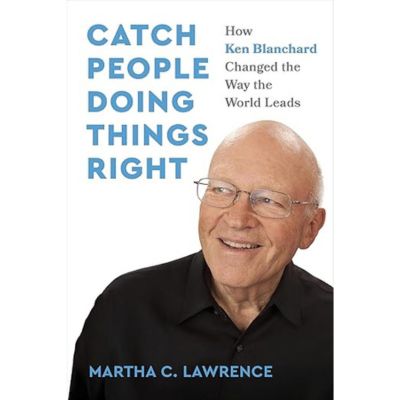

In this powerful episode of Inside Personal Growth, Greg Voisen pulls back the curtain on one of the most influential leadership icons of our time: Ken Blanchard. Joining him is Martha C. Lawrence, Ken’s long-time collaborator and executive director, to discuss her award-winning biography, Catch People Doing Things Right: How Ken Blanchard Changed the Way the World Leads.
What happens when a man told by his professors that he “couldn’t write” and “lacked academic interest” goes on to co-author one of the best-selling business books in history? This conversation explores the fascinating, often unconventional journey of the man behind The One Minute Manager. From his childhood as a “programmed optimist” to his evolution into a global leadership guru who views Jesus as the ultimate management model, Martha reveals the private moments and spiritual turning points that shaped Ken’s revolutionary philosophy.1 It is a story of intuition over conventional wisdom, of leading with love instead of power, and a reminder that the most effective way to change the world is simply to catch someone doing something right.
Redefining the “Pinnacle of Success”
Throughout the episode, Martha Lawrence shares intimate stories from her twenty-year collaboration with Ken. She describes him not just as a business titan, but as a human being who achieved the highest levels of professional success while remaining a spiritual role model.
Listeners will go behind the scenes of the Blanchard organization, learning how Ken and his wife, Margie, built a culture where values are the only boss. Whether it was navigating the financial fallout of 9/11 through radical transparency or choosing to write parables when the academic world demanded dry textbooks, Ken’s life serves as a blueprint for anyone looking to lead with integrity.
What Listeners Can Learn
-
The Power of Positive Reinforcement: Why “catching people doing things right” is scientifically more effective than traditional reprimands for driving performance.
-
Trusting Your Instincts: How Ken used his “inner voice” to take risks—like starting his own company—when conventional wisdom said otherwise.
-
Values-Based Crisis Management: The real story of how the Blanchard organization survived 9/11 without layoffs by prioritizing people over profits.
-
The “One Boss” Rule: How to structure an organization where core values—not the person with the fancy title—dictate every decision.
-
Leading with Love: Insights into how vulnerability and servant leadership can transform a workplace from the top down.
Connect with Our Guest
To dive deeper into the life and lessons of Ken Blanchard, explore Martha’s work and connect with her here:
-
The Book: Catch People Doing Things Right
-
Official Website: marthalawrence.com
-
LinkedIn: Connect with Martha C. Lawrence
You may also refer to the transcripts below for the full transcription (not edited) of the interview.
00;00;00;02 - 00;00;23;09
Speaker 1
Welcome back to Inside person group. This is Greg voice in the host of Inside Personal Growth. And we have a guest joining us from Escondido, California. Martha AC Lawrence, who has written a book called Catch People Doing Things Right. How can Blanchard Change the way the World leads? Martha, good day to you. How are you?
00;00;23;27 - 00;00;27;05
Speaker 2
I'm very well this morning, Greg. How are you?
00;00;27;07 - 00;00;53;27
Speaker 1
Great. Well, it's a pleasure having you on Inside Personal Growth to share your experiences of all the years you've spent with Ken and this wonderful book, which is also a way to teach our listeners, but at the same time, a memoir. Too many things that I didn't know about Ken, but I'm going to let our listeners know a little bit about you because you're the one that wrote this book.
00;00;55;10 - 00;01;38;04
Speaker 1
You know, I've had the pleasure actually, of sitting down face to face with Marcia, which was wonderful. We both live here in North San Diego County. Martha is a master editor who spent decades at Simon and Schuster and Harcourt before becoming the executive director of the Ken Blanchard Companies, where she collaborated with Ken for over 20 years. She edited hundreds of books, including multimillion copy bestsellers, number one, number one, New York Times bestsellers, and this book that she has written about Ken and his teachings and a bit of a memoir is wonderful.
00;01;38;16 - 00;02;03;08
Speaker 1
And I held the book up. But again, for all my listeners, we're going to have a link in the show notes below. Go to the link. You'll be able to go to Amazon and get a copy of the book. It just won the 2025, but we're in 2026 already. It's hard to believe Best Best Book Award for biography written with warmth, the narrative flow of a novel.
00;02;04;17 - 00;02;29;16
Speaker 1
And it's a wonderful book, but it reveals how a student who was told he couldn't write became one of the most influential leadership voices of our generation. What strikes me most about Martha's work is how she's captured the heart of Ken's revolutionary philosophy that leadership isn't about catching people doing things wrong, but about catching people, doing things right.
00;02;30;13 - 00;03;05;19
Speaker 1
It's a message that resonates deeply with everything we talk about on the show. Leading with love, serving others, bringing out the best in people, and even during life's most challenging moments. And for all of my listeners who are in and around the San Diego area, Martha is local resident. As I said, she lives in Escondido. She also coauthored Trust Works with Ken, which won a 2014 San Diego Book Award.
00;03;06;20 - 00;03;40;15
Speaker 1
So, Martha, welcome to the show. They can go to your website at Martha Lawrence and that's L.A. w r e AECOM To learn more about this book and to learn more about martha herself. Well, good day to you. It's a wonderful 2026 and we're off and running already. Let me ask you a question because, you know, you've worked with Ken personally for so long, you got to know him so well over all the decades.
00;03;41;18 - 00;04;06;20
Speaker 1
What prompted you to write this biography? I know that Ken's aging, obviously, and I know one you were if you were officially asked that the one to put something about Ken's organization into the book, what kept you pulling you back to tell this story versus it being another how to book?
00;04;07;08 - 00;04;30;27
Speaker 2
Well, first of all, thank you for that amazing introduction, Greg. And yeah, I, I started working with Ken in 2003 and actually nobody wanted me to write this book. There was I knew pretty quickly after meeting Ken who the minute you meet him and you know this Greg, you've had him on the show. Yes, a.
00;04;30;27 - 00;04;31;22
Speaker 1
Couple of times.
00;04;31;23 - 00;04;50;14
Speaker 2
Yeah. And you know, immediately he is just one of the nicest people you'll ever meet. And I, of course, knew of Ken. I, I had known of Ken for many, many years. I began my career in book publishing, so I had known him since the one minute manager took the world by storm. He was the coauthor of The One Minute Manager.
00;04;50;14 - 00;05;15;08
Speaker 2
But pretty quickly after meeting him, I recognized for a remarkable human being. He was I mean, here was this guy who was told in college that he couldn't write, and he goes on to coauthor, one of the bestselling business books of all time. He was told he had no academic interest when he was in graduate school. He was he was evaluated as not having enough academic interest.
00;05;15;08 - 00;05;38;28
Speaker 2
And yet he goes on to co-create one of the most widely used leadership role models in the world. And by his own admission, he couldn't even balance his own checkbook. And yet he establishes this global leadership organization. So that in itself was, you know, interesting enough. And he was, of course, the author of so many books. He just was a fascinating human being.
00;05;39;07 - 00;06;12;08
Speaker 2
But what really prompted me to write the book, Greg, was that there are so many stories about business people, really innovative, incredible business people. Steve Jobs, Elon Musk, you know, the list goes on and they're fascinating, but they're not for me necessarily great role models as human beings. And here was someone who had achieved the pinnacle of success and at the same time was somebody that I wanted to be when I grew up spiritually.
00;06;12;26 - 00;06;39;12
Speaker 2
So I thought, yeah, how did he do that? You know, how what what made what made this man so incredible? And so over the years, I would say, you know, Ken, what do you think about me writing a biography? And he was like, Oh, no, no, no, that's not that's not important. You know, what's important is serving others and and people around the company were like, I don't know if that's such a great idea, but I was compelled to do it.
00;06;39;14 - 00;06;46;16
Speaker 2
Just when COVID hit, it was like, somebody has got to record the life story of this man because he's incredible.
00;06;47;11 - 00;07;18;17
Speaker 1
He is indeed. And I have met him many times too, in person. And there is aura, if you want to say or something about him when you meet him. His vibrational energy is is really, really infectious. Right? It's kind of like, oh, this is somebody I'd like to be around a lot more. And, you know, one of the most beautiful lines from the book is that Baby Can Laugh Before he cried, he danced before he walked and he sang before he talked.
00;07;19;02 - 00;07;46;10
Speaker 1
His mother, Dorothy. And you've put pictures in here to repeat repeated This was so often that he actually programed his own optimism. Now, that's one thing that Ken has is optimistic. So how did Ken's parents, particularly his mother's boundless possible positive energy and his father's value driven leadership, shaped the man who would influence millions of people?
00;07;47;24 - 00;08;16;29
Speaker 2
Yeah, this was a really important part of the biography to me, you know, because his parents, he credits his parents with shaping his leadership point of view. His father retired as a rear admiral in the Navy and everyone who knew Ted Blanchard said that he was the most positive, incredible man. And they knew he he was definitely a leader, but he was also someone who was deeply humble.
00;08;17;18 - 00;08;36;14
Speaker 2
He taught Ken one of his first leadership lessons. When Ken was in seventh grade, he won the presidency of the seventh grade class and he went running home. And he was so proud of himself. Mom, Dad, I'm the president of the seventh grade, and his dad pulled him aside and said, Ken, that's great, son. I'm so proud of you.
00;08;36;14 - 00;09;04;21
Speaker 2
And now that you have that title president, don't ever use it. People follow leaders not because they have a fancy title, but because they trust them and they respect them. So right away, Ken is getting those leadership lessons. His mother, as you said, just an incredible optimist. She she had a daily habit of reading something called the Daily Word, which was put out by Unity Church.
00;09;04;22 - 00;09;46;19
Speaker 2
And she so she just loved that positive spiritual energy. And she taught Ken early on. She said, you're not better than anybody else, but nobody is better than you. There's a pearl of goodness in everyone, so dig for it. And those kinds of messages really got into Ken's DNA, but I think he came into the world. Honestly, Greg, I think he's one of those souls that just came in to be a teacher and a guide because he, as you know, as Dorothy talked about, he was from a young age that positive, positive little kid that just magnetically drew people to him.
00;09;47;14 - 00;10;21;29
Speaker 1
You know, it's this is a reflection, the kind of person you've written about here is the kind of people that we need more in leadership roles. I'm going to say this. Unfortunately, we're not experiencing that as a country. Many countries are not experiencing that. And you you're wondering where the values of those people kind of went, you know, their integrity, the values, because those are key things in a leader.
00;10;23;23 - 00;10;55;18
Speaker 1
And you mentioned in this book, and I think this is a great story about Ken, you called it the basketball story in the in the Prolog. It's very powerful where Ken heard an inner voice saying, this is your game, take it. You describe it as the first of several times he'd take a shot against all odds. Can you share how this willingness to trust his instincts showed up throughout his career, even when conventional wisdom said otherwise?
00;10;57;01 - 00;11;16;21
Speaker 2
Sure. That's a thank you. I'm glad you liked that story. First, I just want to comment on your comment about leadership in the world. And again, then I gets back to why I wrote the book, because somehow we've gotten this idea that leadership is about power and control. And that's the opposite of what Ken Blanchard teaches. You know, leadership is an influence process.
00;11;17;02 - 00;11;47;09
Speaker 2
It's it's we, not me. You know, it's to empower people. You don't control them. So so yeah. So he was quite a basketball player as a youngster. He he had flat feet and he didn't run very fast, but he had a killer outside jump shot. And so this was this was actually how he became friends with so many different groups, you know, long before long before there was desegregation, Ken was hanging out with black kids because he played basketball.
00;11;47;09 - 00;12;09;13
Speaker 2
But he was in this one game. It was I believe it was the championship game, and they were down 12 points. He hadn't played. And the coach put him in because he figured, why not? We're not going to win anyway. Well, Ken scored four baskets right away and pretty soon the game's tied. It went into to overtime. So here they are, sudden death, right?
00;12;09;22 - 00;12;34;02
Speaker 2
Then the next team to score is going to win the championship. And Ken was in this huddle with the coach and he just heard this inner voice saying, this is your game, take it. And so, you know, he goes out on to the court, he gets the ball, and from half court he sees an opening. And, you know, he's he's way out side, way out side.
00;12;34;02 - 00;13;02;01
Speaker 2
And he sees that opening and he takes that shot because he remembered it's my game. I'm going to take it. And the coach is losing his mind. But of course it hits nothing but net and that sort of thing. Where can just follow that inner guidance? Just it showed up when he he had a very secure position as a professor back east at the University of Massachusetts.
00;13;02;11 - 00;13;27;18
Speaker 2
And he was out here in California on sabbatical. And one of his graduate students invited him to speak at a young Presidents organization event. And he was so overwhelmingly charismatic and popular, he got this huge standing ovation and that and people said, wow, what are you going to do next? You've got to you know, you're amazing. And he said, I'm going to go back to the university and teach.
00;13;27;18 - 00;13;51;19
Speaker 2
And they said, you can't do that. You're when you're hot, you're hot. You've got to start your own company. Well, you know, he had this secure tenured position, but yet he took the chance to start his own company. He didn't have to dimes to rub together, you know, So the one minute manager there's another example of when everybody was writing these boring sort of textbooks in business.
00;13;51;19 - 00;14;19;13
Speaker 2
Here comes Ken writing this little parable story. Conventional wisdom would say, Do not publish that. In fact, his academic friends said, Can you can't publish that book. It's embarrassing. But Ken knew, you know, he had this instinct. This is what people need. So again and again, with servant leadership, you know, he was one of the first leadership thought leaders to advocate for servant leadership in the new era.
00;14;19;24 - 00;14;26;28
Speaker 2
And a lot of people thought that was pretty out there and woo, woo and risky. And Ken just went all in on it. So he's all.
00;14;26;28 - 00;14;56;04
Speaker 1
He has always been unconventional. And if you look at any of the leaders and I know you mentioned, you know, like Steve Jobs and Bill Gates and people like that, and they one of the things that I found in doing the research for my book was intuition. One thing I recognized about Ken is just the strength of his intuition, his willing to listen to the inner voice because he knows a higher spirit is speaking with him.
00;14;56;04 - 00;15;28;13
Speaker 1
He's very spiritual man, and that is very, very important in leadership. And I think people have to have that. You know, one of the thing you just mentioned was a one minute manager. I mean, it just became so crazy. It was like a whole new brand in the world, you know, is like Nike, right? Everybody. Did you read The One Minute manager and Bernie Browne commented that Ken was talking about vulnerability and love in leadership way before any of us.
00;15;28;13 - 00;15;41;05
Speaker 1
What made this little parable, the book that you just spoke about, so revolutionary at the time, and why does catching people doing things right still resonate 40 plus years later?
00;15;41;27 - 00;16;12;01
Speaker 2
Mm hmm. Yeah. The one minute that manager I remember was in New York when that was published. It was 1982, and, you know, it was everywhere. I think it's hard for people to understand now because there's so much noise and publishing has exploded. But back in the days when there were like six major publishers and now that book was everywhere at the time that was published, I think one of the reasons it was such a phenomenon is that business books tended to be long and dry and boring.
00;16;12;01 - 00;16;45;10
Speaker 2
They didn't even really have a business book section. It was just kind of lumped into nonfiction. And and along comes this little book. It's 100 pages. And it's not it's not narrative nonfiction. It's I mean, it's it's a narrative. It's a terrible about it. Young man who's looking for an effective manager. And it taught three secrets, you know, one minute goals, one minute praising and one minute reprimands, which are now called one minute redirects, because reprimand has a bit of a negative connotation.
00;16;45;10 - 00;17;06;29
Speaker 2
Yes, it does. So, you know, that's more side by side leadership now, not top down, but, you know, those three, I think the reason it still resonates and of course, catch people doing things right. The idea there is that once those goals are set and used, you have told people, shown people, guided people, coached people how to reach those goals.
00;17;06;29 - 00;17;32;07
Speaker 2
When you see them doing things that accomplish those goals, you catch them doing something right, you praise them. Ken found that praise is one. It releases dopamine in the brain and it's so much more effective than, you know, telling people what they're doing wrong and we're so hardwired to catch each other doing things wrong. You know, that's how we survived as a species.
00;17;32;07 - 00;17;52;28
Speaker 2
You know, we looked out of the savanna and if something was sketchy, we jumped on it before, killed us. Right. So we've got that negative bias. So it's really it sounds simple, but as Ken often says, common sense is not common practice. You know, you need to teach that lesson over and over about the importance of catching people, doing things right.
00;17;52;28 - 00;17;53;28
Speaker 2
So yeah.
00;17;54;06 - 00;18;21;24
Speaker 1
Probably part of it too. Martha Pardon me for interrupting, but no problem. You know, it's, it's as we've we've driven as business people, people that are listening to this to always be better, always do more. It's not enough. And so the not enough tape, you know, just keeps rolling in the head. But also the kind of self-criticism that we do for ourselves.
00;18;21;24 - 00;18;46;12
Speaker 1
And if you are to speak to Ken, I know that he would tell you is like, be easier on yourself. You know, take it easy. You know, you look at all the things you have done, look at all the things you have accomplish, right? And take those accomplishments as really something quite special that you've contributed to the world.
00;18;46;12 - 00;18;53;11
Speaker 1
And I think we miss that frequently. We were always saying, okay, what's next? What's next? What are we going to do next? Right?
00;18;54;13 - 00;19;20;20
Speaker 2
You're exactly right. And, you know, I remember working with Ken was such a trip because I none of these things came naturally to me. I've learned over the years being Ken's acolyte, as it were, But I'm pretty hard on myself. And I remember one time making a pretty bad mistake, and he pointed out to me that nobody had died as a result of my mistake.
00;19;20;20 - 00;19;42;08
Speaker 2
Right. And that I was being way too hard on myself. And you know, he just he just has that easy way where you know, it, things you can tell. He he doesn't let it bother him and he's not going to let your mistakes bother him either. He's. Yeah, that's such a good point, Greg. We need to be catch ourselves doing things.
00;19;42;08 - 00;20;03;18
Speaker 1
Right there besides having a lip manager or another leader do it. Now, one of the things that struck me and. And I've met Margie, his wife. It's been a while ago, but you had this is a, you know, clearly a kind of a central theme to the story. You describe how she was struck by three things about him very early on.
00;20;03;29 - 00;20;26;26
Speaker 1
One thing you've mentioned is his optimism, his talent for connecting with people, which that one is extremely strong and how he fell in love with her entire family. How did their partnership because they always say behind a great man is a great woman, shape Ken's leadership philosophy and his ability to lead with love.
00;20;28;06 - 00;20;41;18
Speaker 2
Oh, it's that's such an insightful question, Greg, because without Margie Blanchard, there wouldn't be a Ken Blanchard. Ken. Ken would probably be on a street corner somewhere with the hat out because she's.
00;20;42;02 - 00;20;42;11
Speaker 1
He.
00;20;42;21 - 00;21;14;25
Speaker 2
He really doesn't have the self-preservation skills. Along with all this beautiful heart and beautiful generosity comes a certain naivete, I think. Yeah, And Margie has that same deep heart and love of people. And yet she is she has a little more grounding and we can talk about that. But he can always says, I'm married above myself. He met Margie when he was at Cornell and she she is the one.
00;21;14;25 - 00;21;38;19
Speaker 2
She is actually the reader of the pair. You know, Ken is deeply immersed in leadership theory and knows a great deal about that, but he's not as voracious reader as Margie. And so Margie is the one. If something was going on, she would bring him what was new in leadership thought and, you know, call his attention to things.
00;21;39;12 - 00;21;52;26
Speaker 2
She also shared his values and augmented his values all along the way. You know, if he had a vision for something, she was the one who could figure out how to put how to put, you know, a foundation under that vision.
00;21;53;20 - 00;22;22;15
Speaker 1
Well, I think we talked about this just a little bit. And I want to ask this question because he is a man of faith and his spiritual journey has been interesting. And you wrote about it. You said Ken's faith journey is fascinating from Dizzy Flapper, Methodist mother who loved Robert Shiller to leaving the church after seeking a pastor fired atrociously to eventually suiting up for Jesus in his fifties.
00;22;23;09 - 00;22;57;09
Speaker 1
Walk us through kind of this evolutionary part that Ken went through in his life, where he pivoted. He had pivotal moments and people, because I used to listen to Norman Vincent Peale, Robert Schuller to Bob Buford, Peter Drucker, who helped him find his faith. You're saying, hey, he kind of like bounced around a bit. But the reality is he was looking for more, I think more spiritual ism versus religiosity.
00;22;58;06 - 00;23;27;13
Speaker 2
Yeah, it's well, I thought it was really important in his biography to talk about his faith journey because he was pretty I wouldn't say agnostic, but definitely not particularly focused on spirituality earlier in his life. I mean, his parents used to go to Norman Vincent Peale's Marble Collegiate Church in New York City, so he was exposed to that kind of positive spirituality and of course, admired that in his parents.
00;23;29;02 - 00;23;54;25
Speaker 2
When Margie, when he and Margie were in, let's see, he was just getting his a he had just started teaching graduate school, I think. And then they started they were in know it was when he was at the University of Ohio, Ohio University, he was teaching there. And they found a church early on in their married life. And as you mentioned, this was during the Vietnam War days.
00;23;54;25 - 00;24;23;22
Speaker 2
And there pastor at that church was participated in some of the protests because they were expanding the war into Cambodia. And the conservative congregation there fired that guy in the most vicious way. And Ken and Margie just said, if that's what Christianity is all about, forget it. We don't want any part of it. And Ken thinks that's sort of sad now because his kids grew up without any kind of exposure to any kind of spirituality.
00;24;24;23 - 00;24;45;26
Speaker 2
But he really he became interested again after the one minute manager. His publisher was looking for another project for him and said, Hey, how would you like to write a book with Norman Vincent Peale? And of course, Ken knew Norman from his days as a kid and said, Is he still alive? And he said, Yeah, not only is he alive, he's great.
00;24;45;26 - 00;25;19;10
Speaker 2
So Ken, Matt, Norman, Ken and Margie became really good friends with Norman and Ruth Peale. And Norman, of course, was very spiritual. And Ken didn't he wasn't ready to buy in that yet, though, but he was very influenced by him. And really, I think. Greg, what what did it was Ken reached a place where he had because Ken and Margie had their own company, but they ran into the same kinds of problems that their clients ran into, you know, personnel problems, budget problems, all that.
00;25;19;10 - 00;25;43;11
Speaker 2
And he can encountered this situation with a guy that they had hired to be president of the company who did not share their values, and he didn't know what to do about it. And I think he reached that point where a lot of us reach where it's like, I cannot handle this myself. And he turned to a power greater than himself, and he just surrendered in that moment and said, you know, I need your help.
00;25;43;14 - 00;26;11;19
Speaker 2
He just turned to a higher power and just said, I need your help with the situation. And he found so much. He had that flood of relief. And that happens. If you've ever had a spiritual experience like that, when you recognize that your ego can't handle something. So so I think that was the moment. That's the moment that he talks about that he well, and then, of course, he had those friendships you talked about with Buford and Bill Hybels and and Peter Drucker.
00;26;11;19 - 00;26;14;20
Speaker 2
And and they, they they also influenced him.
00;26;15;01 - 00;26;50;09
Speaker 1
Yeah. And, you know, he carried the title of chief spiritual officer rather than CEO. The book reveals that Ken Blanchard, our Blanchard Training and development, spent this considerable time defining the core values which were ethical behavior, relationships, success and learning ranked in that order. So how did can actually live by the principles that when a company is truly leading by its values, there is only one boss?
00;26;50;09 - 00;27;10;05
Speaker 1
The values, not the boss, right? Yeah, because there is no boss in that case, it's the values that are direct in the company. All right. You. You were at the company long enough. You got to see lots. So what was your what are Martha's thoughts about that?
00;27;10;27 - 00;27;38;24
Speaker 2
Well, yeah, I watched that happen several times. Where and the reason they're ranked in order, you know, ethical behavior, relationships, success and learning is that you make the decision based on those, you know, if if it if that preserves relationships but it's not ethical, then sorry. Ethical trumps relationships. Right. So so well, 911 is a great example of living by those values.
00;27;40;08 - 00;28;10;02
Speaker 2
After 911, like so many companies, the Blanchard Organization started bleeding money and they had an emergency leadership meeting and and decided they needed to cut staff because how else where they're going to, you know, make their make their payments and I talked to someone who was in that meeting with Ken and she said that he he just looked up from the table and there were tears streaming down his face and he said, we're not going to do that.
00;28;10;02 - 00;28;26;28
Speaker 2
We are not going to put people I didn't build this company to put my friends out on the street at a time like this. We got to think of something else. And of course, everyone else, nobody wanted to let people go on and they said, Ken, that's great. But you know, the banks are going to own the company.
00;28;26;28 - 00;28;52;16
Speaker 2
What do you recommend we do? And he said, let's, you know, let's be completely transparent. Let's open the books to everybody, Let's brainstorm together. Let's figure this out together. And that's exactly what they did. And, you know, between people voluntarily cutting salaries and other cost measures, they made it through. And then, you know, Ken said, when we get through this, we're all going to go to Hawaii.
00;28;52;16 - 00;29;13;04
Speaker 2
And by golly, we all went to Hawaii once the economy turned around. You know, So it's that that's the kind of thing that now now not every company is able to do that in every economy. I understand that there are times, but there's a loving way to do that when you're when you're having to do those kinds of hard decisions.
00;29;13;04 - 00;29;17;25
Speaker 2
There's a way to do it without being cold and impersonal.
00;29;18;07 - 00;29;48;24
Speaker 1
Yeah. You know, there there's a story in the book and you share it where I can forgot his I.D. when he was boarding a Southwest flight. So he used the book with the cover of Don Shula on it to get on the flight, which became a teaching moment about customer focused versus hierarchy focused companies, which was Southwest. And how did can use his own life experience.
00;29;48;24 - 00;29;55;07
Speaker 1
Even mishaps like this as leadership lessons as you kind of following them around for many years.
00;29;56;15 - 00;30;16;05
Speaker 2
Yeah that was hilarious I think it's hard for listeners today might go what somebody let him under an airplane with no I.D. you know, But that was before 911 and all you had to do was show a picture that matched your ticket at that time, you know, So. So yeah, he had the it was his picture of Ken with Don Shula on the cover of this book.
00;30;16;05 - 00;30;39;04
Speaker 2
And and it was funny when the skycap at Southwest saw that he said he knows Shula put him in first class. I know first Southwest didn't have a first class. It was a joke. But. But and then, you know, Ken talks about how the other airlines were a lot more bureaucratic about it. And he you know, he said the to he got bumped up so many levels.
00;30;39;04 - 00;31;13;22
Speaker 2
Quack, quack, quack, quack. People kept quacking at him until he talked to the head mallard at the top, you know, and he did use that as an example. Another thing like Ken was looking everywhere for for leadership lessons. He, for example, he wrote a whole book based on a visit he took to SeaWorld. You know, he was so struck by the fact that people could get into a tank of water with a four or five ton killer whale and and work with.
00;31;13;22 - 00;31;35;00
Speaker 2
And of course, now, you know, we don't do that anymore because of the sensitivity to the animals. But what he found out from the trainers is that you don't punish a killer whale. You know, they don't they they all of that was done through positive interactions with the animal. And that can seem like a very valuable leadership lesson.
00;31;35;00 - 00;31;58;08
Speaker 2
You know, the punishment is not the way to to get performance from people. So he wrote a book called Whale Done The Power of Positive Relationships. So, you know, Ken, Ken was always he would tell on his himself. One of the stories he used to tell is how his ego got in the way and almost cost him a career move.
00;31;59;05 - 00;32;19;05
Speaker 2
Back when he was set, the university of Ohio, he had his Ph.D. and he had heard that there was this great class taught by Paul Hersey and and he wanted to take it, but Hersey required him to sign up for the class. And he was like, I'm on the faculty. Why should I have to sign up for this class?
00;32;19;05 - 00;32;44;09
Speaker 2
You know? And he talked to Margie about it, and she said, Is it is the class supposed to be good? He said, it's supposed to be fabulous. Share. Get your ego out of the way and sign up for the class. And and that led to his collaboration with Paul Hersey and he and Paul. Dr. Paul Hersey co-created Situational Leadership, which is, of course, one of the most widely used leadership models in the world today.
00;32;44;10 - 00;32;52;21
Speaker 2
Ken teaches S.L. too, which is a variation of that. But Ken's relationship with Paul Hersey was very important to him.
00;32;53;02 - 00;33;24;17
Speaker 1
Well, well, you know, he obviously through over the years, Ken has been referred to as like this management guru. But increasingly, he's kind of been indentified as a disciple of Jesus, right. Following the commandments to love God, love your neighbor as yourself. He definitely exemplifies that. And as he's grown older here, his mission is to be a loving teacher and example of simple truths to help motivate others.
00;33;24;26 - 00;33;35;07
Speaker 1
How did he balance being at the top of his field while striving for this kind of humble servant leadership in your estimation?
00;33;35;23 - 00;33;58;12
Speaker 2
Hmm, excellent question. Well, you know, Ken, by the way, he doesn't call himself a Christian. He calls himself a follower of Jesus. Yeah, He considers Jesus to be just a great leadership role model. It was Robert Schuller that pointed out to Ken on he was on his TV show and he said, you know, Jesus was the original one minute manager.
00;33;58;12 - 00;34;22;12
Speaker 2
You know, he he set goals with people. He caught them doing things right. And he redirected them when when they were, you know, so that that was one of his early things. But this is an interesting question. How does he balance that? What I actually asked him that question. I happened to be talking to him yesterday and I said, how do you balance that, Ken?
00;34;22;12 - 00;34;44;06
Speaker 2
And he said he said, it's not about me. It's about the people I'm serving. You know, I don't he just doesn't think about himself. But as someone who has observed Ken over the years, I know that he has a spiritual practice just like his mom, and he reads his daily word in the morning. He has kept a journal for many years.
00;34;44;06 - 00;35;11;29
Speaker 2
He does his positive affirmations. He's belong to a men's group that has people, a men from incredible men from various faiths in that men's group. So he he definitely has a spiritual practice, and I think that has helped him to balance that. And and I also just wanted to say, Greg that in addition to all this spiritual stuff, he's also some he's probably one of the hardest working people I've ever known.
00;35;11;29 - 00;35;27;13
Speaker 2
And, you know, I he said, well, I learned that from my dad. My dad told me that if I wanted to be a success, I only had to work half a day the first 12 hours of the second, 12 hours and, you know, so so Ken has definitely put in the work.
00;35;28;03 - 00;35;58;22
Speaker 1
Yeah, definitely. You know, now, you know, look, you've written a great memoir here. You've written a book that really shows the readers who Ken is all about and what the teachings are all about. If someone listening to this podcast has never read the One Minute manager study Ken's work, what's the one core principle story from this book that you hope will inspire them to become a better leader, whether at work or at home or the community?
00;35;59;05 - 00;36;09;00
Speaker 1
And what would Ken want us to remember most about how to lead and how to live?
00;36;09;00 - 00;36;30;02
Speaker 2
Well, my answer is right there in the title, Catch People Doing Things Right. And someone someone once asked Ken about all the things you've taught over the years. What if you could only hold on to one thing? What would it be? And he said it would be catch people doing things right, you know, because we don't get enough acknowledgment in the world.
00;36;30;02 - 00;37;02;28
Speaker 2
You pointed out, Greg, that we don't acknowledge ourselves enough. We're too hard on ourselves. There's again, there's such negative bias in the world and just try it just it doesn't mean slap someone on the back and say, atta boy out of girl. That's meaningless. It's shallow. Could even be considered toxic positivity, you know. But a true good praising or acknowledgment is to really take the time to think about something that someone did for you.
00;37;02;28 - 00;37;35;17
Speaker 2
Tell them how it made you feel. Tell them the difference it made in your life and give them that acknowledgment no matter who they are, whether it's your spouse, your child, your parent. One of my favorite stories from the book is when Father was Dying and he created that tape. He went outside the hospital room and he poured his his acknowledgment of his father into this cassette tape and gave it to his father before he left for the day and said, Hey, dad, I think, listen, you might enjoy listening to this.
00;37;35;17 - 00;38;02;08
Speaker 2
And when he got the call that his father had passed away that morning, in the wee hours of that morning, I asked the nurse, you know, did Dad get to listen to that tape? And she said over and over and over again. And, you know, because it just it acknowledged him for what his life had meant. And we all have that opportunity to acknowledge each other and we need to do more of it.
00;38;03;01 - 00;38;28;15
Speaker 1
Well, I think, Martha, what you have done by writing this book about Ken is acknowledge him for the value that he's brought to the world, for the difference he's made in so many lives of people who've read everything from the one minute manager to who moved my cheese to whatever it made. It might have been because he has so many books out there.
00;38;28;24 - 00;38;32;23
Speaker 1
I don't know what the number is. What is the number of books at this point that he's written?
00;38;32;23 - 00;38;33;12
Speaker 2
70.
00;38;33;18 - 00;38;58;23
Speaker 1
70. Wow. So that is just in itself a a tribute to this man to have 70 great books that people could pick up. We'll put links to many of them in the show notes. A look below besides this one catch people doing things right. We'll also put a link to Martha's website so you can learn more about Martha and what she is doing.
00;38;58;23 - 00;39;24;21
Speaker 1
And this book. It's just Martha Laurence and that's w it's la w r e n c e dot com easy to get to. Great website, by the way, Martha, it's been an honor and a pleasure to have you on the show to speak with my listener about catch people doing things right and then hold the book up again there for all our listeners.
00;39;24;21 - 00;39;29;20
Speaker 1
Go out and get this book and any last words. Martha you want to leave our listeners with?
00;39;31;01 - 00;39;57;01
Speaker 2
Oh, I just want to say thanks, Greg, for this wonderful podcast. I've listened to so many fantastic shows I love. You're just diving right into that spiritual spirituality in business. I mean, I wish more people had the guts to do that. So I just want to acknowledge you for that. And it's wonderful. I think if if there were more people doing what you're doing, the world would be a better place.
00;39;57;19 - 00;40;18;15
Speaker 1
Thank you for the compliment. And if you would send my blessings to Ken. I have not spoken with him in a long time and just tell him that we did this interview and that I'll send him a link. I still have his email so he can watch this interview that you and I did. So thanks so much.
00;40;19;29 - 00;40;22;18
Speaker 2
Thank you.
Sign up to receive email updates
Enter your name and email address below and I'll send you periodic updates about the podcast.











Leave a Reply