


with Gabrielle Bosche
Feb 12, 2026
Inside Personal Growth
Listen on your favorite platforms
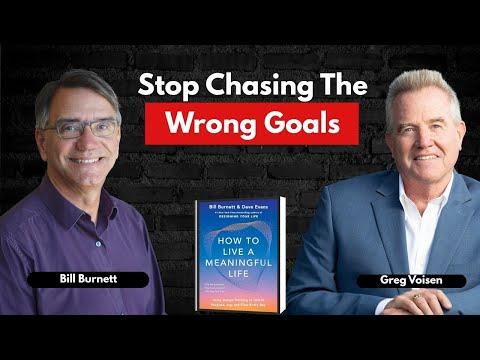
In this episode of Inside Personal Growth, Greg Voisen sits down with Bill Burnett, the Executive Director of the Design Program at Stanford University and the visionary co-author of the global bestseller Designing Your Work Life. In this profound and timely conversation, Bill discusses the core philosophy behind his latest work, How to Live a Meaningful Life: Using Design Thinking to Unlock Purpose, Joy, and Flow Every Day. This book isn't just a sequel; it is a vital manual for anyone who has reached the summit of traditional success only to find the air thin and the view surprisingly empty.
We live in a culture obsessed with achievement. From a young age, we are told to check the boxes: get the degree, land the impressive title, secure the high salary, and accumulate the external markers of a "good life." Yet, as Bill Burnett points out, many of the world’s most successful people wake up at 3:00 AM with a hollow ache in their chest, asking, "Is this all there is?"
The tragedy of the modern professional is the belief that this lack of fulfillment means they are broken. Bill’s message is a liberating reframe: You aren’t broken; you are misaligned. You have been using the wrong tools to solve a problem of the soul. You have been treating your life like a transaction to be optimized rather than an experience to be designed.
At the heart of Bill’s design philosophy is a deep understanding of neuroscience. He explains that our brains operate through two primary systems: the Achieving Brain and the Awakened Brain.
The Achieving Brain is located primarily in the prefrontal cortex. It is the seat of executive function—the part of us that makes lists, hits deadlines, and navigates the transactional world. While necessary for survival, the Achieving Brain is incapable of experiencing deep meaning. It is always focused on the "next thing," living in a perpetual state of future-tension or past-regret.
The Awakened Brain, conversely, is the system that allows for presence, connection, and transcendence. This is where meaning lives. When we are "fully alive," we have shifted our primary awareness from the transactional "doing" to the experiential "becoming." Bill argues that we have over-indexed on achievement at the expense of awakening, leading to a "meaning crisis" that no amount of career advancement can fix.
One of the most provocative points in the interview is Bill’s critique of the "impact mindset." We are often told that to have a meaningful life, we must make a "big impact" or "change the world." While noble, Bill warns that placing all your "meaning eggs" in the impact basket is a recipe for disappointment. Impact is transactional; it is an outcome you cannot always control.
Instead, Bill introduces a concept from philosophy known as the Scandal of Particularity. This is the idea that we don't experience ultimate truths like love, beauty, or truth in the abstract or the "big." We experience them in specific, tiny, finite moments.
"Meaning is found in the intimate, not just the ultimate."
Whether it is the specific shade of purple on a flower during a morning walk or the look on a child's face when you give them a cupcake, these "particular" moments are the gateways to a meaningful life. Bill teaches us to become "moment designers," learning to inhabit the present so deeply that time seems to stand still.
Design thinking is, by definition, practical. Bill doesn't just offer philosophy; he offers a "bias to action." He shares tools that can be implemented immediately:
In a world that is more connected than ever via technology, loneliness is at an all-time high. Bill notes that the U.S. Surgeon General has declared loneliness a primary health crisis. The solution isn't just "more social events."
Bill distinguishes between social groups (fun but shallow) and Formative Communities. A formative community is a group of people who gather around a "focal question"—a shared intent to help one another become better versions of themselves. These are "packs" where vulnerability is the currency and growth is the goal. Bill shares his own experience of being in a men’s group for 32 years, proving that deep, meaningful connection requires design and commitment, not just proximity.
From Gen Z students at Stanford who feel the heavy weight of the world’s chaos to retirees wondering what their next chapter holds, Bill Burnett’s insights provide a roadmap. He reminds us that even in tumultuous times, being "fully alive" is an act of rebellion and a source of power. By using the mindsets of a designer—curiosity, reframing, and radical collaboration—we can move from a life of mere transactions to a life of profound meaning.
Our Guest, Bill Burnett: ➥ Book: How to Live a Meaningful Life: Using Design Thinking to Unlock Purpose, Joy, and Flow Every Day ➥ Buy Now: a.co/d/hf7xjdO Website: designingyour.life LinkedIn: linkedin.com/in/bill-burnett-4225401/ ➡️Instagram: @fullyalive_bydesign ➡️Youtube: Designing Your Life on YouTube
You may also refer to the transcripts below for the full transcription (not edited) of the interview.
Continue Listening