

 #1269
#1269Podcast 1269: The Holistic Wealth Strategy: A Framework for Building Legacy Wealth and Unlimited Freedom to Live an Extraordinary Life
Oct 24, 2025
Inside Personal Growth
Listen on your favorite platforms
In this episode
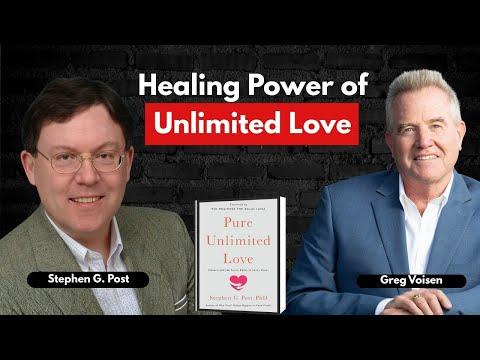
In this episode of Inside Personal Growth, Greg Voisen sits down with world-renowned scholar and "founding member" of the show, Stephen G. Post, for a profound exploration of his latest work, Pure Unlimited Love: Science and the Seven Paths to Inner Peace. Imagine a reality where the security and well-being of another is as real to you as your own—a concept so powerful it prompted the 92-year-old Dalai Lama to break his years-long hiatus on writing forewords just to endorse this specific mission.
We live in an age of "fractured centers." Families are divided by politics, stress levels are at an all-time high, and the sense of community feels like it is slipping through our fingers. Yet, Dr. Post argues that the remedy isn't found in a new policy or a better argument—it is found in the biological and spiritual architecture of love.
One of the most compelling segments of the conversation revolves around what scientists call the "Giver’s Glow." This isn't just a poetic metaphor for feeling good; it is a measurable physiological state. Dr. Post explains that when we engage in "kind giving"—giving with heart and intentionality—the brain’s reward systems and the limbic pathway light up.
Interestingly, the brain cannot easily sustain two opposing emotional states simultaneously. When the pathways associated with altruism and compassion are activated, the "rumination" pathways—those responsible for anxiety, fear, and hostility—effectively shut down. It is the biological realization of the ancient proverb: "Perfect love casts out fear."
Dr. Post shares staggering data from a survey of 5,000 Americans:
Beyond the "feel-good" factor, the physical benefits are concrete. Chronic stress floods the body with cortisol, which converts metabolites into fatty acids (leading to vascular disease) and impairs the hippocampus (damaging short-term memory). Kind giving acts as a natural "stress-buster," lowering blood pressure, reducing systemic inflammation, and even improving cholesterol levels.
Ethereal concepts of love can often feel out of reach in the "real world." To bridge this gap, Dr. Post introduces a practical framework. He emphasizes that love isn't a monolith; it manifests in different "spokes" on a wheel. One of the most unique concepts he discusses is "Carefrontation."
Borrowed from the legendary Scott Peck (author of The Road Less Traveled), carefrontation is the art of corrective love. It’s the ability to steer a colleague or loved one back onto their path with integrity and kindness rather than destructive confrontation. It proves that love isn't always "nice" in a passive sense—it is active, courageous, and sometimes corrective.
Other spokes on the wheel include:
Dr. Post’s journey isn’t just academic; it’s deeply personal. He recounts a chilling story from his youth—a recurring dream of a "Blue Angel" and a young man with dirty blond hair standing on the edge of a bridge. This dream haunted him for years, providing a vivid image of a man about to jump and a voice saying, "If you save him, you too shall live."
Years later, while walking across the Golden Gate Bridge in a thick San Francisco fog, the dream became a reality. Dr. Post encountered that very man. By intervening and sharing a message of interconnectedness, he was able to pull the stranger back from the edge. This wasn't a coincidence; Dr. Post describes it as an intersection with the "One Mind." It suggests that our consciousness isn't just a byproduct of brain tissue, but something that flows through us, connecting us in moments of dire need.
Dr. Post digs deep into the data regarding why altruistic people live longer. It isn't just about the absence of stress; it's about the presence of vitality. When we help others, our body releases oxytocin and dopamine, creating a "helper's high" that strengthens the immune system.
He notes that in medical schools, students often enter with high levels of empathy, but the grueling nature of the curriculum can lead to "empathy erosion." His mission at Stony Brook is to reverse this, teaching doctors that compassion isn't just a "bedside manner" skill—it's a clinical tool that improves patient outcomes and prevents physician burnout. When a doctor connects with a patient's humanity, the healing process becomes a two-way street of emotional energy.
In a world obsessed with "finding your passion," Dr. Post offers counterintuitive advice: Your calling will find you. He suggests that when you commit to serving an "identifiable constituency"—whether it’s the homeless, the "deeply forgetful" (those with dementia), or students—the path reveals itself.
Purpose is not a destination you reach; it’s a byproduct of service. When you use your unique talents to benefit others, the line between "work" and "play" blurs. Dr. Post shares his own experience working with Alzheimer's patients for over 30 years. He calls them the "deeply forgetful" and emphasizes that even when memory fades, the spirit’s capacity to give and receive love remains intact. This realization turned his career from a job into a lifelong calling.
As the interview nears its end, Greg and Dr. Post tackle the "elephant in the room": the extreme polarization of our current culture. Families are being torn apart by differing political views, and dignity in disagreement has become a rare commodity.
Dr. Post’s solution is a return to "Scientific Mysticism." When we view others through the lens of pure, unlimited love, we recognize their infinite value, regardless of their political stance. He encourages us to "disagree with dignity," remembering that "hurt people hurt people." He suggests that we stop "worshipping the political" and instead re-center ourselves on spiritual truths that outlast any election cycle. By shifting our focus from being "right" to being "loving," we create a space where the center can finally hold.
The message of Pure, Unlimited Love is ultimately one of hope. It reminds us that even in our darkest moments of anxiety or division, we have a biological and spiritual "reset button." By turning our attention outward to the needs of others, we don't just help the world—we heal ourselves. As the Dalai Lama notes in the foreword, the convergence of science and spirituality in this work provides a roadmap for a more compassionate future.
Connect with Our Guest, Stephen G. Post:
Book: Pure Unlimited Love: Science and the Seven Paths to Inner Peace
Buy Now: a.co/d/gdjrkOE
Website: stephengpost.com
LinkedIn: Stephen G. Post
Instagram: @stephengpost
You may also refer to the transcripts below for the full transcription (not edited) of the interview.
Continue Listening