

with Susan Fowler
May 12, 2026
Inside Personal Growth
Listen on your favorite platforms
In this episode
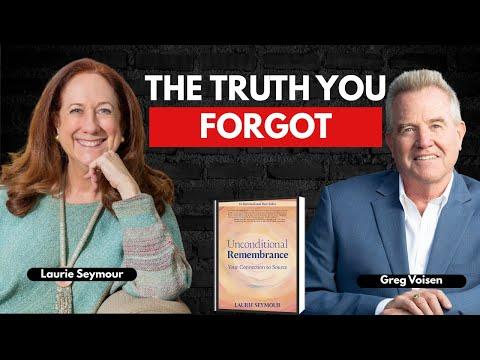
In a world shaped by striving, fixing, and constant self-improvement, the idea that nothing is actually broken can feel radical. In this powerful episode of Inside Personal Growth, host Greg Voisen sits down with Laurie Seymour, author, spiritual teacher, and founder of the BACA Institute, to explore a deeper truth—one that doesn’t require healing, effort, or belief, but remembrance.
Laurie’s work centers on a simple yet transformative insight: we don’t need to become whole—we already are. What’s missing isn’t something to acquire, but something to remember.
Laurie Seymour’s book, Unconditional Remembrance: Your Connection to Source, is not a guide to self-improvement or a roadmap for fixing what’s wrong. Instead, it is an invitation to experience what has always been present beneath layers of conditioning, doubt, and separation.
She describes unconditional remembrance as the physical, embodied knowing that we are not separate from Source—that love, intelligence, and connection are not external goals, but internal realities. This remembrance isn’t conceptual; it’s cellular. It lives in the body, not the mind.
Unlike traditional healing paradigms that reinforce the idea that something is broken, Laurie’s approach gently dismantles that belief. Healing, she explains, can become a trap when it assumes there is something fundamentally wrong with us. Remembrance, on the other hand, restores access to our natural state.
A central theme in the conversation is forgetting—not as failure, but as part of the human experience. According to Laurie, we enter life with an innate knowing of connection, only to gradually forget it as we learn how to survive, belong, and meet our needs in the world.
This forgetting creates the illusion of separation:
The ego, or “small self,” isn’t the enemy—it serves an important role. But when we believe it is the whole of who we are, we lose access to the larger Self: the aspect of us that exists beyond fear, striving, and limitation.
Unconditional remembrance doesn’t eliminate the ego; it places it in context.
Laurie offers a refreshing perspective on self-doubt. Rather than seeing it as something to overcome, she frames doubt as a form of contrast—a way to recognize truth by feeling what isn’t true.
When we’ve experienced even a brief moment of unconditional love or deep connection, doubt helps us discern the difference between truth and conditioned belief. The heart, she explains, has its own intelligence. It knows.
The real issue isn’t doubt—it’s mistaking doubt for truth.
One of the most profound parts of the conversation centers on emptiness—the uncomfortable space that arises when something has ended but nothing new has yet begun.
Laurie explains that the void is not something to escape or fill. It’s a necessary stage of creation.
Nature itself abhors a vacuum, but if we rush to fill emptiness with explanations, distractions, or meaning, we interrupt the creative cycle. When we allow ourselves to stay with not knowing—without trying to fix or understand it—something new begins to emerge.
This is where genuine transformation happens.
Another key insight Laurie shares is the difference between personal will and inner law.
Personal will is driven by control, safety, and expectation. Inner law arises from surrender—an openness to guidance beyond the ego’s plans. When we live from inner law, decisions feel clearer, action becomes aligned, and creativity flows from a deeper source.
This shift doesn’t require faith or spirituality. It begins with curiosity, stillness, and a willingness to listen inwardly.
Many listeners resonate with the idea of being “bridge builders”—people who have moved through pain and now feel called to help others. Laurie offers a simple but powerful insight: if the thought of sharing your gift arises, it’s already time.
You don’t need to be fully healed. You don’t need certainty. The invitation itself is the signal.
Growth doesn’t move in straight lines. Quantum shifts happen when we pay attention to subtle inner nudges and allow ourselves to follow them.
When asked what would change if the world lived from unconditional remembrance, Laurie’s answer is clear: separation would dissolve.
The “us vs. them” mentality would lose its grip. Compassion would replace fear. Care for the planet, for one another, and for ourselves would no longer be optional—it would be natural.
To remember is to see through the eyes of connection.
Unconditional remembrance is not about becoming someone new—it’s about returning to what has always been true. In a time of uncertainty, noise, and division, Laurie Seymour’s message is both grounding and expansive:
You were never broken. You simply forgot.
And remembering changes everything.
You may also refer to the transcripts below for the full transcription (not edited) of the interview.
Continue Listening