

with Anton Grosz
Feb 26, 2026
Inside Personal Growth
Listen on your favorite platforms
In this episode
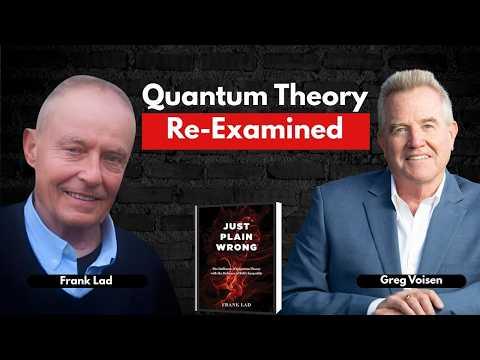
In this episode of Inside Personal Growth, host Greg Voisen sits down with Frank Lad to discuss his groundbreaking book, Just Plain Wrong: The Dalliance of Quantum Theory with the Defiance of Bell’s Inequality. Frank, a mathematician and probability expert, challenges long-standing scientific beliefs and exposes fundamental mathematical errors in quantum mechanics.
Frank Lad, a research associate at the University of Canterbury, has spent years analyzing the flaws in Bell’s Inequality, a fundamental principle in quantum mechanics that many physicists accept without question. In his book, he argues that the conventional interpretation of Bell’s Theorem is mathematically incorrect and rooted in a misunderstanding of probability theory. Bell’s Inequality suggests that quantum mechanics supports non-locality, meaning that two entangled particles can influence each other instantaneously across vast distances. However, Lad’s findings reveal that this widely accepted theory is built upon an error of neglect, where crucial mathematical relationships were overlooked.
One of the most fascinating aspects of this discussion is how Albert Einstein originally questioned the probabilistic nature of quantum mechanics. Einstein famously rejected the idea that “God plays dice” and believed there must be hidden variables that explain quantum behavior deterministically. Lad expands on this idea, showing that probability in quantum mechanics has been misunderstood for decades. According to Lad, the scientific establishment has been resistant to challenging mainstream ideas, which has allowed errors in quantum mechanics to persist. He argues that the scientific community needs to embrace critical thinking and mathematical scrutiny to correct past misconceptions.
A key takeaway from Lad’s book is the importance of probability theory in understanding quantum mechanics. Rather than viewing probability as an inherent property of particles, he suggests that it represents our lack of knowledge about hidden variables. This perspective could revolutionize how we approach quantum physics, moving it from mysticism to rigorous scientific methodology. Lad also introduces the idea that entanglement is often misinterpreted. Instead of two particles influencing each other instantaneously, he suggests that their behaviors are better explained by understanding the deeper statistical properties governing their interactions.
Lad’s findings have not been widely accepted in mainstream physics, largely because they challenge Nobel Prize-winning research. He highlights the difficulty of introducing new perspectives in a field that heavily relies on established dogmas. However, he remains committed to presenting his work at conferences and engaging in discussions with physicists worldwide. He will be presenting his research at the American Physical Society Conference in March, where he hopes to encourage open dialogue among scientists.
If you're intrigued by this discussion and want to dive deeper into Lad’s theories, you can explore his work here:
This conversation with Frank Lad highlights the importance of questioning mainstream science and critically analyzing widely accepted theories. His work on Bell’s Inequality and hidden variables challenges some of the deepest assumptions in quantum mechanics and opens the door for future breakthroughs. Whether you're a science enthusiast, mathematician, or simply curious about how the universe works, this is a discussion you don’t want to miss.
You may also refer to the transcripts below for the full transcription (not edited) of the interview.
Continue Listening