
In this episode of Inside Personal Growth, Greg Voisen sits down with world-renowned motivation expert Susan Fowler to dismantle everything you thought you knew about “lighting a fire” under your team.
For decades, the corporate world has been obsessed with a singular question: How do we motivate our people? We’ve tried bonuses, corner offices, “Employee of the Month” plaques, and more recently, ping-pong tables and free snacks. Yet, despite these efforts, global engagement levels remain abysmal, and the “Quiet Quitting” epidemic continues to drain productivity.
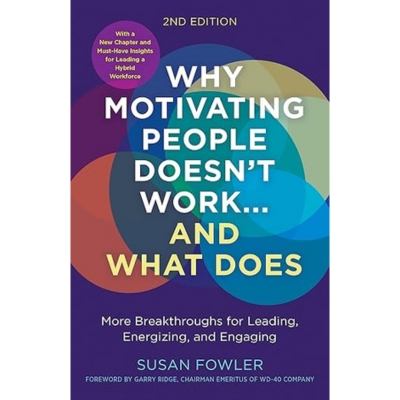
In this deep-dive conversation, Susan Fowler, author of the groundbreaking book Why Motivating People Doesn’t Work…and What Does, Second Edition: More Breakthroughs for Leading, Energizing, and Engaging, reveals a revolutionary truth: The problem isn’t that people aren’t motivated; it’s the quality of the motivation they are using.
The Great Motivation Myth
Most leaders still rely on the “carrot and stick” method—a psychological relic of the 1940s based on research done on pigeons. The theory was simple: reward the behavior you want and punish the behavior you don’t. However, as Susan explains, humans are not pigeons.
When we use external rewards (carrots) to drive behavior, we are feeding our teams “psychological junk food.” It provides a temporary burst of energy—a sugar high—but it is unsustainable. Eventually, the person crashes, and they require an even bigger carrot to get moving again. This cycle doesn’t just fail to produce long-term results; it actively undermines creativity and problem-solving.
The ARC of Optimal Motivation
If “motivating” people doesn’t work, what does? Susan points to Self-Determination Theory, which identifies three basic psychological needs that must be satisfied for a human being to thrive. She uses the acronym ARC:
1. Autonomy (Choice)
Autonomy is the need to feel that we are the architects of our own lives. It’s the sense of agency. When a leader mandates that everyone must return to the office five days a week without explanation, they destroy autonomy. However, if a leader explains the rationale and asks the team to help decide which days would be best for collaboration, they provide Choice. People don’t want to be controlled; they want to be the directors of their own efforts.
2. Relatedness (Connection)
We are social creatures. We need to feel that we belong and that our work contributes to something greater than ourselves. High-quality motivation comes when people feel a deep sense of connection to their colleagues and a clear alignment with the company’s values. In a toxic workplace, relatedness is the first thing to go.
3. Competence
Competence is the need to feel effective at what we do and to experience growth. Susan notes that many people left their jobs post-pandemic because they felt stagnant. If an employee doesn’t see a path to learn, evolve, and master new skills, their motivation shifts from “optimal” to “suboptimal.”
The Six Motivational Outlooks
One of the most profound insights Susan shares is that motivation is a spectrum, not a binary “on/off” switch. There are six “Motivational Outlooks”:
Suboptimal Outlooks (The Junk Food):
-
Disinterested: You simply don’t see the value in the task.
-
External: You’re doing it only for the reward (money, status, or praise).
-
Imposed: You’re doing it because you feel you have to, or out of guilt or fear of letdown.
Optimal Outlooks (The Health Food):
-
Aligned: You do it because it aligns with a significant value, like family or health.
-
Integrated: You do it because it is core to who you are (e.g., “I am a teacher”).
-
Inherent: Pure intrinsic motivation—you do it because you simply love the activity.
Practical Steps for Leaders
Susan challenges leaders to stop asking “How can I motivate my people?” and start asking “How can I create an environment where my people are likely to satisfy their needs for Choice, Connection, and Competence?”
She suggests moving away from “holding people accountable”—which feels like a threat—and toward “helping people be accountable.” This involves having Motivation Conversations. Instead of focusing on the deadline, ask: “What choices do you feel you have in this project?” or “How does this task help you grow the skills you want to develop?”
The Future of Work: Hybrid and AI
As we navigate the new landscape of hybrid work and the integration of AI, the ARC framework is more important than ever. Remote work can be lonely (attacking Connection), and new technology can make people feel obsolete (attacking Competence). Leaders who prioritize these psychological needs will not only see higher productivity but will foster a culture of vitality and genuine well-being.
As Susan beautifully puts it, “Every day we are above ground is a good day.” But to make those days truly meaningful at work, we must move beyond the carrot and the stick and embrace the science of human flourishing.
You may also refer to the transcripts below for the full transcription (not edited) of the interview.
[fusebox_transcript]











Leave a Reply