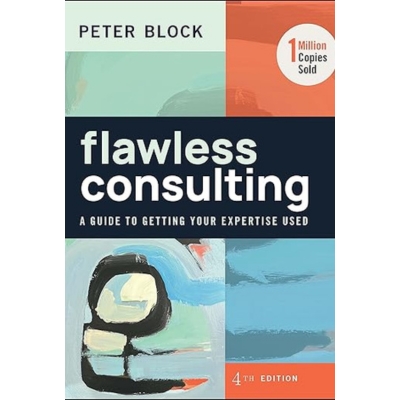

In this episode of Inside Personal Growth, Greg Voisen sits down with the legendary Peter Block, a man whose name is synonymous with the evolution of organizational development. For over four decades, Block’s seminal work, Flawless Consulting: A Guide to Getting Your Expertise Used, has served as the “consultant’s bible,” selling over a million copies and shaping the careers of thousands of advisors, coaches, and internal change agents.
In this deep-dive conversation, Greg and Peter explore the release of the fourth edition of this masterpiece. They discuss why, in an era dominated by Artificial Intelligence and virtual interfaces, the “flawless” consultant must prioritize relationship over data, and curiosity over being “right.”
The Evolution from Transactional to Transformative
Greg opens the dialogue by noting a massive shift in the industry since the book’s first publication in 1981. In the early 80s, consulting was largely transactional—you were hired to fix a specific problem and then shown the door. Today, the work is transformative. Organizations are no longer just looking for technical fixes; they are looking for cultural shifts that address isolation, fear, and a lack of accountability.
Peter Block explains that while the tools have changed, the fundamental human resistance to change remains. “The radical thing about the book,” Peter notes, “was it said relationships matter.” People don’t hire you because of your resume or your “proof of concept.” They hire you because of the connection they feel in the room.
The 12-Minute Trust Rule
One of the most striking revelations in the podcast is Peter’s assertion that it takes roughly 12 minutes to build “Big T” Trust. How? Not by listing your credentials or showing off a polished PowerPoint deck, but by being authentically curious.
“I want to replace judgment with curiosity,” Peter says. When a consultant walks into a room with a “right” answer, they inadvertently create resistance. By asking partnership-building questions—such as “What are your doubts?” or “What is the promise you want to make to this team?”—you invite the client to become an agent of their own change rather than a passive recipient of your advice.
Navigating the “Expert” Trap
Peter introduces a new, provocative chapter in the fourth edition titled “Being Right.” He argues that the need to be the expert actually undermines effectiveness. When we try to “educate” a client, it is often just a polite way of saying we know what is best for them. This creates a “parent-child” dynamic that kills accountability.
To be a “flawless” consultant, you must work your way out of the job. Your goal is to provide the client with the agency to solve their own problems. Block challenges listeners to move away from the “patriarchy” of corporate control toward a culture of connectedness.
Consulting in a Digital and AI World
The conversation takes a modern turn as Greg asks about the impact of AI and virtual meetings. While Peter acknowledges that AI can save time and improve efficiency, he is quick to point out its limitations: “Nothing in AI builds trust.”
In virtual spaces, the challenge is to bring “aliveness” to the screen. Peter suggests abandoning the standard “Robert’s Rules” of meetings. Instead of a 60-slide PowerPoint, try starting with music. Ask, “Are you getting what you came for?” halfway through the call. These “humanizing interruptions” break the sterile nature of the digital interface and allow for authentic engagement.
The Power of Naming Resistance
In a standout moment of the episode, Greg and Peter engage in a live role-play. Greg plays a stressed, “tough guy” CEO who claims he has no time for “window time” or relationship-building. Peter demonstrates how to handle this by naming the resistance directly.
Instead of defending his fee or his process, Peter asks, “You’re disappointed in me, aren’t you?” This pivots the conversation from a power struggle to a vulnerable, honest dialogue. By putting the disappointment on the table, you build more trust than any data-driven report ever could.
Final Wisdom for the Modern Consultant
As the episode concludes, Peter offers a piece of advice that is counter-intuitive for an author of a guidebook: “Stop seeking advice.” He encourages consultants to learn from their own experiences and to treat every client interaction as a shift in context.
The fourth edition of Flawless Consulting isn’t just an update; it is a reaffirmation that in a world of high-tech solutions, the most powerful tool a consultant possesses is their own humanity.
You may also refer to the transcripts below for the full transcription (not edited) of the interview.
[fusebox_transcript]











Leave a Reply